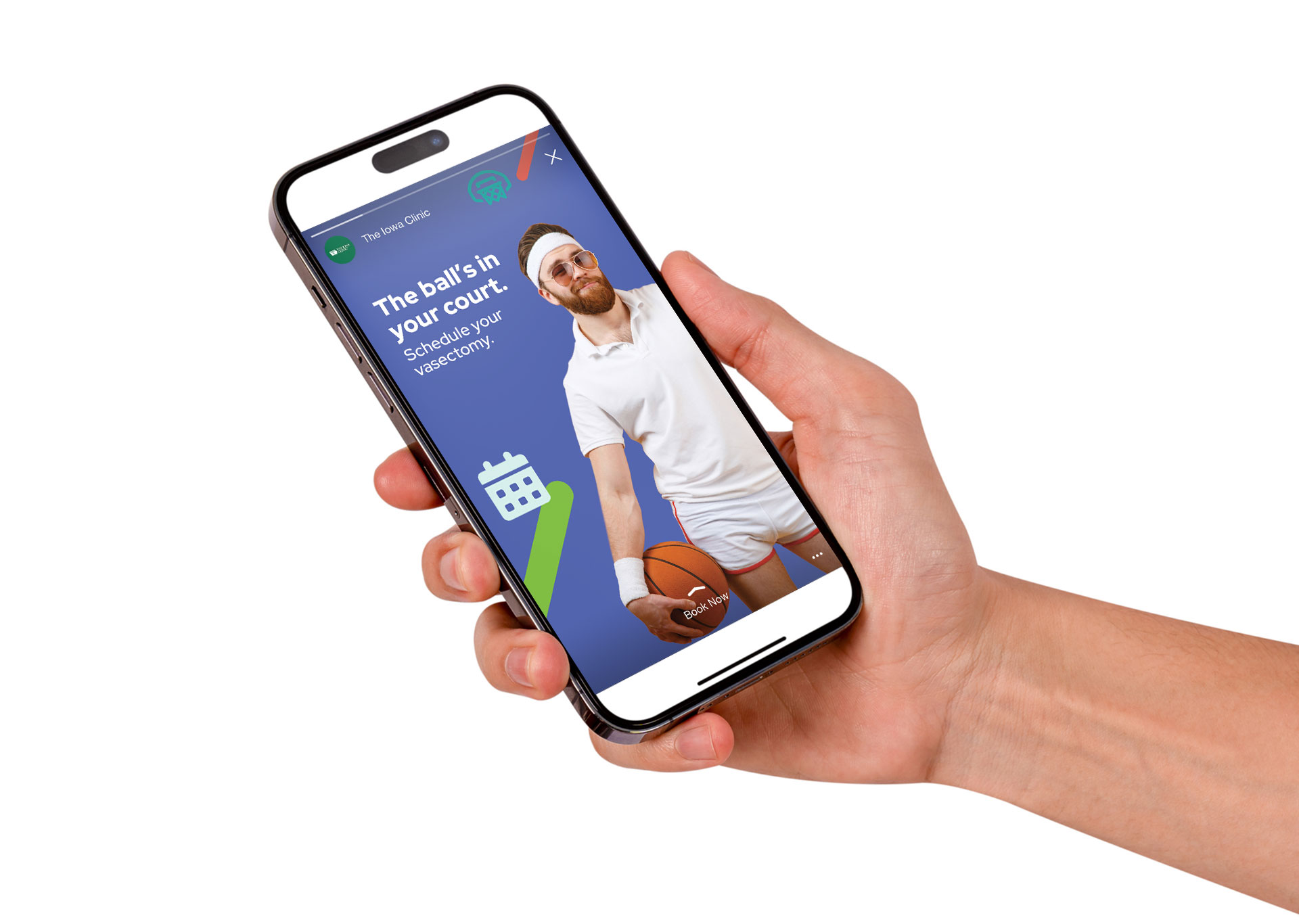
Imagine a man in Iowa who has been postponing a vasectomy. He knows the procedure is brief. He knows what it accomplishes. More information is unlikely to move him. ZLR Ignition found a more useful opening: the man would quite like permission to sit on the couch during March Madness or The Masters, remote in hand, without being asked to fix anything. Recovery became the excuse. The campaign made him the household hero. During the campaign window, every available appointment at The Iowa Clinic was filled.
This is the kind of story ZLR likes to tell about itself, and it explains the company more cleanly than a list of services. ZLR is a full-service branding and marketing agency in Des Moines. It conducts research, defines brands, writes and designs campaigns, builds websites, manages public relations, buys media and measures what happens. But the interesting part sits one level down. Its real product is the hinge between a belief and an action.
The good driver problem
Road-safety advertising has an old difficulty. The person speeding home does not think of himself as the dangerous driver. The dangerous driver is the stranger weaving through traffic. The person leaving a party thinks he can handle it. The seat-belt holdout has made the same trip a hundred times. An authoritative voice can state the rule perfectly and still miss the person entirely.
Research for Iowa's Governor's Traffic Safety Bureau exposed that distance. Many self-described good drivers saw other people as the problem. Their own shortcuts seemed exceptional and manageable. ZLR changed the center of gravity from instruction to consequence: an unsafe choice made by a decent person can still injure someone they love. The campaign's reported figures are unusually blunt for an agency portfolio.
The numbers belong to ZLR's case study and should be read as campaign-period outcomes, not proof that advertising acted alone. Roads, enforcement, weather and driver behavior form a noisy system. Still, the choice of metric says something important. The agency put fatalities on the scoreboard, not awards or views.
“Most agencies say they think outside the box. ZLR's twist is to create inside it - inside the desired outcome and the human truth.”ZLR Ignition's stated creative philosophy, paraphrased
First, find the excuse
ZLR describes a loop with three named parts. First comes “purposeful impact,” the result a client actually wants. Next is “human truth,” the observation that explains the audience's behavior. Only then comes “tuned-in creativity.” This reverses the agency stereotype in which a clever line appears first and research arrives later to defend it.
Iowa Workforce Development offers a small, almost comic example of the second step. “IowaWorks” was a label. “Earn & Learn” was a bargain. A registered apprenticeship could now be understood in three words: get paid while learning a profession. ZLR built a lead-generation site, produced more than a dozen videos and ran pre-roll, search and sponsored social advertising. The state returned for a second campaign aimed at employers.
For Your Life Iowa, the difficulty ran in the opposite direction. Alcohol, drug, gambling, mental-health and suicide resources had been consolidated, creating one destination but a foggy identity. ZLR did not isolate one crisis. It positioned the service as “everyday life support,” broad enough to welcome someone who did not yet have a clinical name for what was wrong.
What failed first
Not every failure here is a ruined campaign. Often it is the first framing of the problem. In traffic safety, official instruction failed to penetrate the identity of the “good driver.” In fireworks safety, pure information was unlikely to hold the attention of thrill-seeking men ages 18 to 35. ZLR used a comic, older-brother tone and placed digital ads and billboards near fireworks retailers. In the month before July 4, 2020, the work generated more than four million impressions and 8,500 website visits.
The pandemic broke a production assumption too. The Iowa Secretary of State needed to explain absentee and in-person voting without a conventional live-action shoot. ZLR used illustration, then divided the general-election message into three timed phases: request the ballot, return it, then vote safely in person as Election Day approached. The 2020 primary produced 529,586 votes, including 411,767 absentee ballots. Turnout was 45.5% higher than in 2018. It was a historic election shaped by many forces; the useful lesson is narrower. When circumstances change, preserve the behavioral sequence and change the production method.
The price of knowing before making
Agency pricing is usually hidden inside a proposal. Municipal records give this story a rare window. In 2015, Ames approved a $55,000 first phase with ZLR to research whether a campaign could attract young adults along the I-35 corridor. The committee liked that the agency was prepared to refocus if research found barriers too large to overcome. A later campaign agreement was capped at $145,000.
That last comparison matters. In 2014, another Iowa city considered a ZLR branding proposal of nearly $60,000 while holding a $10,000 budget. A competitor offered to fit the smaller number. ZLR did not reshape its proposal to match, and price became the decisive fact. Research-first work makes sense when the cost of a bad campaign exceeds the cost of learning. It is a poor fit when the buyer needs a bounded deliverable, already understands the audience or simply cannot finance the discovery.
From novelty to authority
The same method travels into business-to-business marketing. Cemen Tech makes volumetric concrete mixers, a category whose technical novelty could easily swallow the commercial story. ZLR shifted attention from features to proven business benefits and built a steady public-relations program around expert commentary. Between 2020 and 2024, targeted coverage rose from virtually zero to more than five placements a month. ZLR reports that the company reached nearly 100% share of voice in its chosen trade media.
This breadth explains where ZLR sits in the market. It competes with integrated Midwest agencies, specialist digital shops, public-relations firms and media buyers. Its customers range from health systems and universities to state agencies and industrial companies. The pitch is not category exclusivity. It is continuity: the researchers, brand planners, writers, designers, media team and publicists can work from the same human insight.
The agency has added signals that matter to larger buyers. It belongs to ICOM, a network of more than 80 independent agencies in more than 60 countries. It reported Google Premier Partner status again in 2026, placing it among the top 3% of participating U.S. agencies. In 2025 it received its first SOC 2 report, turning the unglamorous handling of data and systems into part of the offer. For a hospital, university or government office, procurement confidence can be as persuasive as a portfolio.
The useful thing to steal
A small team can copy the logic without copying the campaign. Begin the brief with a behavior in plain English. Ask interview questions that invite rationalization: Who is the rule really for? What would make this easier to postpone? What reward would make action feel immediate? Then write the insight as a contradiction. A good driver can make an unsafe choice. A medical procedure can provide a welcome day off. An apprenticeship is work that pays you to learn.
Next, put the message near the decision. Fireworks advice appeared close to the retailer. Voting messages changed with the calendar. Apprenticeship ads led to a focused site. Finally, measure the verb from the first sentence of the brief. Appointments are better than smiles in a focus group. Applications are better than video completions. A share of voice is useful only if becoming the category authority was the job.
This approach cannot rescue an undesirable offer, a tiny budget stretched across too many audiences or an institution unwilling to change after the research. Human truth is not a magic phrase; it is a constraint. That is ZLR Ignition's most portable idea. Creativity gets sharper when it has less room to wander.