Before OpenLoop could help other companies open virtual clinics, its own customers stopped picking up. The business had begun by matching hospitals with available physicians. Then COVID arrived. In a 2024 interview, co-founder Jon Lensing recalled the moment: “There was just one day where the lights flipped off, and it was just radio silence.” The need for care had survived. The way hospitals bought staffing had changed.
The story in three beats
- OpenLoop supplies the people and operations behind other brands’ virtual clinics.
- Its June 2026 Launchpad release packages that infrastructure into a faster setup process.
- The attraction is less work to assemble. The tradeoff is more reliance on one operating partner.
The hospital phones went quiet
Lensing and co-founder Christian Williams started OpenLoop in 2020. Their early problem was practical: connect medical capacity with places that needed it. When the pandemic interrupted the hospital business, they moved toward telehealth. Customers there wanted clinicians, then help with licensing, then software and billing. The product grew around the obstacles to using the original product.
There is an unusually useful business lesson in that sequence. A supplier can see what prevents a customer from succeeding after the sale. Solve enough of those recurring problems and the thing being sold changes. OpenLoop’s expanding list of responsibilities became its proposition: let someone else operate the medical machinery.

The appointment comes with a back office
A patient sees a familiar brand and an appointment screen. OpenLoop’s customer sees a much longer checklist: recruit a clinician, verify credentials, arrange coverage, collect intake, document the encounter, coordinate prescriptions and answer the message that arrives afterward. Its expertise lives in those connections. A video call alone does very little of this work.
The buyers include digital health businesses, hospitals, health plans, retailers and pharmacies. More recently, OpenLoop has addressed wellness brands, fitness platforms and creators. What unites them is a desire to offer care without assembling every clinical and administrative function themselves. OpenLoop sells technology alongside managed services; the customer keeps its own name in front of patients.
carePharmacy &
diagnosticsOngoing
support
One patient journey. Several businesses’ worth of work.
Insurance adds another layer. In March 2023, OpenLoop announced a payer network spanning more than 600 insurance plans alongside revenue cycle management. The point was to help clients offer reimbursable services as well as cash-pay care. Access is partly a scheduling problem. It is also a payment problem.
That expansion required capital. Public announcements describe a $3 million seed round in 2021, an $8 million Series A in 2022 and another round labeled Series A, for $15 million, in 2023. The last was led by Nava Ventures. Those are financing amounts, rather than a price tag for building the operation.
Three disclosed financing announcements
Selected announced rounds, not a lifetime funding total.
For customers, the financial test is more mundane than a funding headline. Put implementation, clinician capacity, medication coordination, support and billing into the same operating budget. Then ask how the contract changes as volume grows. Savings from shared infrastructure depend on what it replaces and how much care the business delivers.
The website is ready. The clinic has history.
Launchpad, announced in June 2026, makes the infrastructure argument tangible. A brand describes its audience, selects programs and configures an experience. OpenLoop said storefronts, intake flows and program configuration could be live in as little as 24 hours, with full back-end operations following within days. That timing is a company claim about a prepared system, not a promise for every implementation.
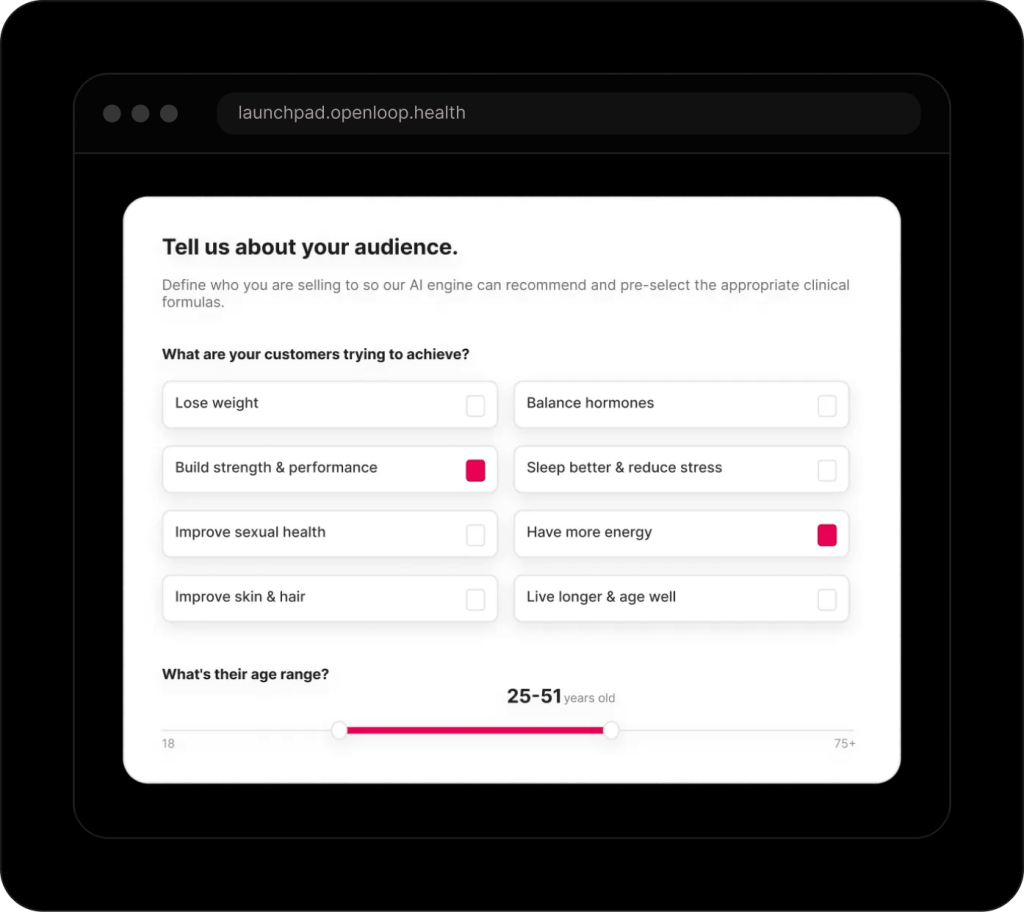
The initial programs included medical weight loss, erectile dysfunction, hair loss, hormone therapy and cellular longevity. Standardization matters here: a prepared program can reuse workflows that a custom service would have to develop. OpenLoop’s current website advertises support for more than 400 virtual care brands. That is its own measure of adoption, rather than an independent quality score.
Wheel and SteadyMD also combine clinician capacity with technology and operations. OpenLoop’s pitch emphasizes how much of the entire workflow it can take on. A buyer should compare the functions included in a proposed contract, the integration work and the cost per supported patient. A quick launch is useful only if the resulting service fits the population and the economics.
A supplier can see what prevents a customer from succeeding after the sale.That is where the next product can begin.
A prescription needs a supporting cast
The 2026 additions show where OpenLoop thinks that workflow extends. It acquired Season Health in April, adding dietitians and nutrition capabilities. It also partnered with Happy Sleep on at-home sleep diagnostics with physician review. Both moves reach beyond the consultation itself. Someone has to connect the recommendation to testing, treatment and the patient’s next ordinary Tuesday.
AI occupies a supporting role in OpenLoop’s current operations offering: scheduling, routine billing questions, intake follow-ups and alerts when a patient may be drifting away. Its stated boundary leaves clinical decisions with licensed clinicians. For an operator, the practical question is how reliably a routine exchange becomes a human conversation when it needs to.
People remain a substantial part of the operation. OpenLoop names autonomy, competence and belonging as its core values; its hiring materials describe a relatively flat structure. Purpose Jobs included it on its 2024 Best Places to Work list. These are clues to the employer it wants to be, rather than proof of every employee’s experience.
Shared infrastructure, shared consequences
Consolidation also concentrates responsibility. In March 2026, OpenLoop disclosed unauthorized access to certain systems on January 7 and 8. The company said information involved varied by person and included contact, intake or treatment-related information. It began notifying potentially affected individuals on March 17 and said it had added threat-detection and response tools. Security belongs in any assessment of the service.
The model makes sense when repeatable programs meet an organization that wants help operating them. A highly unusual clinical workflow may require more customization; an in-person procedure still needs an in-person setting. The copyable move is to identify recurring operational friction and make it reusable. The harder part is accepting the duties that arrive with every problem you agree to solve. OpenLoop’s business grows in that space between the appointment button and the care someone actually receives.