A pregnancy lasts roughly nine months. An obstetric appointment might last 15 minutes. The arithmetic leaves a remarkable amount of time in which something can change: blood pressure creeps upward, a question about medication goes unanswered, a new parent wonders whether the baby’s breathing sounds right. Marta Bralic Kerns found this gap odd even before she built a company around it. She had worked in healthcare data, yet her own maternity care, she later told Forbes, felt strangely unpersonalized. Good doctors and good insurance did not make the hours between visits disappear.
- Pomelo Care gives eligible patients round-the-clock access to a multispecialty clinical team through health plans and employers.
- It began with pregnancy and newborn care, added in-person doulas, then expanded into pediatrics and midlife health.
- A 2026 Medicaid cohort study associated longer engagement with fewer preterm births and shorter NICU stays.
Founded in 2021, Pomelo Care took the unglamorous part of healthcare - noticing a problem early, answering a message, arranging the next step - and made it the product. Patients can reach nurses, midwives, OB-GYNs, pediatricians, therapists, dietitians and other specialists by text, phone or video. Clinicians use claims, records and remote monitoring to flag risks and adapt care plans. The company says its median response time is five minutes. The point of that speed is not a pleasing number on a dashboard. It is that a patient has a person to contact while a concern is still a question rather than an emergency.
The business inside the gap
Pomelo sells chiefly through commercial and Medicaid health plans and through employers. An eligible member checks coverage, enrolls and uses the app to meet a care team; the team works alongside an in-person doctor or midwife. A public employer page describes billing based on engagement in care, per patient per month, but individual contract prices are private. Depending on the plan and service, care may be available without an out-of-pocket charge. Its midlife program also describes insured clinical visits in selected states.
That arrangement explains both the appeal and the difficulty. A health plan pays for a population in which a single NICU admission can overwhelm the cost of many routine check-ins. A patient wants help without learning the architecture of insurance. Pomelo’s job is to make those interests meet in a real clinical encounter. It needs licensed staff, access to records and claims, relationships with local providers, and a way to know whether all that attention changes anything. A content library alone would be cheaper. It would also leave the blood pressure unanswered.
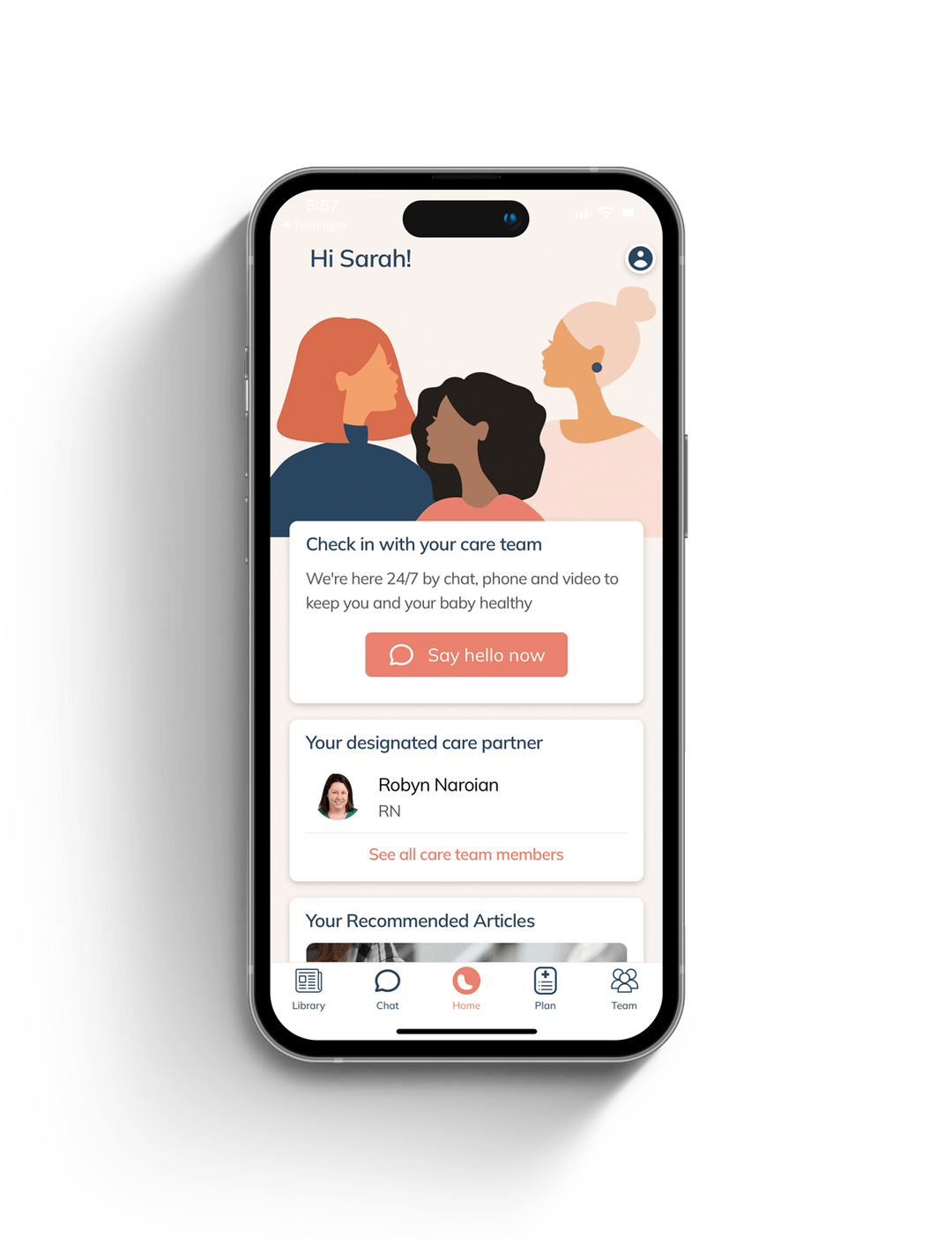
The company’s early scope was deliberately long. It stayed with a family from preconception through pregnancy, delivery and the baby’s first year. That lets the same team follow a gestational diabetes risk, postpartum depression screening and a newborn feeding worry without treating each as a fresh, unrelated ticket. Its services include nutrition, lactation, behavioral health, pediatric care and social-service navigation. This is where Pomelo differs from a generic telehealth hotline: its clinicians are intended to remember the patient, follow a plan and coordinate with the office that handles in-person care.
The screen met the delivery room
Virtual care has a physical limit, and Pomelo made that limit part of its strategy. In September 2024 it acquired The Doula Network, a national network of credentialed doulas. The deal added people who can be present before, during and after birth to a company built around a phone. Kerns had known the network’s founder, Elizabeth Simmons, for years; she wrote that customers had praised its community support. The acquisition moved Pomelo from a purely virtual promise toward a hybrid model with local hands and national availability.
“We’ve long known what works to reduce maternal and infant complications. The questions have always been: can you identify the patients who are at highest risk...”Marta Bralic Kerns, June 2024
The chronology is instructive. Pomelo disclosed $33 million in combined seed and Series A financing in 2023. It raised a $46 million Series B in June 2024, when it said its health-plan partnerships covered more than three million lives. By the doula announcement that September, the figure had reached more than 15 million. In January 2026, a $92 million Series C led by Stripes put the reported valuation at $1.7 billion and the covered-lives figure above 25 million. Those are people eligible through contracts, not 25 million active patients. The distinction matters: the story is about distribution capacity as much as actual care delivered.
What the numbers actually say
Pomelo has made evidence a conspicuous part of its sales pitch. One 2026 peer-reviewed study examined claims from six Medicaid managed-care plans in six states. For the analysis of patients engaged for at least three months, researchers compared 3,785 treated patients with 38,180 weighted comparators. The adjusted preterm birth rate was 8.8% versus 11.6% - a 24.4% lower relative risk. NICU admissions were 12.5% lower, and length of stay was 26.3% lower. The study found smaller effects with shorter engagement. That pattern is persuasive, though the design is observational: it shows an association after statistical adjustment, not a randomized guarantee for the next patient.
2026 retrospective Medicaid study. Associations among a defined comparison group, not universal treatment effects.
A different kind of proof comes from an actual buyer. Koch began offering Pomelo to employees and families in 2022. More than 3,000 enrolled, according to a company case study released in April 2026. That analysis reported a 31% reduction in NICU length of stay, an 8% reduction in admissions and a 7% reduction in cesarean deliveries among participating families. Koch expanded the arrangement in 2025 to add in-person doulas and midlife care. These are partner-reported results, but the extension is a useful signal: the customer chose to buy more of the service after using it.

A bigger patient, a bigger test
The newest chapter stretches the model beyond its original market. Pomelo now describes care for fertility, pediatric needs, preventive health and perimenopause or menopause. The claim is simple enough: the person who needed support during pregnancy does not stop having health needs when the baby turns one. The challenge is less simple. Menopause care has different evidence, reimbursement and referral patterns; pediatric care has its own urgency and staffing needs. Success in one episode does not automatically travel to another.
The company’s name offers a rather good metaphor. Kerns says she chose the pomelo fruit because its thick rind protects what is inside. There is a danger in extending any metaphor too far, particularly in medicine. Yet this one captures the operational idea: make a protective layer around ordinary care so the next small change does not have to wait for the next scheduled visit. In 2026 Pomelo refreshed its brand, but the more important redesign happened earlier, when it put clinicians behind the screen and then put doulas beside the bed.
A would-be imitator can copy the sequence more readily than the scale. Pick a narrow clinical gap; combine risk data with an accountable care team; answer quickly; coordinate with existing providers; measure outcomes in the data the payer already uses. It works best when the patient can be reached early and remain engaged long enough for prevention to matter. It is harder where coverage is absent, local follow-up is scarce or the patient first arrives after a complication has advanced. Pomelo’s own 2026 study points to that condition: duration of engagement was central to the reported result.
The most revealing Pomelo statistic may therefore be a small one. Five minutes is not enough to deliver a baby, resolve every risk or repair American healthcare. It can be enough to start the next right action. For a business built between appointments, that is precisely the territory.
Keep exploring
See the care model, the company’s research and its public updates directly.