A dietitian’s work does not end when the video call does. There is a meal journal to read, a goal to revise, a message to answer. Somewhere, somebody must also send the bill. Put these ordinary tasks in separate applications and a small practice begins to resemble an airport transfer: the journey works, provided everyone makes the connection.
- Healthie combines clinical records, practice administration and patient communication.
- Clinicians can use the finished software; digital health teams can build on its API.
- A 2018 rebuild followed costly overspending and technical debt.
- Its newer AI tools draft documentation while keeping clinicians in the approval loop.
Healthie sells the connections. Its cloud-based electronic health record, or EHR, brings scheduling, intake, charting, telehealth, payments and patient engagement into one platform. The particular obsession is recurring care: patients who return, providers who collaborate, and useful work that happens between appointments. In that world, the second visit matters as much as the first.
01 The million-dollar tuition bill
Erica Jain and Cavan Klinsky met at Wharton in late 2015. Their families’ experiences with dietitians and coaches had suggested that sustained support could change lives. The practitioners delivering it were often managing a jumble of software and paper. Klinsky built an early version over the holidays; Healthie launched in January 2016.
Early sales encouraged expansion. In their published retrospective, the founders estimate they wasted roughly $1 million of a $1.9 million seed round. Sales and marketing spending outran investment in product. Technical debt damaged usability and functionality. By early 2018, the company had to reconsider its priorities and undertake a ground-up rebuild. The sales pitch had become more polished than the thing being sold.
That reset changed the business’s clock. Healthie opened its GraphQL API in 2018 and began serving digital health builders. It operated profitably for close to five years before its 2022 Series A, according to an investor retrospective. Reliability became an explicit value. In healthcare, a customer’s inconvenient afternoon can become a patient’s interrupted care.
“One of our core values as a company is reliability.”
Erica Jain, co-founder and CEO
02 One record, several people
Consider what a practice can actually do. A client completes intake forms, books an appointment and joins a video session. A provider documents the visit, sets a care plan and sends follow-up messages. A colleague can contribute through shared clinical workflows. The administrative team handles calendars and billing with permissions appropriate to its role.
For the patient, the portal and mobile apps offer a place to communicate, complete paperwork, manage appointments and track health information. Providers can tailor which features appear. Journaling and online programs extend the relationship beyond a scheduled call. The software does not deliver the care; it gives the people delivering it somewhere to work together.
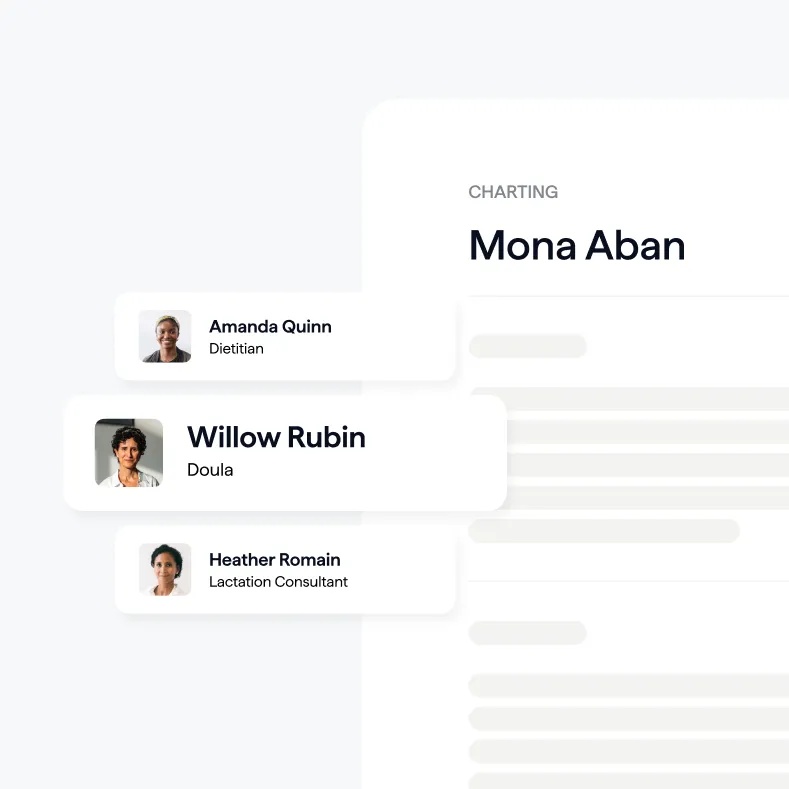
The customers include solo practitioners, group practices and organizations such as Nourish, Seven Starling, Isaac Health and Two Chairs. The last uses Healthie’s EHR and engagement tools across a multi-state behavioral health network. Nutrition, women’s health, coaching and chronic care share a practical requirement: the relationship must survive the interval between encounters.
03 Buy the plumbing. Design the room.
A second customer sits several desks away from the clinician: the engineer. Healthie makes available the same GraphQL API its own front-end developers use. A digital health company can build its own patient or provider interface while relying on Healthie for records, scheduling and other underlying functions. Its developer documentation also describes pulling operational, financial and engagement data for analysis.
This is the company’s distinctive position in the market. Practice software alternatives such as SimplePractice and Practice Better compete for clinicians’ workflows. Healthie also courts teams that want to own the experience patients see. Buying infrastructure leaves those teams to build the parts specific to their care model. It still requires integration work, a budget and decisions about which responsibilities to keep.
Conceptual workflow, not a system architecture.
Healthie Harbor, launched in 2024, adds a marketplace of third-party integrations. Its tenth-anniversary announcement reports more than 75. Partners can supply specialist capabilities without every customer assembling a completely separate stack. The platform publicly lists ONC certification, HITRUST r2 and SOC 2 Type II assurance alongside HIPAA compliance. Those credentials matter to buyers entrusting it with clinical information.
04 The price of fewer loose ends
The business model is subscription software, with different doors for different buyers. Published monthly plans start at $19.99 for Core, limited to ten active clients. Essentials costs $49.99; Plus costs $129.99 and supports unlimited clients. Group starts at $149.99, with additional clinician seats at $50 each. Annual billing reduces subscription prices by ten percent.
Enterprise pricing is negotiated. API access, white-label products and some integrations carry additional costs. A low entry price therefore says little about the eventual bill for a custom digital health business. The useful calculation includes the subscription, implementation work, add-ons and the engineering time a team would otherwise spend maintaining equivalent functions itself.
Healthie’s July 2022 announcement disclosed a $16 million Series A led by Velvet Sea Ventures. A $23 million Series B followed in October 2024, led by TCV. By year-end 2025, the company reported 45,000 clinicians serving 17 million patients. These are measures of platform reach, rather than proof that any particular treatment improved someone’s health.
05 The computer takes a note
AI Scribe, publicly launched in October 2025, drafts structured clinical notes inside the EHR. By June 2026, Healthie documented support for both telehealth and in-person sessions. Plans start at $35 monthly for 40 hours shared across an organization; additional hours generally cost $0.85. The provider reviews, converts and signs the draft.
In a Healthie-hosted webinar, Rhode Island Nutrition Therapy described replacing a third-party scribing workflow that required repeated copy-pasting. That example explains the appeal of native software: fewer handoffs. It also supplies a sensible condition for adoption. Allocate implementation time, obtain patient consent and preserve clinical review. Automation saves less if its output creates another queue of corrections.

In 2026, Healthie marked ten years with Healthie for Good, offering eligible nonprofits pricing tied to their resources. In September, it joined TIME’s healthtech list. The more transferable lesson remains earlier and less glamorous: fund the product’s reliability, understand the customer’s recurring work, and leave enough money to keep improving. The next appointment is already on somebody’s calendar.