A doctor’s visit has an odd relationship with time. The question can take ten seconds to ask. Getting into the room takes rather longer. Counsel Health begins with that mismatch, then asks an impolite question: how much of the machinery surrounding a consultation is actually necessary to deliver useful care?
- Start free: ask Counsel’s medical AI questions and connect health records.
- Add a doctor: $29 buys a seven-day physician visit; $300 a year buys unlimited visits.
- Follow the distribution: employers, health plans and the Oura App bring the service to existing audiences.
Its answer is a messaging-based medical practice. The patient can start with AI, then bring a board-certified physician into the conversation. Behind that simple exchange sits a more ambitious proposition: change the work a doctor must do before answering, and the same clinical workforce might reach more people.
The scarce thing is attention
Founder Muthu Alagappan arrived with experience on both sides of the arrangement. He trained at Stanford, worked as an attending physician at Massachusetts General Hospital and UCSF, and served as chief medical officer at automation company Notable. Counsel began in late 2023. His diagnosis of the industry was a mismatch between demand for care and the supply of clinicians.
There is a tempting response to such a problem: put a chatbot where the doctor used to be. Counsel instead employs physicians and builds software around their work. Its “clinician cockpit” brings together medical records, specialty guidance and research. AI helps organize the material that otherwise consumes a clinician’s attention before a useful reply can be written.

That staffing choice matters. Messaging attached to an already crowded clinic day can become another queue. A practice organized around asynchronous care makes the queue the job. Counsel and its backers have even argued for asynchronous medicine as a specialty. The suggestion sounds grand until one considers how different a written, unfolding conversation is from a fifteen-minute appointment.
A visit with room for a second question
The consumer product makes the distinction tangible. AI guidance is free. A physician visit costs $29 and covers seven days of interaction. Counsel Signature, currently listed at $300 annually, includes unlimited physician visits. Insurance is not required. The annual price has changed: coverage of the October 2025 launch described a $199 membership.
A week is an interesting unit. A symptom changes; a treatment raises a new question; a laboratory result arrives after the original concern. A conversation has somewhere to put those developments. Appropriate prescriptions, refills, lab orders, referrals and second opinions give the service practical consequences beyond producing a plausible paragraph.
Continuity also depends on memory. Patients can connect records, and previous exchanges help inform later ones. Alagappan’s formulation is concise: “Care should never start from scratch.” Repeating one’s history is an administrative ritual with remarkably few admirers.
“Care should never start from scratch.”Dr. Muthu Alagappan, founder and CEO
The doctor moves into someone else’s app
Counsel’s other customers buy a different sort of convenience. Health plans, employers, health systems and consumer-health companies can offer access through their own environments. Public employer testimonials include Nowsta, Photon and Notable. Counsel Studio, described in August 2026, lets organizations adapt the interface, data sources, care pathways and referral networks.
ŌURA provides a concrete example. The partnership puts Counsel’s medical AI and physician access inside the Oura App, with care informed by biometric data that members choose to share. A wearable can prompt a question. The partnership supplies a route to someone who can evaluate it and, when appropriate, act.
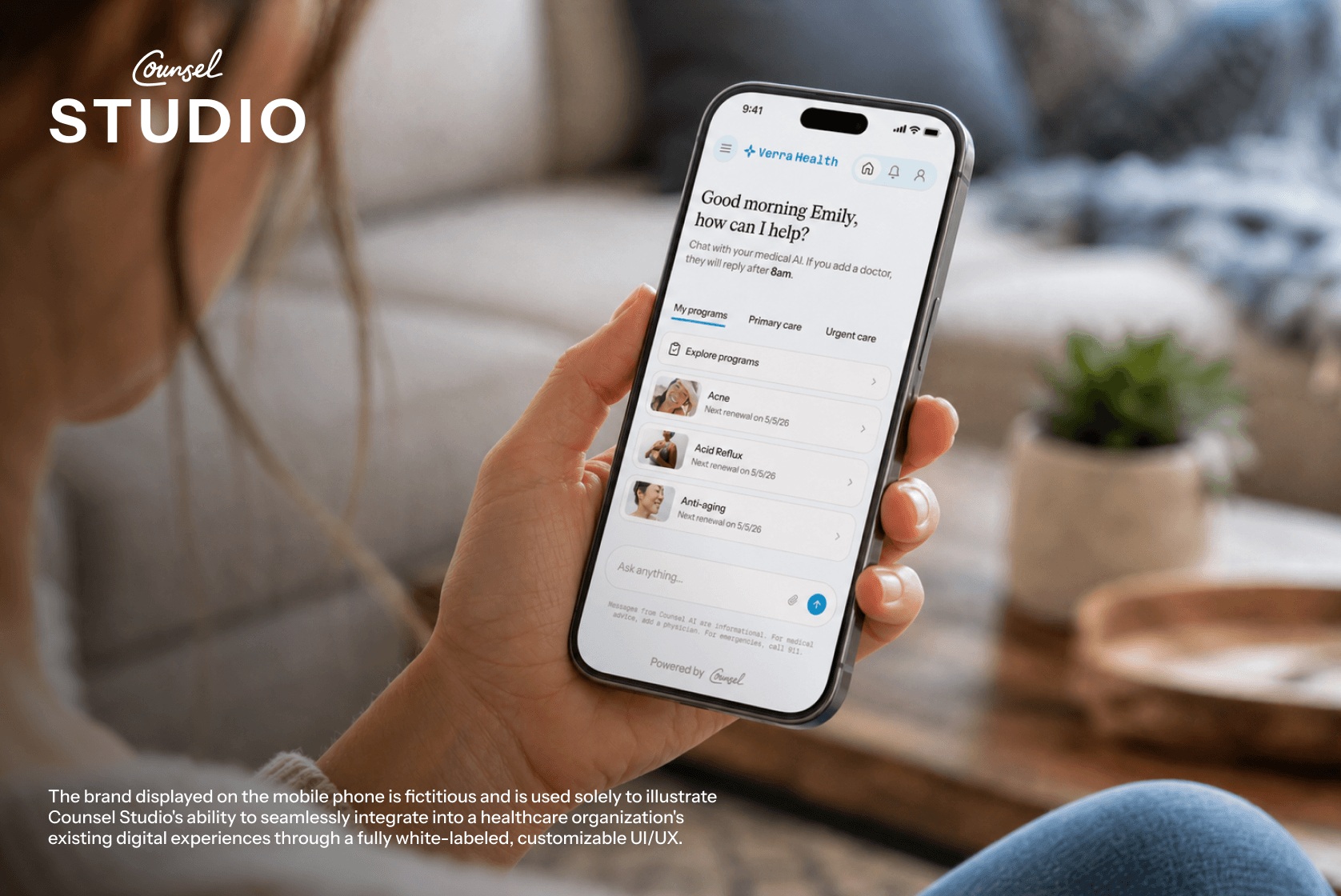
This is also a distribution strategy. Instead of asking every patient to adopt another destination, Counsel can arrive through an organization they already use. For partners, the appeal is care inside an existing relationship, customized to local resources. Enterprise contract prices are not public, so the consumer price should not be mistaken for the company’s entire business model.
A bigger inbox needs a better audit
The capacity argument comes with an awkward sequel. More conversations mean more care to check. In July 2026, Counsel described automated AI judges that review threads against physician-defined rubrics, addressing the limits of manual sampling and reviewer fatigue. It reported 96.59% accuracy on a particular antibiotic-prescribing audit task.
That figure belongs to that task. It is not an overall medical accuracy score. Likewise, Alagappan’s claim that a Counsel physician can cover more than 25,000 patients, against roughly 1,500 in traditional primary care, describes panel capacity. It does not mean one doctor personally examines 25,000 people, or establish equivalent outcomes by itself.
- Gather context
- Support physician judgment
- Deliver care
- Review the thread
Scaling the conversation also means scaling the checks.
The distinction is essential to understanding the company. Counsel is selling an organized care system, with clinical accountability and escalation, rather than simply access to a language model. The useful lesson for builders is equally specific: improve the expert’s workflow, preserve the context, and make the handoff to action explicit.
The next test is continuous care
The financing has followed the proposition: an $11 million seed announcement in October 2024, then a $25 million Series A co-led by a16z and GV in October 2025. In September 2026, Counsel announced participation in CMS’s ACCESS Model. It plans chronic care for eligible Medicare beneficiaries in early 2027, with no out-of-pocket cost and an expanded Oura collaboration.
The boundaries remain consequential. Counsel serves adults in supported jurisdictions, does not prescribe controlled substances, and recommends keeping an in-person primary care physician for examinations, vaccinations and ongoing chronic-condition management. Emergencies belong with emergency services. A better conversation cannot perform a physical examination.
Counsel’s wager is that many ordinary medical questions can reach resolution before an appointment becomes necessary. If it succeeds, the memorable innovation may be wonderfully mundane: asking a doctor something, getting an answer, and carrying on with the day.