A job description is a useful document until somebody mistakes it for a fence. Margaret Meister spent much of her working life finding the gate. She began with actuarial work, moved into finance, took on technology and brand responsibilities, and eventually became president and chief executive of Symetra. The striking part is how much of that education happened while she stayed with the same business.
Her career began in 1988, in the operation then owned by Safeco. By the time she became CEO in February 2018, she had watched the business become independent, go public and acquire a Japanese parent. Thirty years at one organization can sound like a story about staying put. In Meister’s case, the organization itself kept moving.
That makes her an interesting guide to a familiar professional predicament: how do you become something bigger without first being given permission to occupy the bigger chair? Her answer, visible across successive assignments, was to learn enough about the neighboring problem that somebody eventually asked her to help solve it.
The math graduate who liked the questions
Meister graduated from Whitman College with a mathematics degree in 1986 and pursued graduate studies at Washington State University from 1986 to 1988. Mathematics gave her a discipline. It did not arrive with a fully furnished career plan. She has described being uncertain about where her degree should lead, hearing about actuarial work and beginning the professional exams before she understood the occupation particularly well.
Once inside Safeco’s actuarial team, the work caught her interest within months. There is something reassuringly ordinary about that beginning. The future CEO did not need a childhood prophecy about insurance. She needed an opening, some aptitude and enough curiosity to discover what the work actually involved.
Her early assignments focused on annuities. Later, a finance actuarial position brought her closer to decisions affecting the whole company. Product launches, changes to systems and relationships with distributors widened her field of view. The numbers belonged to a business with customers, partners and people whose work depended on one another.
“I never let a job description box me in.”
Margaret Meister
She has called herself a “businessperson first.” That ordering helps explain the range of work she later accepted. Technical knowledge gave her something useful to bring into the room; curiosity supplied a reason to enter another room. The resulting career was less tidy than a sequence of neatly enlarged actuarial assignments.
A company learns to stand on its own
In 2004, Safeco sold the life and investments business that became Symetra. Meister was involved as the appointed actuary. She has recalled a point at which the sale might have failed and the effort to find a solution fell to her. A transaction had become a practical examination in making decisions with consequences beyond her own specialty.
Independence also required the unglamorous construction work of corporate life: legal and human resources functions, new responsibilities, a board with expectations. A business does not become self-sufficient merely because its stationery has changed. Meister helped with the transition, learning how many moving parts sit behind the reassuring simplicity of a company name.
She became chief actuary in 2004 and CFO in February 2006. Two years later came the financial crisis. By her account, guiding employees through uncertainty mattered alongside maintaining financial discipline. The company was still young as an independent organization. Its leaders were being tested while they were still building the institution that would have to withstand the test.
From joining the actuarial team in 1988 to becoming CEO in 2018.
Those episodes complicate the usual portrait of an insurance executive as a custodian of predictability. Meister’s formative work involved ownership changes and a market upheaval. The promise the business made to customers required steadiness; the business itself demanded a capacity to adjust.
The CFO with extra departments
Symetra’s initial public offering followed in 2010. The acquisition by Sumitomo Life followed in 2016. Meister played a principal role in both. Each transaction changed the setting in which financial decisions were made, while keeping the practical obligations of running the insurer very much in place.
Her CFO remit grew well beyond financial reporting. It included risk and accounting responsibilities, and she also oversaw information technology. From 2014 to 2016, she served as chief information officer alongside her finance role, leading the technology department during a data-center transition. Anyone collecting impressive titles might have appreciated the extra acronym. The migration itself would have required rather more than a revised business card.
The Puget Sound Business Journal recognized her with its CFO Leadership Award in 2015. The award acknowledged financial stewardship and wider leadership. At that point, the range of her responsibilities already made the conventional image of a CFO feel a little cramped.
Marketing, advertising and communications were part of her experience too. So was leadership of the commercial mortgage loans unit. These assignments explain why the eventual move to CEO had a long preparation: she had worked with the machinery, the finances and the public identity of the same enterprise.
- 1988Actuarial student
- 2004Chief actuary
- 2006Chief financial officer
- 2014-16Also chief information officer
- 2018President and CEO
The succession was announced in August 2017. Meister would follow Tom Marra; Tommie Brooks would follow her as CFO. By February 2018, the former actuarial student was Symetra’s first female president and CEO. The promotion was a milestone, but it also formalized a breadth of responsibility she had spent years acquiring.
Why an actuary turns up at the arena
In a 2019 photograph, Meister and NHL Seattle CEO Tod Leiweke bend over an arena model. The miniature seats are empty; much of the project’s public life is still ahead of it. Here is a different kind of forecasting assignment: deciding where an insurer should place its name and its money before the crowd arrives.
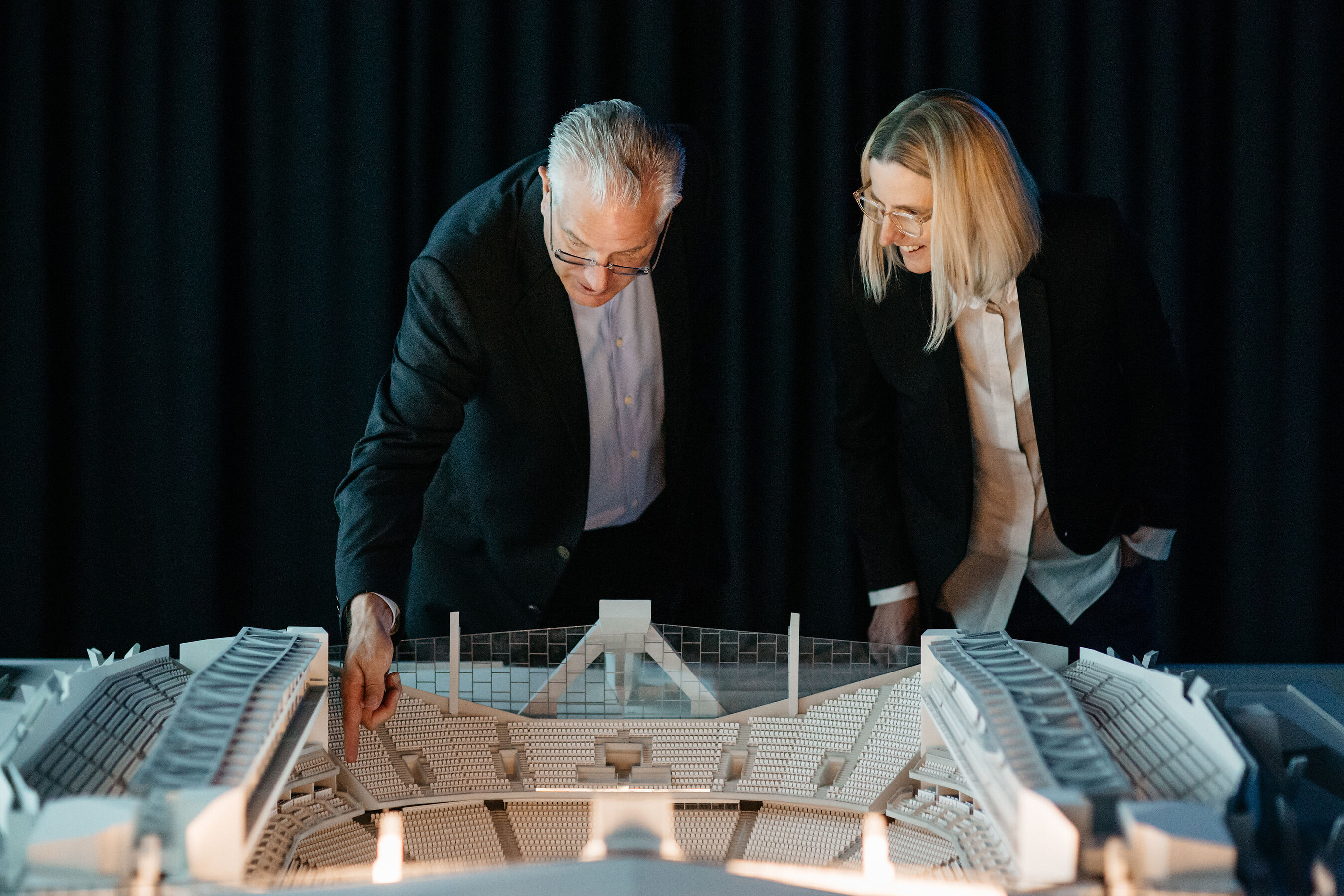
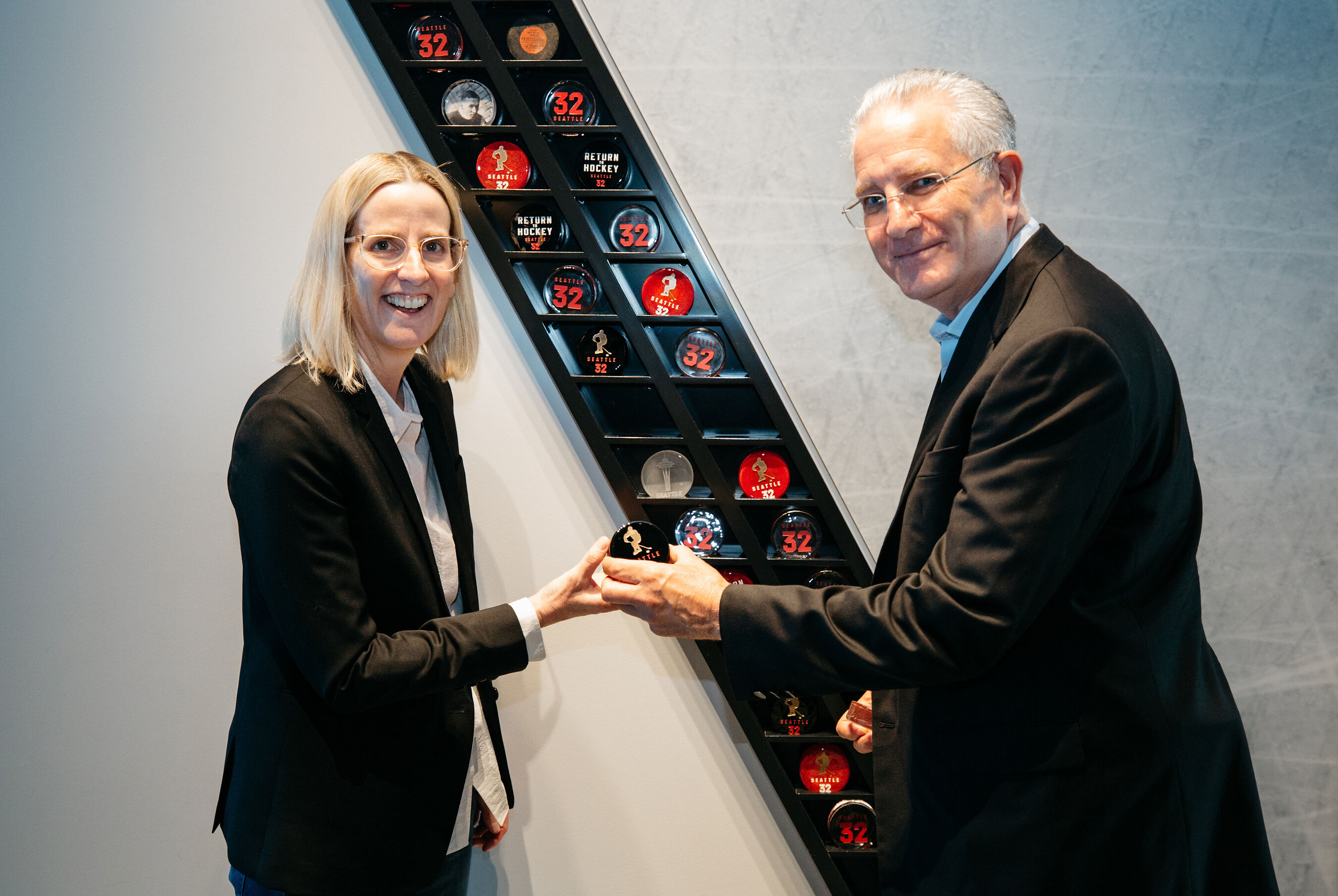
Symetra became the first founding partner of NHL Seattle, the new arena and the practice facility in June 2019. The partnership promised prominent branding and community programs. Meister explicitly connected it to reaching customers and increasing national awareness while working with organizations rooted in the Puget Sound region.
That spring, Symetra had also announced a decade-long partnership with the Seattle Storm. The agreement included a jersey badge and support for Inspiring Women Night. Meister connected the relationship to empowering women and youth, inclusion and community, alongside its commercial purpose.
The two partnerships show how the former CFO approached brand building as CEO. A company selling promises about the future still needs people to recognize its name today. Sports offered a public setting for that introduction, with shared community work giving the relationship something to do between the advertisements.
Making room for the next person
When Bellevue College invited Meister to deliver its 2019 commencement address, she described becoming “comfortable with being uncomfortable.” The phrase fits her own professional history. It also makes an unusually candid offering to graduates: advancement may feel awkward even when it is going well.
Her conversations with younger employees have a less ceremonial side. Speaking to summer interns while she was CFO, she told them, “you gotta have fun.” She also described the satisfaction of staying long enough to recognize one’s contribution to the company. Coming from someone with decades inside the business, that observation had the advantage of having been tested.
Other people’s accounts add texture. Trinity Parker, who joined Symetra after work at Sound Transit and the Bellevue Chamber of Commerce, has described being drawn to Meister’s vision and leadership. Meister offered her an opportunity, and Parker accepted. Leadership here includes the practical business of noticing somebody whose experience was built elsewhere.
Her own outside responsibilities have included the Washington Roundtable, the American Council of Life Insurers and the Henry Art Gallery. Public policy, industry affairs and contemporary art make for a wider set of conversations than an insurance executive’s title might suggest. The Roundtable welcomed her to its board in June 2019, alongside Seattle Storm leader Alisha Valavanis.
A longer view, with people in it
Meister introduced Symetra Empowers in 2019, setting a direction centered on wider access to financial freedom. The strategy links customers and distribution partners with employees and communities. In her 2024 message to Sumitomo Life’s readers, she described work on product choice, distribution and technology, as well as the importance of giving employees room to contribute.
Symetra Social Impact, launched in March 2022, gave the company’s community responsibilities a more explicit program. Its initial goals had a 2022-2024 timeframe. That detail matters: a stated commitment becomes easier to examine when it comes with dates and obligations, rather than an indefinitely postponed arrival.
A more recent public account of Meister speaking to an operations summit captures a similar combination of practicality and human attention. She reaffirmed support for remote work while encouraging colleagues to get to know one another in person. She also discussed artificial intelligence in terms of opportunities for customers and employees, alongside risks. The technology was new; the habit of examining what another function could contribute was familiar.
In June 2026, she was named among the Puget Sound Business Journal’s Most Admired CEOs honorees. Awards put a date on recognition. Her career is easier to understand through the work between those dates: accepting unfamiliar responsibilities, learning how separate departments connect and making decisions before the outcome feels comfortable.
The job description was never going to have room for all of that. Meister kept finding room in the job.
Follow the conversation
Read Meister’s career reflections and explore the organizations connected to her work.