Janet Menzies arrived at Amazon and found a meeting in which, for a considerable stretch, nobody spoke. The participants were reading. A six-page memo carried the argument; the room gave it time. For an executive accustomed to other companies’ habits, this was an adjustment. Forty-five minutes of silence in a 90-minute meeting is a formidable commitment to the written word. Even a particularly confident PowerPoint would struggle to interrupt.
She described being surprised by the practice when she joined. The attraction became clear: people began the discussion with the information in front of them. The familiar business of catching everybody up had already happened. The meeting could proceed to the difficult part, where people had to decide something.
There is a useful opening here into Menzies’s career. She has worked inside organisations with strong ideas about how work should be done, and she has had to learn their languages. In January 2026, Amazon announced her appointment as technical adviser to Doug Herrington, its Worldwide Stores CEO, in Seattle. The Australian country manager was taking on a different assignment. Once again, there would be a new room to understand.
A first education across the counter
Her working life began at McDonald’s as a teenager. Later came a marketing role at the restaurant business and regional sales management at Procter & Gamble. These were early encounters with serving customers and with companies that put considerable effort into teaching people how to operate. Long before a country manager’s title, she had jobs in which the customer was an actual person to be served.
Menzies went on to earn a Bachelor of Commerce at the University of British Columbia and an MBA at Northwestern University’s Kellogg School of Management. Her career subsequently included more than 15 years in management consulting, with work on strategy and performance improvement. McKinsey & Company was part of that experience.
Education and consulting supplied credentials and methods. They also supplied occasions to reconsider what looked normal. At business school, she recalled, women made up only a quarter of her cohort. At the time, being in the minority felt familiar. Later, she would examine the machinery that kept producing that outcome.
She met her partner at business school, too. Their subsequent decisions about careers and home were joint ones. She worked flexibly and part-time while her children were young; taking a later role with travel required another shared decision. A career biography can make a job change look like one person moving a chess piece. Usually, there are other people at the table.
Who gets the introduction?
In 2011, Menzies began working with Elizabeth Broderick on what became the Champions of Change Coalition. The work brought senior leaders into the task of advancing gender equality. Her involvement in developing the initiative ran from 2011 to 2016. She subsequently served as its chair. This was a practical education in how people with authority could change the organisations they ran.
She had also co-founded Heads Over Heels, now Apropela, alongside Alex Birrell, Melissa Widner and Sara Lucas. The organisation identifies a very particular business problem: a founder can have an enterprise ready to grow and still lack access to the person who can open the next door. An introduction to a buyer, partner or investor can alter the available choices.
Apropela’s events make the request specific. Founders practise their pitches, then present to a network of people able to offer introductions. The organisation changed its name in 2023. Its continuing proposition is refreshingly concrete: help women running businesses meet people who can help those businesses grow.
Menzies’s own account of equality work is similarly operational. Set objectives. Give capable people responsibility. Examine recruitment and promotion. Measure what happens. She argues that responsibility belongs with leaders throughout an organisation. A company already knows how to assign people and resources to a difficult commercial objective; the question is whether it applies that discipline here.
“This can’t just be women’s work”
Janet Menzies, 2023
The apprenticeship before the title
Her next corporate chapter included two roles at Cochlear: chief of staff to the CEO and general manager for Australia and New Zealand. One offered a view across a business; the other put her in charge of a regional team. She was building the experience for the larger operating role she wanted to take.
Amazon had appeared in earlier career conversations, but the timing had not worked. When the company returned to the discussion five years later, she had a different set of experiences to bring. Her initial category and programmes role provided a period of learning before the country manager appointment. A succession plan had room for an apprenticeship.
That is an appealing detail in a world where senior appointments tend to arrive with an expectation of immediate answers. Knowing how to lead somewhere else does not automatically explain how decisions get made here. Taking time to learn the institution is work in its own right.
Twenty million items need a system
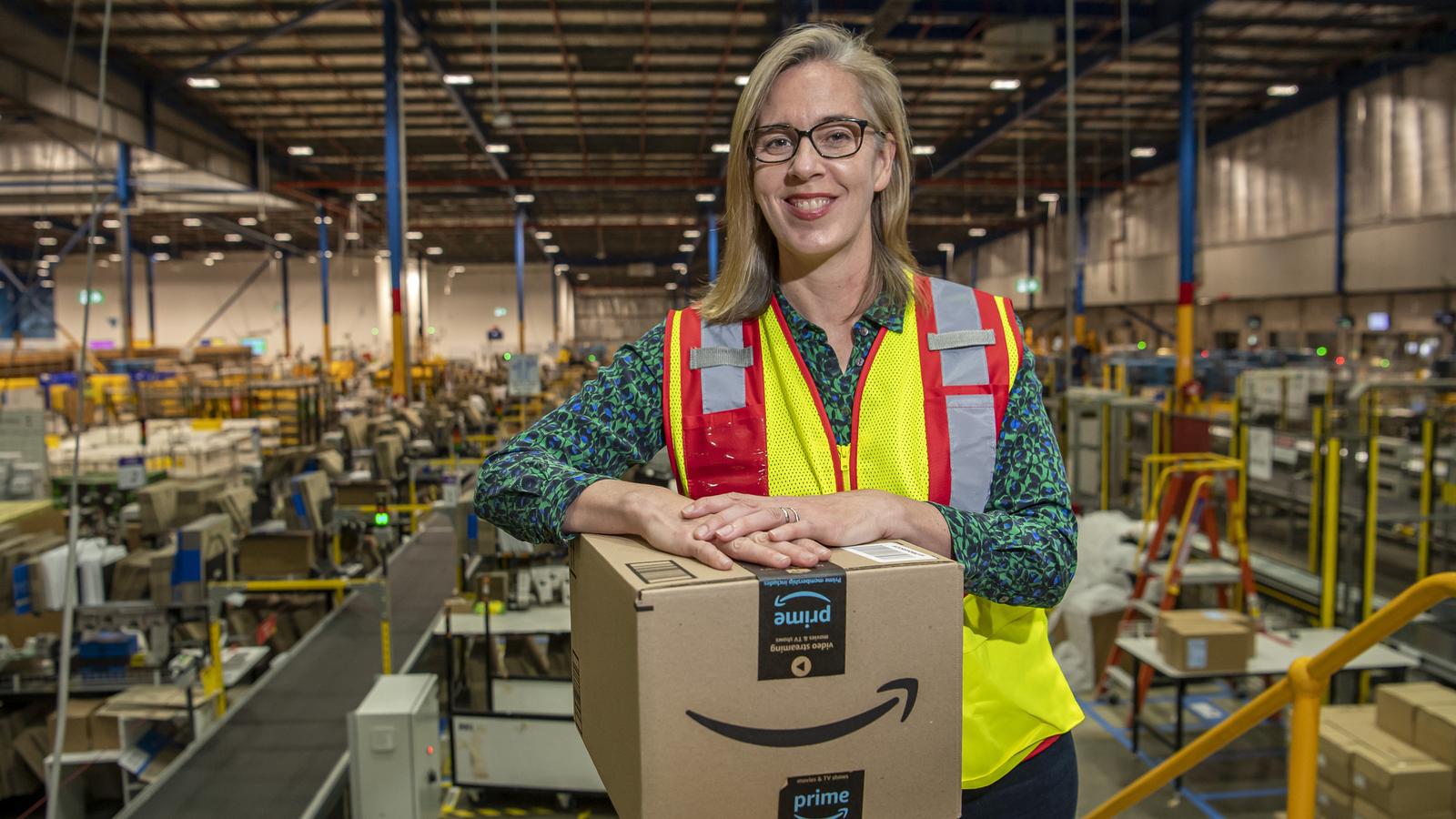
In 2022, Menzies appeared on breakfast television to explain Amazon’s first Australian robotic fulfilment centre in Western Sydney. Shelving units stored the goods; robots moved beneath them and brought them to staff. The system used 100,000 QR codes to navigate a warehouse capable of holding 20 million items.
Those quantities can make a place sound abstract. Her explanation followed the order: a customer chooses something, the system identifies where it is, a robot brings the shelving to a worker, and people take the item through the next stages. The technology becomes easier to understand when it is attached to a familiar request. Somewhere, somebody is waiting for a parcel.
The same customer expectation became more demanding as the network developed. In August 2024, Amazon introduced free same-day delivery for eligible Prime orders in Sydney. The launch covered more than 90 per cent of the city’s population and offered more than a million products, with qualifying orders placed as late as midday arriving before 10pm.
Amazon’s February 2025 account of the previous year reported more than 40 million items delivered to Australian Prime members on the same or following day. That was an increase of more than 40 per cent over 2023. The service had expanded to ten additional next-day locations during 2024.
Items delivered to Prime members on the same or next day.
More than 40% growth over 2023 · Reported February 2025These are company-wide results during her tenure. They belong to the people planning inventory, building sites, handling goods and making deliveries as well as to those directing the business. They also give substance to an executive phrase that can otherwise become rather airy: improving the customer experience.
In August 2025, Amazon announced two new Victorian logistics sites representing a combined A$200 million investment. Cranbourne West’s 52,000-square-metre fulfilment centre was expected to create more than 500 local jobs; Ravenhall’s delivery station, more than 200. The distinction matters. A fulfilment centre holds and processes inventory. A delivery station handles a later stage of the parcel’s trip. Speed requires both.
A small sanctuary before the calendar fills
For all the industrial scale, Menzies’s description of preparing for work was modest. In 2024, she described arriving at a café near the office around 7.30am. She used the time to read the news, plan the day, organise tasks or prepare feedback for her team. Sometimes there was Taylor Swift.
She has also discussed feedback as something worth receiving even when it is uncomfortable. Her gift analogy allows the recipient to examine what has been offered and decide how to use it. Accepting the conversation does not require accepting every conclusion. It does require enough curiosity to understand why somebody thought the point mattered.
The café and the silent meeting make a neat pair. Both allocate time before the conversation gathers speed. An hour with a notebook and a news feed is less cinematic than a crisis resolved in a boardroom. It may also make the boardroom rather less dramatic. A little preparation has a way of spoiling an excellent emergency.
A typical 90-minute meeting in her 2024 account. Equal time; different work.
The colleague who said hello
When Menzies announced her Seattle move on LinkedIn, she included an unusually good detail about her successor. Matthew Benham had welcomed her on her first day at Amazon. He was now taking over the Australian country manager role, with the transition announced for early February 2026. A first-day greeting had acquired a second chapter.
Amazon’s announcement credited Benham’s involvement in the Australian retail business from its launch and his subsequent work as general manager of retail. Menzies’s message thanked the teams she had worked alongside in Australia, China and Singapore, pointing to wider selection and a growing logistics network. She also singled out the leadership team and the people building the business.
Her appointment puts her alongside Herrington in the Worldwide Stores organisation. She described looking forward to the new assignment while remaining connected to the Australian team. It is a change in scope and in the daily company she keeps, after five years leading the Australian business.
The career has accumulated recognisable names: McDonald’s, Procter & Gamble, McKinsey, Cochlear, Amazon. The more revealing details happen between them. A founder asks for an introduction. A household agrees on a decision. A new colleague says hello. An experienced executive sits down with a document and begins to read.