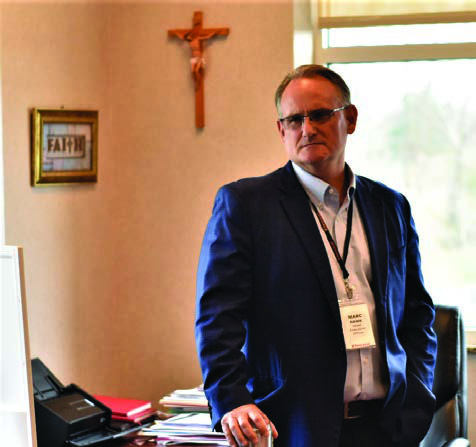
Marc Hawk went to Notre Dame dreaming of the Heisman Trophy and came away with an accounting degree. It is a pleasingly economical account of how adulthood works: arrive expecting applause, leave qualified to examine the accounts. He graduated in 1992, began at Ernst & Young, and then spent a decade in commercial banking with Park National Corporation. Before he was asking anyone to believe in his business, he was helping decide which businesses a bank could believe in.
That background makes his later career particularly interesting. Entrepreneurship is often narrated as an escape from people who understand spreadsheets. Hawk brought the spreadsheet with him. He progressed to senior vice president of commercial lending at United Bank, a Park National affiliate in Bucyrus, Ohio. His early working life involved the practical concerns of business owners: borrowing, repayment, and the considerable distance between an attractive idea and a durable company.
He grew up in Danville, Ohio, the son of an entrepreneur. In 2004, he joined his older brother Michael’s businesses, ECR Computers and Copper.net. The move took him from financing other people’s enterprises into running existing technology businesses. His eventual startup story therefore begins with an established working relationship, an operating team, and a willingness to change professions. There was a family connection, certainly, but there was also a business to run.
A second life for a dial-up business
Copper.net belonged to the era when going online was an activity you could hear. Dial-up internet had a built-in problem for its operators: the world was discovering faster ways to connect. The Hawk brothers’ next venture emerged from that changing market. In November 2010, they and colleagues from their existing businesses launched RevLocal, applying their experience to digital marketing for smaller companies.
The opportunity was close to the shop window. Local businesses needed customers to find them online, and their owners needed help keeping pace with changing digital channels. A neighborhood business could be excellent at its trade and still have work to do on how it appeared in a search. RevLocal offered a way to address that gap through marketing services built around local discovery and customer relationships.
The early expansion was substantial. RevLocal reached number 108 on the 2013 Inc. 500 list, and took first place in Central Ohio’s Fast Fifty that year, followed by second place in 2014. By Hawk’s January 2015 Startup Grind appearance, the business had nearly 200 employees and representatives in more than 20 markets. These were company achievements, produced by a team, with Hawk leading the organization.
By 2015, the venture was large enough for its progress to be discussed at a Columbus startup gathering. Hawk appeared for a fireside chat, an appropriate format for a career that resists a single dramatic founding scene. There were earlier employers, a brother’s businesses, and colleagues already working together. RevLocal’s early recognition gave that accumulated experience a public marker. The next task was continuing to operate a company that had grown beyond its beginnings.
His personal joke survived the growth: the Notre Dame graduate remained an Ohio State fan. College loyalty, like a business plan, can apparently accommodate a little complexity. The detail suits a founder whose career has repeatedly involved carrying something familiar into a different setting: an Ohio upbringing into banking, banking into technology, and an existing team into a new business.
- 2004Joins Michael at ECR Computers and Copper.net
- 2010Co-founds RevLocal with the existing team
- 2024RevLocal joins Hibu after 14 years
The former lender has to find the money
Growth brought an awkward reversal. Hawk understood lending, yet RevLocal’s need to reinvest and its lack of collateral made conventional bank financing difficult. The banker had become the borrower whom his former profession would struggle to accommodate. “When I was a banker, you had to be making money,” he said in 2020.
Michael supplied early backing. Later, Marc pursued angel funding, holding roughly 35 to 40 meetings over six to nine months before securing a round that supported another two years of development. As outside equity entered the picture, he examined investors’ expectations as carefully as their checks. He also described rethinking terms after closer inspection of how preferred stock could affect ownership proceeds.
The lesson he drew was practical: understand the capital, its conditions, and its timetable. A growing company can require cash well before growth makes life comfortable. For Hawk, selecting a financial partner involved deciding how much control and pressure the business should accept. It is an accountant’s kind of suspense. The exciting part arrives in the small print.
“When I was a banker, you had to be making money.”
Marc Hawk · 2020
The company grew. The questions grew with it.
By 2019, a Conquering Columbus conversation introduced RevLocal as employing close to 500 people across the United States and Canada. The interview ranged from scaling and raising capital to maintaining culture and choosing people who fit the company. Its agenda also included what Hawk hoped others would remember about him. A founder discussing headcount and legacy in the same conversation offers a useful glimpse of the job’s competing demands.
Those subjects belong together. A founder can know the first few people in a business personally. Hundreds of colleagues, spread across markets, require a different kind of organization. Hiring, management, and the quality of everyday working relationships become part of what the company actually sells. The client encounters an individual representative, rather than an abstract statement of purpose. Whatever a founder intends has to survive that encounter.
In 2024, RevLocal ranked 22nd among midsize organizations in the Greater Columbus Top Workplaces recognition. The category covered employers with 125 to 349 employees, and the awards reflected employee survey feedback. That category should be read as the award’s category, rather than a substitute for a dated company-wide headcount. Hawk credited the people and their commitment to the company’s culture, describing colleagues as “genuine, scrappy, and caring.”
There was a physical homecoming that June, too. RevLocal moved its headquarters from Granville to Westerville after more than a decade in Granville. Marc and Michael attended the June 5 ribbon-cutting alongside company leaders and the local chamber. A national business still needed an office, neighbors, and someone willing to hold the ribbon. The new address placed the company back in a city it had called home earlier in its development.
Fourteen years, then a different decision
In August 2024, Hibu acquired RevLocal. BrightTower, which advised RevLocal on the sale, announced the transaction on August 23; H.I.G. Capital, Hibu’s investment backer, confirmed completion on August 27. Hawk was RevLocal’s chief executive at the time. His stated rationale centered on giving customers additional marketing capabilities, services, and technology, with opportunities for employees as well.
The buyer’s explanation was complementary. Hibu wanted to extend its reach among small and midsize businesses, adding RevLocal’s customers, local presence, products, and teams. It emphasized the growing complexity of digital marketing and the appeal of using one provider for integrated services. That reasoning connects the transaction to the problem RevLocal had been addressing since 2010: owners had businesses to operate while marketing kept changing around them.
By December, Hawk was talking about the sale on Inspired Or Acquired with Clint Fiore and Patrick Dichter. The episode described him as an executive vice president at Hibu following 14 years as RevLocal’s CEO. Its discussion covered integration, the fit between the companies, and how the decision felt a few months after closing. It also presented the sale as a choice the company could make, rather than one it had to make.
An acquisition changes the questions a founder faces. Building an independent organization asks what it can become; joining another asks how people, customers, and systems will work together. Hawk’s public comments stayed close to the original customer promise. In a LinkedIn post about Hibu, he returned to RevLocal’s ambition to earn business owners’ trust and said the partnership could move that ambition forward. The ownership changed. The obligation to customers continued.
From RevLocal’s 2010 launch to its 2024 acquisition by Hibu.
An Ohio life beyond the transaction
Hawk’s work outside RevLocal has its own long timeline. He helped found St. Gabriel Catholic Radio and served as board president for 15 years. He has also served with St. Paul’s Outreach and the Community Foundation of Mount Vernon & Knox County. His marriage to Tonya and their five children feature in his account of life alongside the business. Family, church, and community recur throughout his public biography.
At the community foundation, his service included chairing the Distribution Committee. In December 2016, the foundation recognized him and two other directors reaching their ten-year term limits. That is a different unit of achievement from a sales ranking: a decade of helping govern an institution concerned with a place and its people. It puts his company career beside an extended commitment to the county where he grew up.
He has described his partnership with Michael in terms of complementary abilities, crediting his brother with envisioning opportunities and himself with putting ideas into operation. It is a useful corrective to the solitary founder portrait. The business depended on differences that could work together. In his discussion of faith and work, Hawk also connected serving business owners with the wellbeing of their families. Those interests gave the commercial work a personal frame.
Today, Damascus lists him as board vice-chairman and identifies him as RevLocal’s former CEO. A September 2026 conference announcement also named him for a discussion of family-business succession, financial partners, and ownership choices. Having moved from a bank to his brother’s companies, built RevLocal, and navigated a sale, he has several chapters to bring to that table. The Heisman daydream became an accounting career, then a succession of businesses and civic commitments. Ohio has supplied plenty to keep him occupied.