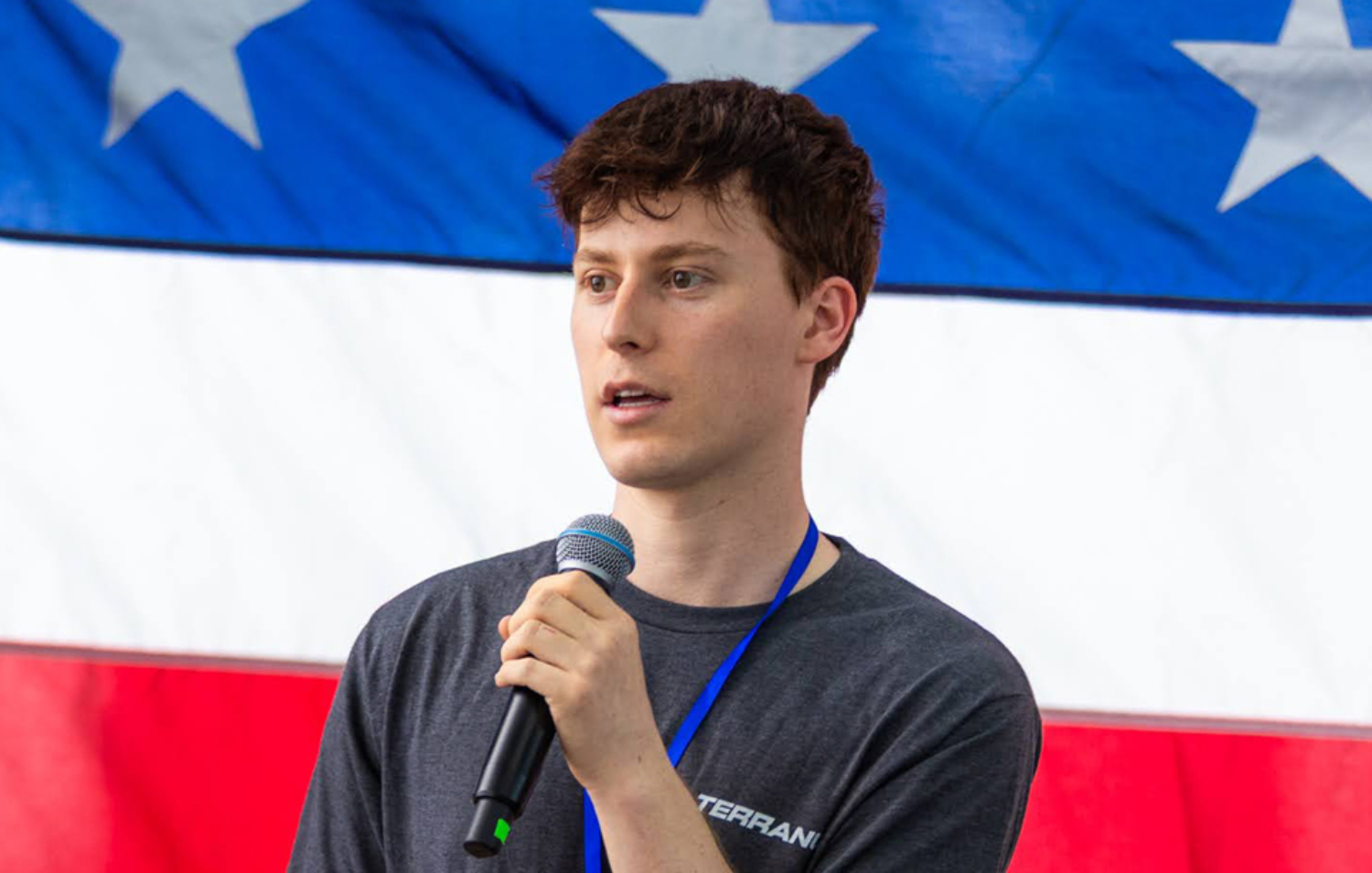
The Canal District in San Rafael, California sits three feet below where it started. The ground has been sinking for decades - slow enough to ignore, fast enough to drown. Laurence Allen grew up there. He knows what waist-deep floodwater smells like in his own neighborhood. Most people who grow up in flood zones either move or complain. Allen did neither.
He built a robot that injects wood waste underground and lifts the land back up. At 24. While finishing his mechanical engineering degree at UC Berkeley.
The technology is called land lifting, and it works the way Allen describes it: "It's like blowing up a balloon under a piece of paper. The surface - and everything on it - rises." Compact tracked robots drill 40 to 60 feet into the ground, pump a proprietary slurry of wood chips, water, and thickening agents into the subsurface, and let the material expand. One acre. One foot. Per day. No digging up streets, no relocating residents, no billion-dollar concrete walls.
We've solved the challenges related to flooding, that's the headline. We're combining heavy robotics and geotechnical innovation to reshape the world.
Laurence Allen, CEO of TerranovaThe SpaceX Detour That Changed Everything
In 2021, Allen was an undergraduate intern at SpaceX - the place that spends its energy pointing upward. He spent his pointing down. During that internship, he started filing patents on subsurface injection techniques for land elevation. Nobody asked him to. He just saw a problem and couldn't stop thinking about the solution.
He came home from Hawthorne, California, back to San Rafael, and kept building. The company was called Levitree at first - Latin roots, upward motion, the kind of name a college student picks at 2am. Later, with a real team, it became Terranova. New land. That's the product.
By the time he graduated in 2024 with a B.S. in Mechanical Engineering, Allen had a company, patents, and pilot data. Not a pitch deck - a pilot site. He slept in trucks there. That detail matters: the leap from whiteboard to real dirt, real machinery, real results.
"Took a lot of long nights sleeping in trucks at the pilot site to get it done." - Laurence Allen, on the early days of Terranova testing
The Numbers That Make Seawalls Embarrassing
San Rafael's Canal District needs to rise about four feet to be safe. Every engineer the city consulted came back with the same answer: seawalls, $500 million to $900 million. The city doesn't have that. Most flood-prone cities don't.
Allen's proposal: $92 million to lift 240 acres by four feet. Annual maintenance: $1.5 million. The math is so one-sided that it almost sounds like a typo. It isn't. The cost per acre-foot works out to roughly $100,000 - compared to hundreds of millions for traditional approaches that also require surface disruption, displaced residents, and construction timelines measured in years.
Cost to Protect San Rafael's Canal District (240 acres)
* Terranova also sequesters carbon from injected wood, potentially generating credits that offset costs by half. Seawalls generate no revenue.
And then there's the carbon angle. The wood injected underground stays underground. It doesn't decompose at the surface and release CO2. That carbon stays sequestered. Terranova plans to sell credits against that sequestered carbon, which could cut project costs roughly in half. One robot doing two things: lifting cities, locking carbon. That's what investors mean when they talk about defensible business models.
How Terranova's Robots Actually Work
Model
AI software combines geographic data with California's well-core database to map the subsurface and plan injection patterns
Drill
Tracked robots autonomously drill injection wells 40-60 feet deep into the ground with minimal surface footprint
Inject
Wood waste slurry - chips, water, thickening agents - pumped from shipping containers at precise volumes and pressures
Lift
Material consolidates in roughly two hours; the surface and everything on it rises. One acre, one foot, per day.
The full system consists of three injection robots and one mothership container. Genetic algorithms optimize the injection pattern based on subsurface modeling. City planners can run simulations using Terranova's planning tool before a single drill breaks ground.
The Raise, the Team, the What's Next
In November 2025, Terranova closed a $7M seed round that was three times oversubscribed. Lead investors: Congruent Ventures and Outlander VC - both firms that back infrastructure-scale climate bets. GoAhead Ventures, Gothams, and Ponderosa (Galvanize Climate fund) also participated. The valuation landed at $25.1 million.
Jordan Kretchmer from Outlander called it "a new category at the intersection of robotics, climate resilience, and American industrial renewal." That framing is deliberate. Terranova isn't a green startup asking governments to care about the climate. It's an infrastructure company solving a budget problem for cities that are underwater - literally and figuratively.
Allen's father, Trip Allen, is Executive Chairman. He has lived in San Rafael for 25 years. The company is family in every sense - two people who know exactly what they're trying to save. A deal with a major natural disaster mitigation company was announced alongside the funding round, with expansion into more markets targeted for early 2026.
The canal district is really far under sea level. The answer, every answer every time, has been like $500 million to $900 million of seawalls, which San Rafael simply can't afford.
Laurence Allen, on the scale of the problemCareer Timeline
SpaceX internship - conceives subsurface wood injection concept, begins filing patents, starts early prototyping
Founds company as Levitree at UC Berkeley; backed by SCET, Berkeley Skydeck, and Bakar Labs innovation programs
Finalist in UC Berkeley's Collider Cup XV entrepreneurship competition; runs early pilot testing
Graduates UC Berkeley with B.S. Mechanical Engineering; rebrands to Terranova; full-time on company build-out
Inside Climate News and Maven's Notebook cover Terranova's AI-guided robot proposal for San Rafael sea-level rise
Closes $7M seed round at $25.1M valuation; TechCrunch exclusive profile; natural disaster mitigation company deal announced
Five Things That Make Laurence Allen Unusual
He's a licensed pilot. Which means his comfort with complex autonomous systems - and trust in instruments over intuition - isn't incidental.
He worked at SpaceX - the company pointed at Mars - and decided the real frontier was 60 feet underground in his own backyard.
He named the company Levitree before it was Terranova. One name pointed at the mechanism; the other points at the product. He picked the right one.
The seed round closed 3x oversubscribed. Investors didn't just fund it - they competed to get in. That's a different signal than a company that had to hustle to close.
Terranova means "new land" - which is exactly what the robots make. The name is the product description. That kind of clarity is rarer than it sounds.
"It's like blowing up a balloon under a piece of paper. The surface - and everything on it - rises."
On how land lifting works"My hometown experiences roughly $1 billion in flood damage annually - the city has flooded to waist-depth three times."
On personal motivation"Took a lot of long nights sleeping in trucks at the pilot site to get it done."
On the early days"We've solved the challenges related to flooding. We're combining heavy robotics and geotechnical innovation to reshape the world."
On Terranova's mission