BREAKING
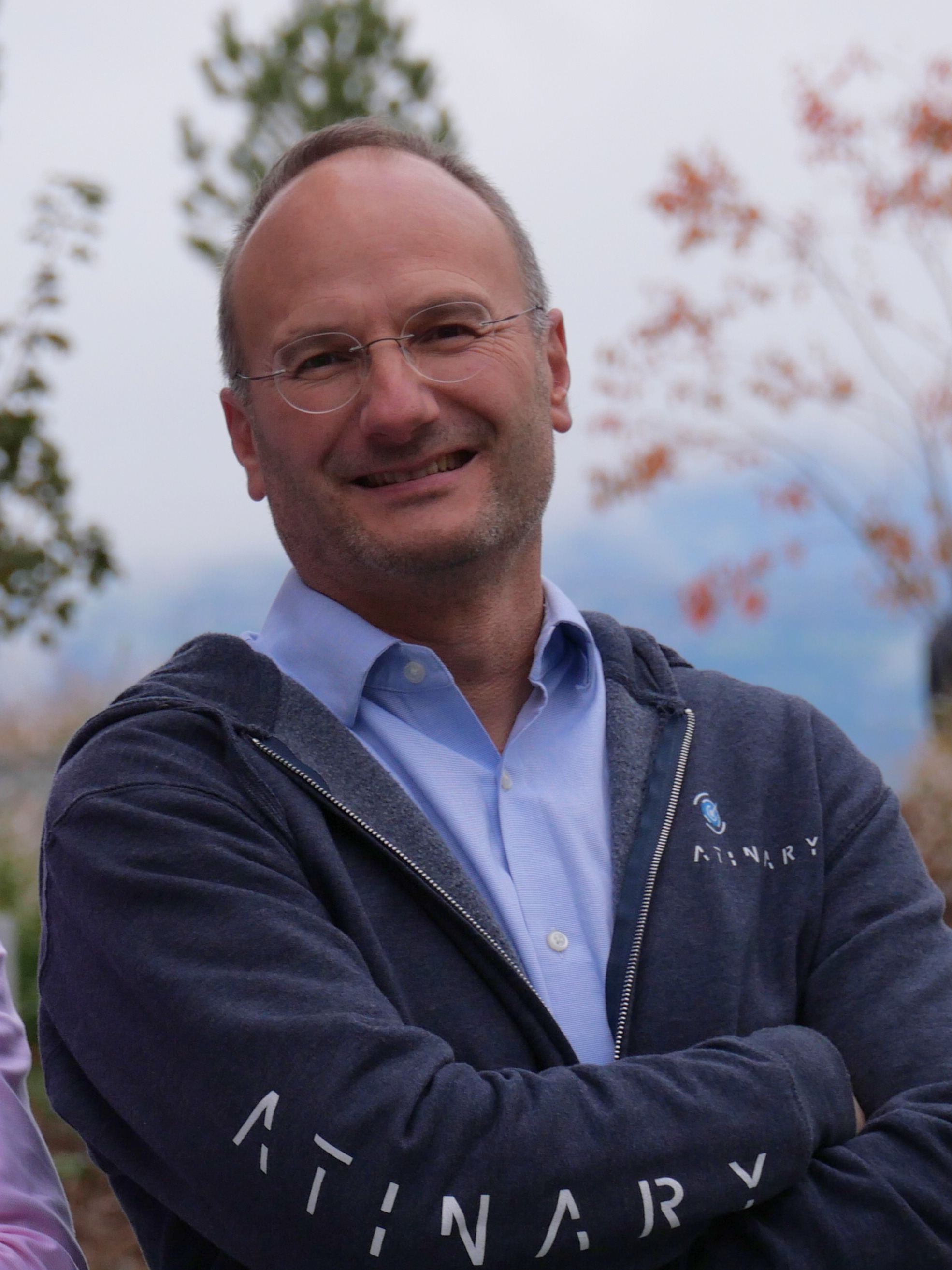
Hermann Tribukait, Co-Founder & CEO of Atinary Technologies
Co-Founder & CEO / Atinary Technologies

Hermann
Tribukait

The Economist Who Taught Machines to Do Science

A Harvard-trained economist lands in a chemistry lab and decides the problem isn't the chemistry - it's the method. He co-coins a term, files a trademark, writes a seminal report, and then builds a company that compresses two years of R&D into a week. The experiment is still running. Results are accelerating.

AI/ML Platform Self-Driving Labs Deep Tech Climate & Pharma $10M Raised
1,000x
Faster than trial-and-error R&D
$10M
Total funding raised
31
Team members, 13 nationalities
2hrs
Time to onboard SDLabs

The Unlikely Chemist

Hermann Tribukait is not a chemist. He studied economics - summa cum laude at Mexico's elite ITAM, then a PhD at Harvard. Yet in 2017, he walked into a room of 55 of the world's top materials scientists and came out having co-coined the phrase that would define a field: "Self-Driving Labs."

That phrase, now a registered trademark, describes the closed loop between AI, robotics, and physical experimentation - where machines design experiments, execute them, learn from results, and iterate without human bias getting in the way. Tribukait didn't need a chemistry background to see what the scientists in that room couldn't quite articulate yet: that the bottleneck wasn't talent or funding. It was method.

Before founding Atinary in 2019, he spent years designing global innovation partnerships - North American and European public-private collaborations that directed more than $200 million toward accelerated R&D. He represented Mexico's Energy Innovation Funds at Mission Innovation, the global clean energy initiative, where he co-led the Clean Energy Materials Innovation Challenge.

It surprises me that most R&D is still human-driven.

Hermann Tribukait, Co-Founder & CEO, Atinary

The frustration is specific: researchers guided by bias, exploring familiar chemical territory, relying on intuition and Excel spreadsheets instead of systematic search. Tribukait frames it as a cognitive mismatch - humans trying to navigate a search space too vast for human brains to traverse efficiently.

His answer was to build software that does the navigating. SDLabs, Atinary's no-code AI/ML platform, lets a researcher define their experimental constraints and then sits at the wheel. No robotics PhD required. No code. Just faster science.

R&D Time Compression

From years to days — what SDLabs changes
Traditional
~2 years average
With SDLabs
~1 week

■ Represents formulation & materials optimization cycles. Results vary by application. Source: Atinary / Cherubic Ventures interview 2023.

How a Conference Became a Company

In 2017, Tribukait organized an international conference on accelerated materials discovery. He was doing what he did best - convening the right people across academia, government, and industry to push an idea forward. Fifty-five of the world's leading scientists showed up.

One of them was Dr. Loïc Roch, a Swiss chemist and AI researcher who was building the other half of the same idea from the laboratory side. The two immediately found common ground. By the end of the conference, they had a shared vocabulary. Two years later, they had a company.

Atinary's name comes from the Spanish verb atinar - to hit the target. It's a nod to Tribukait's Mexican roots and to the precision at the heart of the company's technology. The ML algorithms don't just guess; they learn which experiments will yield the most information and direct resources there, narrowing in on the solution without wasting trials.

The co-founders secured angel investment within their first month of operation. That early bet was placed on a specific conviction: that the trillion-dollar R&D industry was running on methods designed for the 20th century, and that software could fix it.

By 2023, they closed a $5 million seed round led by AgFunder, with Cherubic Ventures as a key supporter. The pitch landed because the technology landed - Atinary had already demonstrated that SDLabs could compress roughly 100 years of progress in CO₂-to-methanol catalyst research into a single month.

In February 2026, Atinary opened its first physical Self-Driving Lab in Boston - two autonomous "Scientific Discovery Factories" running closed-loop Design-Make-Test-Analyze-Learn cycles. MIT Professor Stephen Buchwald, cited as the world's most-referenced chemist for a decade, joined the effort.

The Long Run

Early Career
BA in Economics, summa cum laude, ITAM (Mexico). Then Harvard - MA and PhD in Economics. Built global innovation partnerships generating $200M+ in R&D investments across North America and Europe.
2017
Organized landmark international conference on accelerated materials discovery. Met future co-founder Dr. Loïc Roch. Co-coined "Self-Driving Labs®" and co-authored the Materials Acceleration Platform Report - now a seminal document in the field.
2017
Led the Clean Energy Materials Innovation Challenge under Mission Innovation, representing Mexico's Energy Innovation Funds at the global level.
2019
Co-founded Atinary Technologies with Dr. Loïc Roch. Secured angel investment within the first month. Headquartered in Lausanne, Switzerland and Silicon Valley.
2023
Closed $5M seed round led by AgFunder and Cherubic Ventures (September 2023), bringing total funding to $10M. SDLabs platform launched publicly.
2026
Launched Atinary's first physical Self-Driving Lab in Boston (February 2026), featuring two autonomous Scientific Discovery Factories for pharma and chemistry research.
Co-coined and trademarked "Self-Driving Labs®" (2017) - now a standard industry term across AI-driven R&D.
Co-authored the Materials Acceleration Platform Report, a foundational roadmap for autonomous experimentation integrating AI, robotics, and cloud computing.
Led global R&D initiatives directing more than $200 million in investments across public-private partnerships.
Built SDLabs - deployable in under 2 hours, no code required, accelerating R&D by 10x to 1,000x.
Demonstrated CO₂-to-methanol catalyst development compressing roughly a century of scientific progress into one month.
World Economic Forum Agenda Contributor - representing the frontier of AI-driven materials discovery.

What He Keeps Saying

"The human brain is not suited to screen massive and complex chemical spaces."

"AI is not threatening scientists' jobs. It's something fascinating and exciting!"

"Self-driving labs are about bringing AI into contact with reality. By closing the loop between experiment design, physical execution and learning, we enable science to progress at a fundamentally different pace."

"We're not replacing the driver; scientists still hold the steering wheel."

"Make imagination the bottleneck in experimentation and unleash accelerated R&D."

The Details That Matter

Tribukait met his co-founder at a conference he had organized himself. Not a happy accident - a deliberate act of convening the right people, then recognizing when you've found your complement. Loïc Roch, the chemist and ML expert, was the laboratory side of the same idea Tribukait had been building from the policy side.

"Atinary" comes from the Spanish verb atinar - to hit the target. It's embedded in the company's DNA: algorithms that learn which experiments to run next, targeting the solution instead of fumbling through the chemical space like a blindfolded researcher with a pipette.

He's an economist running a company of chemists, biochemists, data scientists, and software engineers. Atinary's own team bio notes there is exactly one economist on staff. The rest are scientists. The organizational chart is its own kind of self-driving lab.

Before there was a company, there was a report. The 2017 Materials Acceleration Platform report - co-authored by Tribukait - became one of the field's foundational documents. The company followed the document. The document followed the conference. The conference followed the conviction.

Personality & Approach

Tribukait is multilingual - English, German, Spanish - which tracks with a career built at the intersection of Mexico, the United States, and Switzerland. He's a nature enthusiast with a particular affinity for the sea, and frames Atinary's mission in terms that go well beyond profit: faster development of sustainable materials and catalysts as a path to addressing climate change and pollution.

He talks about R&D with the frustration of someone who sees an obvious inefficiency that the field has collectively normalized. The spreadsheets, the gut instincts, the trial-and-error - not as quaint traditions but as symptoms of a system that hasn't been updated in decades.

Nature enthusiast, loves the sea Multilingual (English, German, Spanish) Systems thinker Mission-driven, climate-focused Global networker Precision over intuition

The Aspiration

The long game is democratization. Tribukait wants self-driving labs to be as accessible as email - not just for well-funded pharmaceutical companies with robotics infrastructure, but for any research team anywhere. SDLabs' no-code design is the proof of concept: a tool built for working scientists, not for AI engineers.

The Boston physical lab is the next step - closing the loop between software and actual bench science, showing that the autonomous experiment isn't just a digital concept but a physical reality that can run in a real laboratory.

His stated goal: unlock limitless science and accelerate the transition to a healthier, more sustainable future. It's the kind of sentence that sounds large until you look at the specific technology underneath it - and then it sounds exactly right-sized.

Five Things

01
He's the only economist on Atinary's team of chemists, biochemists, data scientists, and engineers. The company was built on the premise that solving science's method problem required someone who wasn't already inside the method.
02
The term "Self-Driving Labs®" that Tribukait co-coined in 2017 is now a registered trademark - and a term used by researchers, journals, and companies worldwide. He named the category before the category existed.
03
Atinary's SDLabs can be fully deployed and running in under two hours - no code, no robotics expertise required. The onboarding is faster than most enterprise software demos.
04
The CO₂-to-methanol demonstration: using SDLabs and automation, Atinary reproduced roughly a century's worth of catalyst development progress in a single month. The long history of chemistry, compressed.
05
Tribukait graduated summa cum laude from ITAM in Mexico - before Harvard, before Atinary, before any of it. The habit of being precise started early.

Where This Work Lives

Self-Driving Labs Bayesian Optimization Materials Discovery Drug Discovery AI for R&D Closed-Loop Experimentation No-Code AI Pharma Biotech Climate Tech Green Chemistry Catalysis Formulation Chemical Synthesis Multi-Objective Optimization Deep Tech Autonomous Experimentation MLflow LangChain AWS Process Optimization Mission Innovation WEF
Share this profile