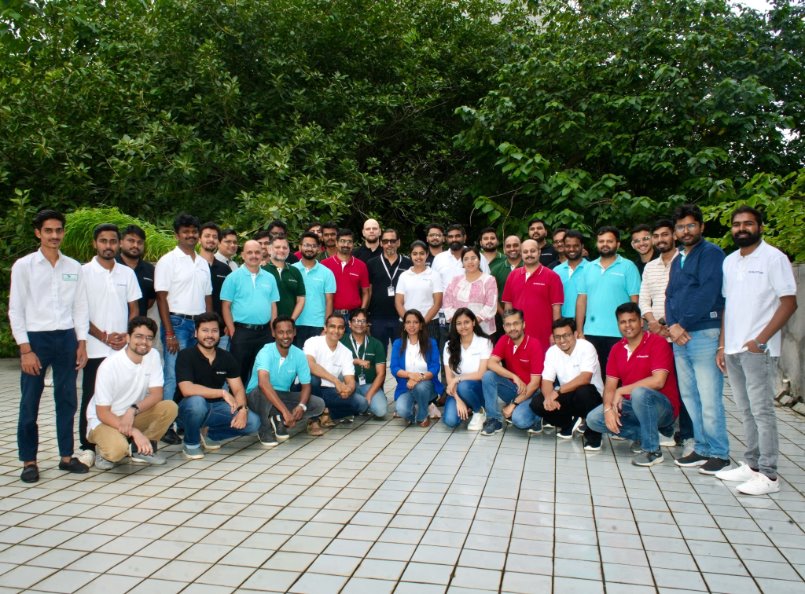
The nearly 30 colleagues had never all been in one place. In July 2022, KK Gupta brought them to Facctum’s new Bangalore office for a week. There were two hackathons, conversations about products and customers, escape-room puzzles and a race around the city modelled on The Amazing Race. For a company concerned with financial crime, it was an unusually cheerful programme of coordinated activity.
The building had required a different kind of coordination. Gupta and his colleagues had spent three months working through the design and construction, watching costs and involving themselves in small details. Their deadline slipped by two or three weeks. The founder admitted that part of the original schedule had rested on estimates and part on whim. Entrepreneurship had introduced a new variable into the project plan: the person making it was also paying attention to the bill.
Afterwards, he noticed something on an all-hands call. People had their cameras on. Many wore company T-shirts. He described a visible change in confidence and camaraderie. The useful detail is the camera: a small, voluntary act that made a dispersed business feel more like a group of people who knew one another. Gupta had spent decades helping institutions connect their systems. Here was a connection he could actually see.
Fifty tools, one large headache
Before Facctum had an office, it had an argument. Announcing the venture in January 2022, Gupta described businesses operating technology estates with more than 50 separate specialist solutions. Each tool could look sensible on its own. Taken together, they demanded maintenance, oversight and effort that made change difficult. Buying another good idea could leave an organisation with another awkward junction.
This was the complaint of someone who had lived with the consequences. Gupta had left corporate employment in July 2021, following a banking career at Citigroup and Barclays. His final Barclays job was chief information officer of its US Consumer Bank. Earlier responsibilities included the chief data officer role for Barclays UK and leadership in global data platforms. He had seen banking from the machinery room.
His founding announcement was broad. He wanted ready-to-use software to improve decisions across customer journeys, including onboarding, lending and servicing. Data platforms were the recurring interest. The ambition was to remove some of the work required to make a collection of technologies behave like a coherent service. There is a familiar office comedy in fifty individually helpful products requiring a fifty-first to introduce them to one another.
“The simpler a product is to use, the harder it is to engineer.”
KK Gupta · announcing Facctum, January 2022
Kota, Pilani, then the banks
Gupta grew up and went to school in Kota, Rajasthan, before studying electrical and electronics engineering at the Birla Institute of Technology and Science, Pilani. His working life then took him through two global banks and five countries. The geographical range matters less than the repeated encounter with institutions large enough for technology decisions to acquire long lives.
At Citigroup, his responsibilities included global compliance technology. At Barclays, he spent nearly 15 years in leadership roles. By the time he founded a business, he had experience building products and running large transformations, along with a close view of the delays that complicated them. The founder arrived with a substantial apprenticeship in the problem he meant to address.
Away from work, his stated tastes include live sport, travel, Japanese food and P. G. Wodehouse. The last preference is a pleasing companion to a career in complicated organisations. Wodehouse understood how an apparently modest arrangement could produce an elaborate predicament. Gupta’s professional interest lies in getting the arrangement to work with fewer complications.
Engineering
& Barclays
Facctum
A narrower problem with real consequences
Facctum, founded in 2021, developed a particular focus on financial crime compliance. That gave Gupta’s larger systems argument a concrete setting. A financial institution needs information about the people and organisations it deals with, a way to check that information against relevant lists, and a process for deciding what to do when a check produces a possible match.
Facctum’s product names divide that work into recognisable jobs. FacctList handles watchlist management. FacctView screens customers. FacctShield screens payments. The sequence is useful because it makes the dependence visible: a decision rests on a screening result, which rests on the information supplied to the system. A fast check is only one part of the journey.
In May 2023, NTT DATA Payment Services India chose FacctView for its e-commerce platforms. The announced purpose was to identify and assess sanctions, terrorism-financing and money-laundering risks in consumer transactions. That placed the young company’s proposal in a payments business, where risk controls have to coexist with customers’ expectations of speed. The relationship gave Gupta a named example of the sort of operational work he wanted his software to support.
The selection also brought the conversation down from architecture to use. Somebody had to integrate the product into an existing operation. The appeal of simplification would be judged in the ordinary work of processing transactions and handling risk, where an elegant diagram has to earn its keep.
- 01 / PrepareManage watchlist dataFacctList
- 02 / ScreenCheck customers and paymentsFacctView · FacctShield
- 03 / ReviewInvestigate potential matchesConnected workflows
The delay hiding after the update
By July 2025, Gupta was explaining another awkward junction in sanctions screening. A regulator could release an update, and a data provider could obtain it quickly. The institution still had to get that information into the systems doing the checks. Receiving news and making it usable were separate events. The interval between them was part of the problem.
In a conversation with Lucinity’s Luke Fairweather, Gupta discussed the difficulty of bringing modern data handling into older compliance infrastructure. He recalled expensive, lengthy upgrade cycles that produced little additional functionality. His approach at Facctum centred on more flexible engineering and manageable changes. On artificial intelligence, he argued for choosing appropriate uses and proceeding incrementally.
The partnerships followed the same concern with connections. In October 2024, Facctum and Lucinity announced an integration between screening and financial crime investigations. In November 2025, a collaboration with LSEG brought World-Check On Demand data into FacctList. That announcement described ingestion, enrichment and distribution of data into institutional workflows, including existing screening engines.
For Gupta, these relationships extend the original complaint into a practical business proposition. Institutions already own systems, already have staff using them and already carry responsibility for the decisions. Connecting new information to that working environment is a substantial job. His career gives him a reason to take the unglamorous middle of the process seriously.
May 2023 NTT DATA Payment Services India selects FacctView.
October 2024 Facctum announces its Lucinity partnership.
November 2025 LSEG collaboration brings World-Check On Demand into FacctList.
The founder has to hear the answer
Gupta’s explanation of leadership returns repeatedly to the quality of the team and the conversations inside it. He advocates giving feedback promptly and asking for it regularly. In 2023, he also acknowledged that Facctum had further to go in putting that belief into practice. It is a useful admission from a founder describing his own culture: the declared principle still required work.
“Unleash your inner voice the freedom it deserves and express yourself fearlessly.” His invitation to prospective colleagues is expansive. It commits the organisation to hearing things its leadership may find inconvenient. The practical test comes when an engineer questions a plan, a colleague needs help or a customer points out that a supposedly simple process remains cumbersome.
In his 2025 conversation with Sumit Gupta, he explored the change from an established banking career to starting again. The discussion covered identity, focus, culture and leadership by introverts. One short observation gets to the daily discipline involved: “Saying no is a leadership skill.” A founder with a broad interest in data platforms has plenty of possible directions available. Choosing which work deserves the team’s time is part of the job.
The office week offers a more tangible version of those principles. People spent time solving problems, discussing the business and enjoying one another’s company. The programme made room for colleagues to meet outside their usual roles. A second hackathon may sound like a peculiar holiday, but the mixture suited a group assembled to build software.
A room of their own
The Bangalore gathering had also contained a promise. Gupta wanted dedicated offices in Pune and London as the company grew. In September 2024, he celebrated Facctum’s own Pune office after a period in coworking spaces. The occasion coincided with the company’s third anniversary. The earlier wish had become an address where colleagues could turn up.
Facctum now describes a workforce of more than 100 across five global locations. In his five-year anniversary reflection, Gupta emphasised the team’s persistence, learning and continued ambition. The terms are modest compared with the grand language technology companies sometimes reserve for their birthdays. They also describe activities over which a founder has some influence, day after day.
There is a connection between the software ambition and the office ambition. Both require attention to what happens between capable people or capable components. Buying the pieces, hiring the people and announcing the plan leave a great deal of work unfinished. Gupta’s accounts keep returning to the effort of making those arrangements useful.
The image that stays with his early Facctum story is the all-hands screen after the Bangalore week: cameras on, familiar faces, colleagues wearing the same shirts. It offered no grand answer to the difficulties of financial crime compliance. It did suggest that the people tackling them had begun to feel like a team. For a founder who left banking to make things fit together, that was a reasonable place to start.
Keep the conversation going
Watch KK Gupta discuss Screening at Speed, or listen to his Choosing Leadership conversation with Sumit Gupta.