The wrong name can make a lot of work. A customer resembles somebody on a watchlist. A payment produces a possible match. An analyst must decide whether the resemblance matters, while the next transaction is already arriving. In financial crime compliance, the alarm is often only the beginning of the job.
Facctum has built a business around that uncomfortable interval between finding a possible risk and making a defensible decision. Its software prepares watchlist data, checks customers and payments, monitors activity and helps resolve alerts. The ambition is practical: give compliance teams less avoidable work while keeping the evidence they need to explain their decisions.
The London company occupies a particular corner of enterprise technology. Its buyers are banks, fintechs, payment providers and other regulated businesses. Its users need to know what triggered a match, which information supported it and what happened next. A dramatic red warning is easy to display. A useful answer takes more plumbing.
First, fix the list
Facctum’s most revealing product may be its least theatrical. FacctList handles watchlist management: bringing together regulatory, commercial and internal records, making their formats consistent, finding duplicates and reconciling changes. It can enrich records, suppress selected information and deliver the resulting data to downstream screening engines.
That places the company upstream of the moment most people imagine when they hear “financial crime detection.” Before an algorithm compares names, somebody must decide which records reach it and in what condition. An untidy input can become an expensive queue. Facctum makes this preparation a product in its own right.
Its November 2025 collaboration with London Stock Exchange Group gives that proposition a concrete shape. LSEG’s World-Check On Demand supplies continuously refreshed information covering sanctions, politically exposed persons, adverse media and enforcement actions. FacctList brings the data into institutional workflows through ingestion, enrichment and distribution.
The intended customer can connect that information to existing onboarding, screening and monitoring systems. This matters commercially: a bank may want fresher data without replacing every tool that consumes it. Facctum is selling a route through an existing technology estate, with compatible output formats and records of where information came from.
- 01PrepareIngest · reconcile · enrich
- 02ScreenCustomer · payment · activity
- 03DecideReview · act · retain evidence
Editorial illustration of the workflow. Each stage has its own timing and controls.
A complaint with 50 moving parts
Founder KK Gupta’s original explanation for Facctum was broader than sanctions. In a public announcement introducing the venture, he described businesses wrestling with technology estates containing more than 50 niche solutions. Individual products could be promising, he argued, while the assembled architecture created problems with cost, stability, agility and customer experience.
His proposed answer was a data platform supporting ready-to-use software services. Financial services would be the starting point; the early ambition included onboarding, lending, marketing and servicing. The present product family makes financial crime compliance the concrete expression of that idea. The continuity is the concern with how information moves between systems.
Gupta brought experience from Barclays and Citigroup. Facctum’s current leadership also includes Courtney O’Keefe as chief operating officer and Deep Pai as chief product and technology officer, alongside dedicated architecture and data leadership. That combination fits the problem: this software must survive contact with institutional data and the people who operate it.

Founded in 2021, the business dates FacctView’s launch to October 2022 and FacctList’s to the following month in its YourStory company profile. By May 2023, it had a publicly named payments customer. The sequence is useful: build the screening product, build the data-management product, then put the proposition into a real payments setting.
The payment provider behind the pitch
NTT DATA Payment Services India selected FacctView for its e-commerce platforms. The announced work was to detect and assess sanctions, terrorism-financing and money-laundering risk in consumer transactions. This is a more informative description of Facctum’s customer than a row of anonymous bank logos: a payment business balancing risk checks with the speed of its services.
At the time, NTT DATA Payment Services chief executive Takeo Ueno described the technology as a fit for a growing, customer-focused Indian payments operation. He linked the selection to both stronger controls and faster service. The announcement establishes the intended use; it should not be read as a measured reduction in losses or investigation costs.
“Its addition to our anti-financial crime defences shows our commitment to protecting customers”
Takeo Ueno · NTT DATA Payment Services · May 2023
The same tension runs through Facctum’s wider pitch to fintechs and payment providers. More customers and more transactions create more opportunities for checks. Adding reviewers is one response. Improving the information and decisions that reach those reviewers is another. Facctum’s proposition is built around the latter, with software that supports high-volume operations and connected compliance workflows.
Five products, five different jobs
FacctView screens customers and counterparties. Its advertised controls include configurable screening profiles, impact analysis, automated tuning and champion-challenger testing, which lets teams compare an alternative configuration with an existing one. Continuous monitoring extends the work beyond the initial check. The company also emphasises explainable results and connections to case-management tools.
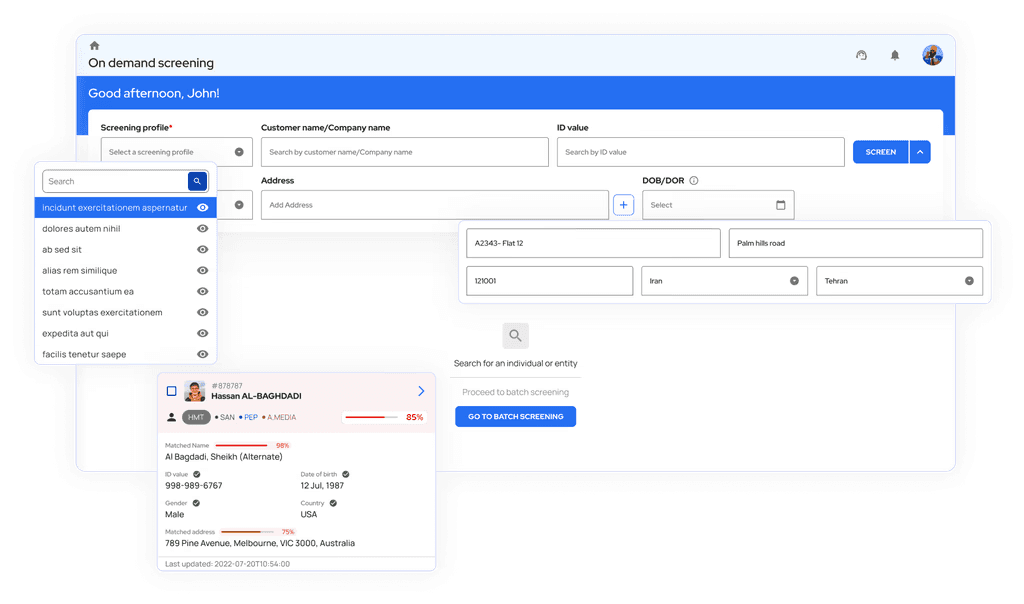
FacctShield deals with payments. It offers configurable rules, watchlist integration, stripping detection and the reuse of earlier decisions, plus a sandbox for testing. Its job sits close to transaction processing, where a useful result has to arrive in time for the institution to act on it.
FacctGuard tackles transaction monitoring through behavioural analysis, adaptive risk categories, links between entities and configurable scenarios. FacctGuide addresses the alert queue, using scoring and automation to prioritise or adjudicate alerts and integrate with case management. Together with FacctList, these products divide a broad compliance problem into recognisable operational tasks.
That division helps a buyer ask sharper questions. Is the immediate problem slow list preparation, too many ambiguous customer matches, payment delays, suspicious patterns or repetitive investigations? Different problems call for different demonstrations. A software suite becomes easier to evaluate when the institution can name the job it needs done.
First two figures: Facctum’s current platform claims. They measure different tasks and are not an end-to-end investigation benchmark.
The handoff is part of the product
In October 2024, Lucinity and Facctum announced a partnership connecting watchlist screening to Lucinity’s case-management platform. Analysts could review screening results within the investigation environment, with Lucinity’s AI copilot providing assistance. The announced workflow also allowed analysts to block or release transactions from that interface.
This makes Facctum’s place in the market easier to see. It can provide screening capabilities inside another vendor’s workflow. Financial institutions do not necessarily need every function from the same supplier; they do need the result of one function to arrive usefully in the next.
Taidalos added another piece in April 2025: adverse-media screening alongside Facctum’s existing compliance functions. The integration brought another kind of risk information into the offering. Along with LSEG, these relationships show a company building around specialist data and workflow partners, with its own software connecting and applying their capabilities.
Facctum competes in screening categories that also include NICE Actimize, LexisNexis Risk Solutions, Fincom and Fenergo. Everest Group’s 2025 financial crime technology recognition includes Facctum alongside such providers. The distinction worth examining is its combination of list preparation, configurable screening and integration. Membership of a vendor list alone cannot settle which product fits a particular bank.
What the savings depend on
Facctum operates as an enterprise software business; its YourStory profile describes subscription revenue, and its website directs buyers toward a sales conversation and demonstration. For a prospective customer, the relevant calculation extends beyond the subscription to data preparation, integration, testing and the time spent reviewing the alerts that remain.
The company advertises reductions in false positives of up to 70 percent. That is a vendor claim, and “up to” describes a possible result rather than a baseline every institution can assume. A smaller queue is useful only if the institution remains satisfied with what the system detects.
A practical evaluation follows from that distinction: run representative data, compare results with the current configuration and inspect both unnecessary alerts and missed matches. FacctView’s testing features provide a reason to ask for precisely that demonstration. The copyable habit is to measure a decision process, including its errors, rather than celebrate a lower alert count.
A useful pilot would follow one list update all the way through to a reviewed alert. The institution could record when the update arrived, when screening used it and when somebody acted. That exposes delays between products as well as delays inside them. It also gives the buyer a concrete basis for discussing integration work and the value of automation.
Likewise, reused decisions need conditions under which they should be reconsidered. A changed customer record or new list information can alter the case. Automation depends on usable inputs, working integrations and controlled rules. These are operational implications of the product design, not reported failures at Facctum.
People still have to make the systems work
Facctum’s careers page advertises hybrid work, a five-day week and leadership transparency. Its own account of culture puts an emphasis on collaboration and staff speaking freely. A more tangible detail arrived in September 2024, when Gupta celebrated a dedicated Pune office after the team had worked from coworking spaces.

For buyers, another milestone concerns the handling of their information. In September 2023, Facctum announced ISO/IEC 27001:2022 certification covering its UK and India operations. That addresses information-security management, a separate question from how accurately a screening engine identifies risk. Both belong in an enterprise buying decision.
Facctum’s most persuasive story is therefore quite specific. A former banking technology executive saw a problem in the joins between systems. The company built products around those joins and secured named customers and partners. Its next test is the same one its users face each day: can a possible match become a timely, explainable decision? The name on the screen is where the work starts.