Marc-Henri Chamay had a two-year plan. He joined Allen & Overy expecting to stay for two years. In February 2024, as aosphere became independent of the law firm, he looked back at the arithmetic. He had stayed ten times longer than intended. Somewhere between arriving and leaving, the temporary assignment had become a business worth spending a considerable portion of a working life building.
The work that held Chamay’s attention was practical: putting specialist legal information into products that customers could subscribe to and use repeatedly. The company grew around the proposition. When the moment came to leave its parent, he went with it.
“I joined A&O with the aim of staying for 2 years and I ended up staying 10 times longer!”Marc-Henri Chamay, February 2024
Thirteen questions and a beach ball
The early aosphere story begins with a modest-looking piece of organisation. netalytics, its first product, began in 2001 as a joint venture with the International Swaps and Derivatives Association. aosphere itself dates its establishment to 2002. For a business concerned with precision, the distinction is a fitting place to start.
The product took legal opinions about netting and made them easier to interrogate across jurisdictions. In practical terms, netting concerns the ability to offset obligations. For financial institutions, the legal details matter. A small coloured indicator therefore carried a substantial responsibility.
Victoria Wells, who helped devise the original template, remembered thirteen questions and a traffic-light system. Making the answers comparable turned out to be difficult and time-consuming. The apparent simplicity of the finished product concealed the effort needed to produce it.
Its appearance at the 2002 ISDA annual meeting in Berlin had less elaborate packaging: laminated A4 signs and giveaway beach balls. Wells recalled queues at the stand. The juxtaposition is rather good: an inflatable souvenir alongside a product intended to make complicated legal opinions easier to use.
A simplified view of the original netalytics approach.
A business with its own clock
Chamay was building inside an organisation whose main business had a different rhythm. A law firm sells professional work to particular clients. A subscription information business has to make something useful to many customers, then keep giving those customers a reason to renew. The lawyer’s expertise remains essential; the commercial arrangement changes what the surrounding organisation must do.
By 2014, Chamay was managing director of eBusiness at Allen & Overy and discussing slow client adoption on a LawExpo panel. His career already included recognition in the Financial Times’ 2013 list of ten innovative individuals. He was a non-lawyer operating at partner-equivalent level in a profession where qualification usually supplies the entrance ticket.
The setting helps explain why his story rewards a longer timescale. New products need development, but they also need an audience willing to change an established habit. A launch date is a point on a calendar. Adoption asks for rather more patience.
Jonathan Brayne, an Allen & Overy partner involved in innovation, later described aosphere as one of the things he was most proud of. In that account, the business had more than 400 corporate subscribers and almost 15,000 individual users. Chamay’s prolonged assignment had acquired a constituency.
The people inside the product
When Chamay reflected on leaving Allen & Overy, his first reason for staying so long was the aosphere team. He listed quality, trust, respect, fun and a no-fuss attitude among their shared values. Many colleagues had become friends. His account of a business departure sounded, in places, like someone explaining why he had kept returning to the same table.
That loyalty also ran beyond his own company. HighQ co-founder Ajay Patel has credited Chamay with guidance on product ideas and international expansion over many years. The connection places him within a wider group of people learning how to turn legal technology into businesses that could travel beyond their first customers.
The domestic explanation was apparently less straightforward. In another public post, Chamay said his wife and children often asked what aosphere actually did. He welcomed a company video that could help explain global legal compliance. A useful reminder: a business can make perfect sense to a financial institution and still require a little assistance at home.
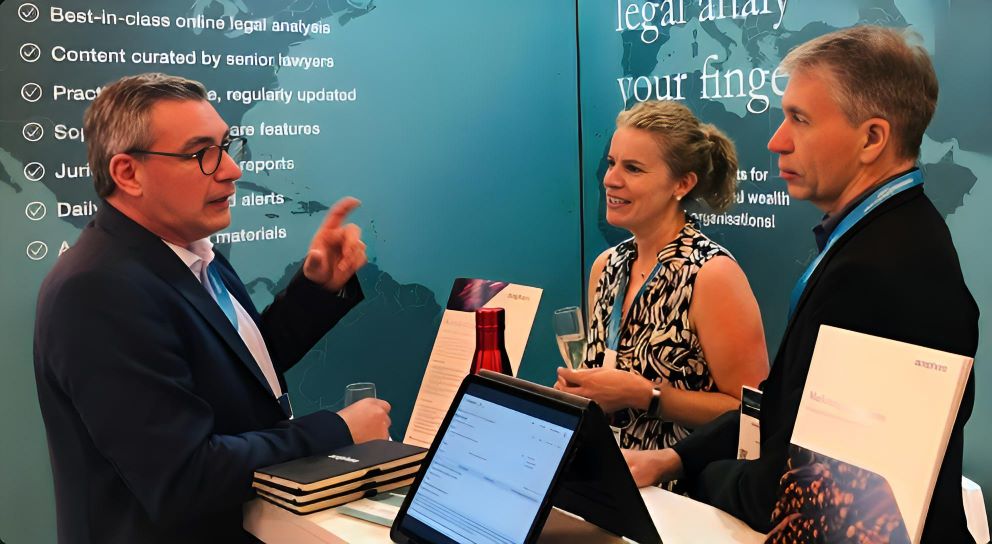
Learning to stand alone
In 2024, aosphere became independent through a carve-out backed by Inflexion and US investor Endicott, alongside Allen & Overy. The company already had a product history and customers. Independence added a fresh set of practical obligations: the systems and functions that a parent organisation had previously helped supply.
Within the first year, aosphere assembled a full functional leadership team, including finance, technology and people leadership, with a transformation specialist supporting the separation. It established its own IT, finance and HR systems and moved off transitional service agreements ahead of schedule. A business that sells clarity had plenty of internal detail to settle.
Chamay’s account leaves room for the difficulty. The first six months were tough, he said. He also valued the chance to construct new systems rather than inherit every existing arrangement. That is an understandable attraction for someone whose work involves deciding how complicated information should be organised.
The commercial organisation changed too. aosphere doubled its commercial team, building out sales, account management and revenue operations. In his account of the first year, Chamay emphasised US expansion and cross-selling. Independence brought a more deliberate effort to reach customers, as well as the infrastructure to support them.
Chamay reported a doubling over the two years preceding aosphere’s November 2025 succession announcement.
Swiss colleagues, wider horizons
The new arrangement also made acquisitions possible. In September 2024, aosphere bought BRP Bizzozero & Partners, a Switzerland-based provider of banking and financial regulation products. The combination extended its reach into private banking and wealth management. Together, the businesses served more than 1,200 institutions.
BRP’s approach had a family resemblance to aosphere’s: standardised products built from complicated regulatory material. Its cross-border manuals covered more than 190 countries, developed with a network of expert law firms. The deal widened the audience for the kind of work Chamay had spent years developing.
His own announcement included a more personal pleasure: working with Swiss colleagues again after more than twenty-five years in the UK. By the end of 2024, a cheese fondue had earned a place in his list of highlights. Corporate integration is rarely described through its dinner arrangements. In this instance, the dinner seems to have done its part.
Investment Navigator followed in September 2025. Its tools brought cross-border compliance checks into investment workflows, including questions about product eligibility. For Chamay, the appeal was the opportunity to accelerate the digitisation of regulatory obligations. The group was extending from information people could consult towards tools that helped them apply it during their work.
A different seat at the table
In November 2025, aosphere announced Robert McKay as its next CEO and Chamay’s move to chair. McKay brought experience in information, analytics and compliance workflows, including leadership roles at Neustar and Accuity. The founder would continue supporting the leadership team from a different position.
Chamay used the announcement to take stock. The business had grown from an idea and prototype to more than 1,400 institutional clients, supported by over 150 professionals. He reported that annual recurring revenue had doubled over the preceding two years, alongside the carve-out and the BRP and Investment Navigator deals.
Those milestones describe a busy period. His emphasis on retaining clients, colleagues and the company’s culture describes what he wanted carried through it. A transaction can redraw an ownership chart in a day. The habits that make people comfortable working together take longer to establish.
Now the original builder had a different assignment. Chairing the company meant helping the next leader take responsibility for a business whose history he knew from the inside. The two-year plan had acquired another chapter.
- 2001 / 02netalytics begins; aosphere is established.
- 2013Financial Times legal innovation recognition.
- 2024Independence and the BRP acquisition.
- 2025Investment Navigator; CEO succession announced.
- 2026Chamay speaks publicly as chair and co-founder.
The next question is about data
In October 2026, Chamay appeared on Legal Innovation Spotlight with Ted Theodoropoulos. The conversation returned to a familiar concern in a newer setting: the quality of the information behind the answer. As AI enters legal workflows, he sees demand for trusted data that those tools can use.
His advice about creating legal products was similarly practical. Start with a defined client problem and sufficient demand. Give the work a dedicated team. Take sales and marketing seriously. These are useful considerations for anyone tempted to confuse the possession of expertise with the existence of a business.
The questions around the interface will keep changing. Chamay’s career has followed the work underneath: organising knowledge, finding customers and maintaining a team willing to keep at it. A short intended stay became a long commitment because there was always another part of the problem to solve. He has now changed seats. The questions continue to arrive.