Before Mostafa ElSayed had a robot, he had a recruiting message. Karian, who would join Automata’s people team, remembered its premise: “I haven’t made a robot yet but I’m going to”. It is an admirably economical job description. The product is pending; the conviction is already in stock.
That small exchange catches something useful about ElSayed. His career has required people to follow an idea across professional borders. Architecture became robotics. A robotic arm became part of a connected laboratory. Along the way, the company he co-founded had to change its understanding of the job it was selling.
He is now co-founder and CEO of Automata, based in London. The title gives little warning of the route. Before the benches and workflow software, there were architectural models, computational geometry and a colleague named Suryansh Chandra. They worked at Zaha Hadid Architects, where the distance between an interesting shape and something that could actually be made was a professional concern.
Dubai, then the drawing board
ElSayed grew up in Dubai. In a 2017 founder conversation, he connected that upbringing with his decision to pursue architecture. It is an apt starting point for a career concerned with making things: a city’s construction can become part of a young person’s picture of what work is for.
He studied architecture at the American University of Sharjah and went on to a master’s in Architecture and Urbanism at London’s Architectural Association. His interests extended into the mathematics and computation behind form. The public record of his work includes research on subdivision surfaces, fabric-forming and curved-folded geometries.
Those subjects make the later move less abrupt than it first appears. A folded panel brings a design into contact with material behavior. A computer model must eventually answer to something physical. The elegance of a surface on a screen offers limited assistance when the object refuses to behave.
In 2014, ElSayed, Chandra and Shajay Bhooshan co-authored work on curved folding, including a paper presented at an international meeting on origami in science, mathematics and education in Tokyo. It is a useful detail in the partnership’s history. Before they were selling a machine, the two future founders were already working together on how geometry could become an object.
Origami also places a rather strict condition on imagination: the material has to follow. A drawing can suggest almost anything; a fold has to happen somewhere. The connection to robotics is practical. Design and fabrication remain in conversation, with each placing demands on the other.
The Architectural Association’s 2014 Design Research Laboratory roster lists ElSayed as a course tutor. He appears again in the school’s 2018-19 annual review. Teaching therefore belongs inside the founder story, rather than as a decorative footnote. His professional life already involved explaining computational ideas and helping other people make things with them.
At Zaha Hadid Architects, he became lead designer in the Computation and Design Group. Chandra was a colleague. Their interest in robotics grew out of architectural research, where applying a machine to a seemingly straightforward making task exposed how much expertise the machine demanded from its user.
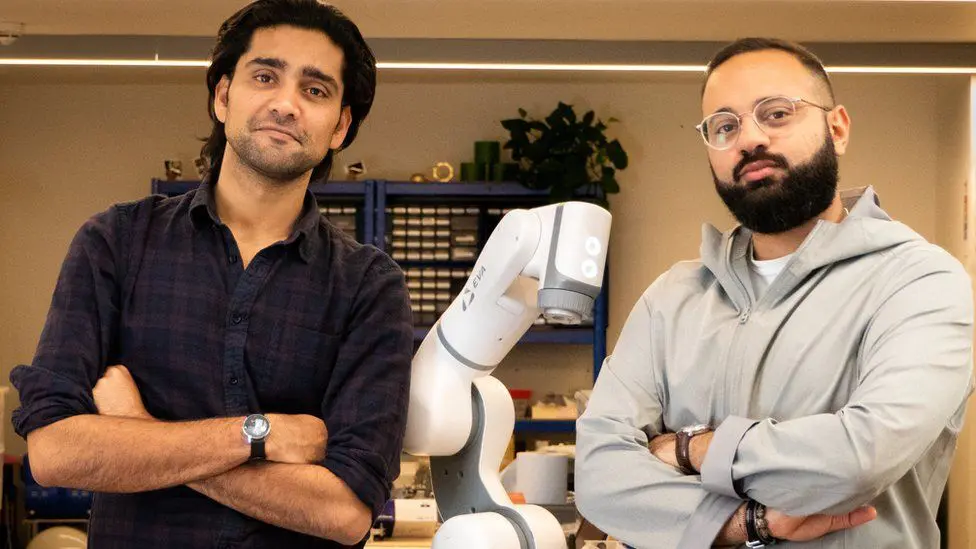
An arm with a larger assignment
The early irritation was specific: panel bending. Working with a small robot made the pair question why programming it was so complicated for someone without deep robotics experience. They had encountered a tool that could help with fabrication, accompanied by a substantial new occupation: learning how to persuade the tool.
Automata was founded in 2015. Its first product, Eva, was a compact robotic arm built around accessibility. The machine could sit on an ordinary work surface, and its interface offered ways to program movements without treating every prospective user as a robotics specialist.
That ambition had practical consequences. Early descriptions emphasized low weight, a controller within the machine’s base and browser-based programming. A person could also guide the arm through movements and record them. The object was being designed together with the experience of setting it up.
Eva made a clear proposal: repetitive physical tasks should be approachable candidates for automation beyond the organizations already comfortable with industrial robots. The founders’ architectural background showed up in the question they asked about use. What would somebody need around this thing before it became helpful?
The answer eventually grew larger than an arm. An individual robot could complete its assigned movement while the surrounding process still depended on people to connect the steps. Equipment might perform its own task perfectly and then wait for a human handoff. The local success left the wider working day only partly changed.
Eva focused attention on the robotic arm. LINQ connects the bench, instruments, scheduling and data around the work.
The people who changed the drawing
ElSayed did not make that transition alone. Nick Pattinson found Automata after searching for robotics startups and cold-emailed him in 2018. Pattinson brought experience from Rolls-Royce and consultancy Newton. His work at Automata included examining how the company would manufacture, sell and deliver its technology.
The business moved toward a complete offering for laboratory workflows. That demanded a different mix of skills. Building the machine, understanding the application and supporting the customer became connected responsibilities. The founder’s role expanded with them.
Organizational changes also reached the early employees. Karian described ElSayed talking directly with colleagues about whether they wanted to continue as the company changed direction. Her account emphasized his attention to making departures easier for people whose interests no longer matched the work ahead.
There is a quieter design problem here. A company can redraw its product strategy quickly. The people who helped build its earlier version still have their own expectations. A direct conversation takes longer than moving a box on an organization chart, and usually explains more.
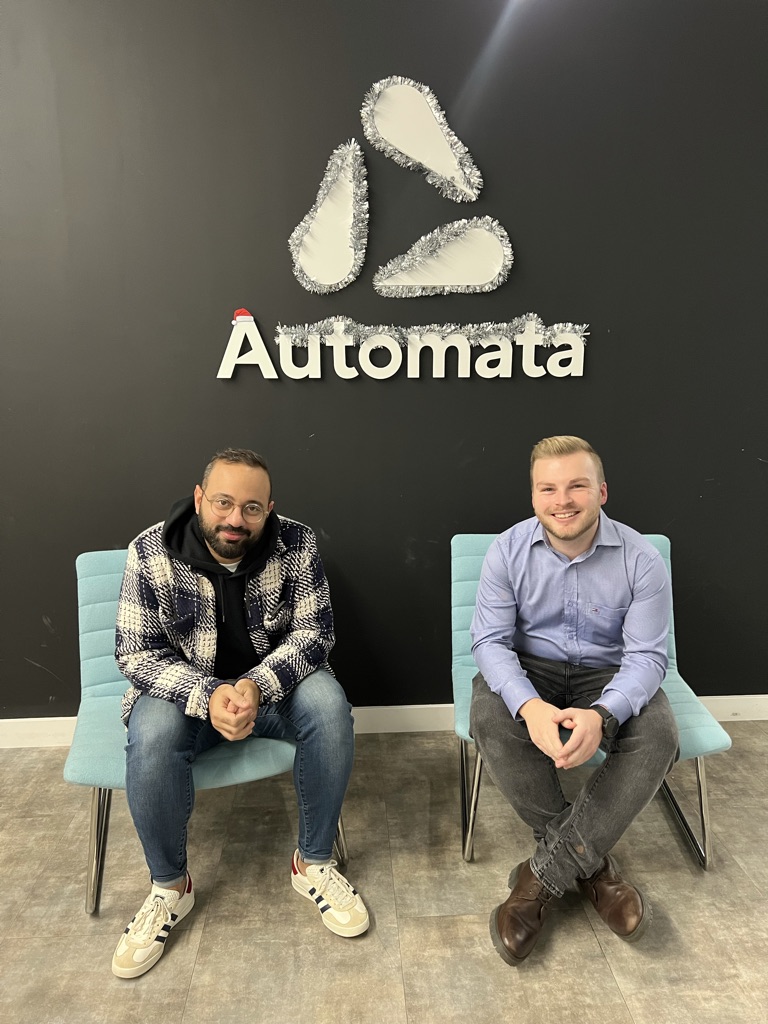
Designing the handoff
The platform that emerged, LINQ, makes the change visible. Its physical side is a configurable bench system. Its software side describes and coordinates workflows. The challenge encompasses what fits in a room, how equipment can be reached and what happens when several tasks need the same resource.
For an architect, these are recognizable questions of arrangement and circulation. LINQ benches can form lines, islands and corners. Instruments can occupy different heights. Sliding and rotating access mechanisms help people reach equipment for servicing and replacing consumables. The room continues to contain humans, even when a process runs automatically.
The software adds another drawing: a sequence of work. Users define tasks and labware, connect the steps and simulate workflows before running them. A control interface lets them monitor execution. A machine’s position is one part of the story; the state of the work matters too.
There is an important choice in how people enter that system. LINQ offers a visual approach alongside a Python software development kit. Both work with the same workflow definition. A scientist and an automation engineer can approach a shared job through different tools.
The developer tools reach beyond moving hardware. They support external interfaces, data connections and custom error handling. Version controls let teams specify software components for a workflow. These are the less photogenic details that help a process remain understandable after the first successful demonstration.
Seen through ElSayed’s career, the bench is a kind of small building with unusually active furniture. Physical placement, access, timing and information all influence whether it works. The description is an analogy, but the underlying design concerns run continuously from his architectural training into the product Automata now sells.
The building keeps changing
By January 2026, ElSayed was framing the next stage in terms of infrastructure for artificial intelligence and physical experiments. Automata announced a $45 million Series C led by Dimension. Participants included Danaher Ventures, Tru Arrow Partners, Octopus Ventures and Entrepreneurs First.
“AI-first biology requires fundamentally different infrastructure.”
Mostafa ElSayed, January 2026
The announcement also brought a strategic investment partnership with Danaher and a board seat for Murali Venkatesan. The planned spending covered further deployments, software development and international operations. It described an ambition whose delivery would require both engineering and an organization capable of supporting installed systems.
ElSayed’s more recent public discussion reaches toward a laboratory that behaves like dependable infrastructure: a scientist asks a question and receives experimental data, without continually managing the machinery underneath. That remains a vision. Its appeal rests on removing the operating details from the center of somebody else’s attention.
In autumn 2026, LINQ received UX Design Awards Gold. The jury recognized its consistent design across the system and its approach to creating and running workflows. Credit belongs to the Automata Design Team, whose named designers include Daniela Sonia Pessot, Rhys Davies, Ming Liu, Nicole Huang, Chiara Tognacci, Dan Salisbury and Aloysius Biongan.
The award’s emphasis on the entire system matters. A user encounters the connections as well as the separate parts. An attractive interface cannot by itself arrange the instruments, and a carefully arranged bench still needs instructions that make sense. Keeping those concerns together is a substantial part of the assignment ElSayed’s company has taken on.
The recognition is a fitting return to ElSayed’s starting discipline. Architecture stayed present as the scale and subject of his work changed. He began with the problem of making forms, helped build a machine to make physical work more accessible, and now leads a company concerned with how a whole process holds together.
That first recruiting message promised a robot. The job has since acquired benches, software, collaborators and a great many handoffs. ElSayed’s most consequential design decision may have been allowing the original object to become one part of a larger drawing.