The laboratory had bought automation. Somehow, the work took longer. In a case study published by Automata, an unnamed biotech company’s cell-culture process took three hours by hand and almost six on its automated equipment. The liquid handler pipetted accurately. Then it waited. Incubation occupied scarce space, other steps remained disconnected, and the expensive machine spent too much time doing nothing.
Automata moved tasks onto separate instruments, arranged work in parallel and connected the equipment. The company reports a reduction from 355 minutes to 72. Its affectionate alias for the customer: “Super Cool Biotech.” A less glamorous name for the problem would be an extremely costly queue.
That is the useful way into Automata. The London company sells laboratory automation, but its subject is the work between machines: moving samples, coordinating timing and preserving the record of what happened. Its LINQ platform brings robotic hardware and orchestration software together so scientists can manage an experiment across instruments. The pitch has an unusually human unit of measurement: how long can someone actually walk away?
Company-reported case study. A specific workflow, not a performance guarantee.
First, the architects built an arm
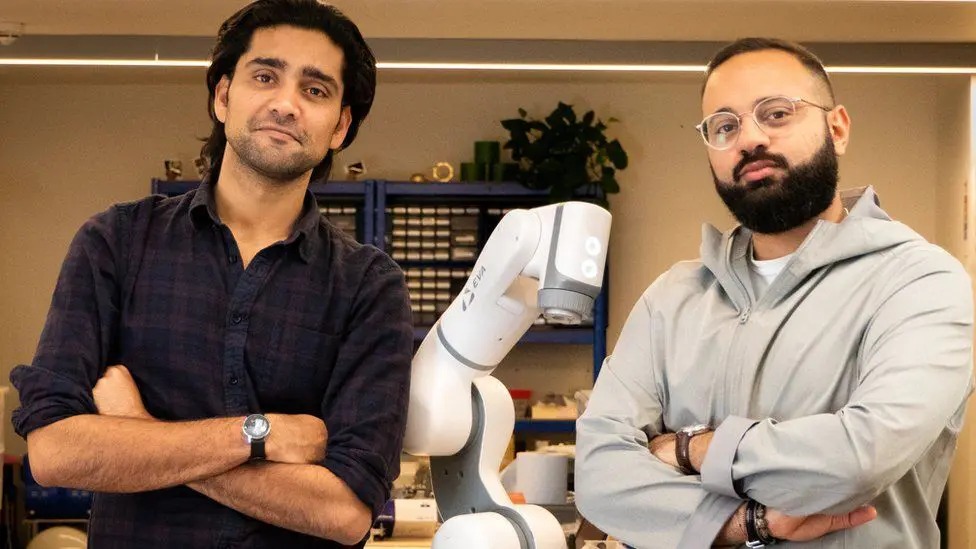
Mostafa ElSayed and Suryansh Chandra founded Automata in 2015 after working at Zaha Hadid Architects. They had encountered robotics through architectural research and found the technology frustratingly difficult to use. Their first response was Eva, a compact robotic arm intended to make automation accessible beyond the factories that could already afford it.
When Eva reached the market in 2019, it cost about £5,000. Trade reporting described a six-axis desktop robot weighing 9.5 kilograms, capable of lifting 1.25 kilograms. These were modest proportions for industrial equipment, and that was the point. Here was a robot a smaller business could contemplate putting on a workbench.
Life sciences gave the company a more concentrated problem to solve. Automata’s investor Octopus Ventures described the attraction of laboratories struggling with repetitive work, staffing demands and disconnected equipment. COVID testing made that pressure conspicuous. By its February 2022 funding announcement, Automata said one NHS laboratory was operating 40 automated stations around the clock.
The shift changed what the company needed to deliver. An arm performs a movement; a laboratory needs a dependable sequence of movements, measurements and decisions. Automata’s expertise expanded around that sequence, drawing application scientists and software engineers into a business whose founders had started with design.
The bench has a traffic problem
LINQ has two jobs that have to agree with each other. Its physical workcell holds instruments and transfers labware. Its software describes tasks, decides when they can run and records execution. A plate cannot arrive at an occupied instrument simply because the next box in a diagram says it should.
The hardware offers a vocabulary for cramped rooms: benches can form lines, islands and corners; racks place instruments at different heights. Access mechanisms let staff reach equipment for servicing or consumables. Transport options include Bridge for point-to-point movement and MagLev, a magnetically levitating system designed for faster, multidirectional plate movement.
On the software side, scientists can build workflows visually in LINQ Canvas, while developers can use a Python SDK. The public documentation describes an API underneath that package and a command-line interface above it. This gives teams different ways to express tasks without making every scientist work at the same technical level.
- 01 / DEFINETasks, samples, timing
- 02 / SIMULATESchedule and movement
- 03 / EXECUTEInstruments and robots
- 04 / RECORDResults and run history
Simulation lets users inspect a planned workflow before committing samples. Browser-based monitoring exposes run status, while data integrations connect experiments to the laboratory’s wider software environment. That record matters: a result is more useful when the team can identify the workflow version, instrument and parameters that produced it.
“Instrument-agnostic” needs a practical reading. Automata’s software page specifies automation-friendly instruments and drivers built to support them. A machine still needs to be physically accessible and digitally controllable. The phrase describes an integration approach, not a magic adapter for every object in a lab.
Six arms at the cancer hospital
At The Royal Marsden, the argument became a clinical installation. In June 2024, the hospital and Automata announced a robotic genomic testing facility equipped with six arms. The launch described plans to double testing capacity within the existing laboratory space, automating pathways involving saliva, tissue, blood and bone marrow.
The distinction between capacity and patient outcomes matters. The announcement concerned the laboratory’s ability to handle more work and broaden testing. It was not a claim that a robot independently diagnosed cancer. Scientists still owned the quality and interpretation of the service.
“The robots are flexible, efficient and fun to work with too.”Professor Michael Hubank
Scientific Director of Clinical Genomics, The Royal Marsden
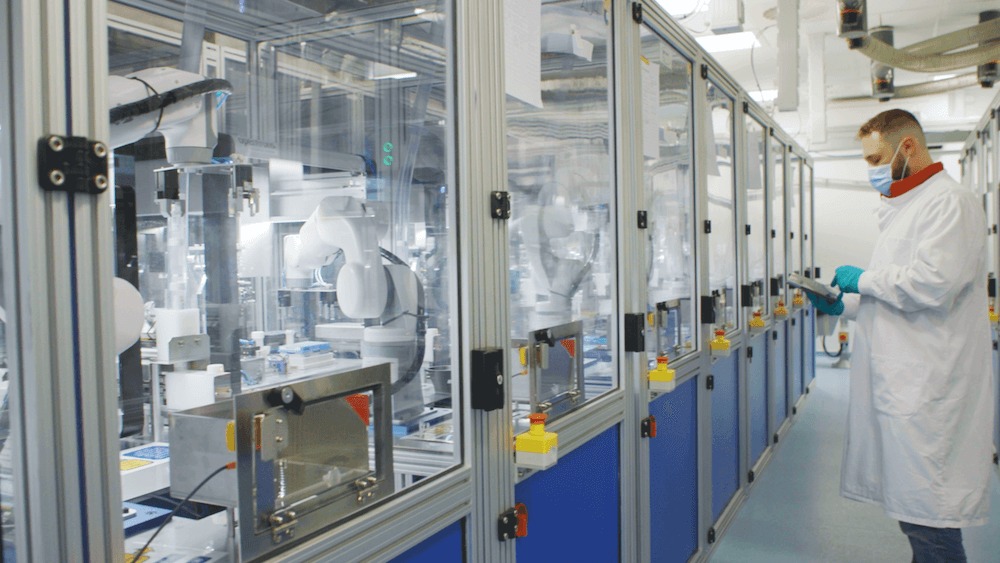
Research laboratories bring different queues. Earlham Institute’s December 2025 partnership with Automata focused on sample quality control. Its planned system spanned eleven instruments, six sample types and five sequencing pipelines. Measurements such as concentration and fragment size can become a constraint even as sequencing itself gets faster. The partnership targeted a fivefold throughput increase and fewer manual touchpoints.
Automata’s broader customer list has included the Francis Crick Institute, Health Services Laboratories, AstraZeneca and bit.bio. These organizations span academic research, testing and commercial biology. The common buyer is a team trying to make equipment, people and information work together at a useful scale.
A £5,000 robot is not a lab budget
Eva’s historical price belongs to a different proposition. A LINQ project involves a configured workcell and a deployment process. Automata describes factory acceptance testing in London or Boston, followed by reassembly and site acceptance testing at the customer’s laboratory. Its service offering includes installation and operational qualification, data integration, training and preventive maintenance.
That makes this a business-to-business systems purchase, with hardware, software and services considered together. The sensible cost question includes instrument requirements, workflow development and the people needed to take ownership after installation. A purchasing team should compare usable capacity and staff intervention across the full project, rather than treating the robotic arm as the whole investment.
Time is another cost. One Automata genomics case study described an engagement beginning in the third quarter of 2022 and an installation scheduled for the third quarter of 2023. The trigger was specific: moving from 96-well to 384-well plates to reduce reagent spending had left the previous automation too inflexible, forcing staff to transfer plates manually.
Capital has followed the larger ambition. Automata announced a $50 million Series B in February 2022 and another $40 million raise in October 2023. On January 29, 2026, it announced a $45 million Series C led by Dimension. Danaher Ventures participated, alongside investors including Tru Arrow Partners, Octopus Ventures and Entrepreneurs First.
Danaher also brought a strategic investment partnership. Technologies from its Molecular Devices and Beckman Coulter Life Sciences businesses were slated to integrate Automata software. For a company dependent on connecting instruments, that relationship has operational significance beyond the money.
AI still needs someone to move the plate
Automata’s newer ambition is adaptive experimentation: results influencing what the lab does next. Its January 2026 partnership with CellVoyant connects LINQ with AI systems called FateView and FateDrive, which analyze cells and guide process optimization. The companies described nearly two years of integration work before the announcement.
They reported up to an eightfold improvement in cardiac-cell differentiation yield and a reduction of more than 85 percent in the cost of cell derivation in their work together. Those are joint, application-specific claims. They make the collaboration worth examining without establishing what another cell line or laboratory would achieve.
This June, Automata also described deepening its work with NVIDIA around AI-connected laboratory infrastructure. The attraction is straightforward: a model’s recommendation can enter a physical workflow, produce measurements and receive feedback. Reliable execution becomes part of the AI system’s usefulness. Biology still has to happen on the bench.
Count the waiting before buying the robot
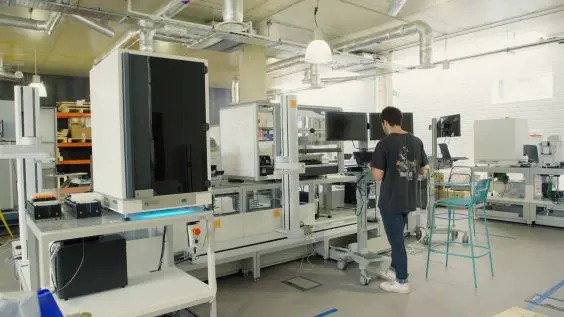
Automata sits among instrument makers, software providers and systems integrators. Tecan’s Fluent workstation, for example, already offers modular configurations, independently moving arms and third-party integration. The market is more complicated than a contest between flexible newcomers and inflexible incumbents. An instrument supplier can be an alternative for one project and part of a LINQ installation for another.
The approach is most persuasive when repeated transfers, instrument scheduling and disconnected records constrain a workflow. Where one workstation already handles the process well, another coordination layer may add little. Likewise, a scarce biological input or an assay’s fixed waiting period cannot simply be programmed away. Parallel execution helps only where tasks, equipment capacity and sample requirements permit it.
There is also a human adoption test. Automata’s careers site describes teams in application science, engineering, design and customer experience, and links a public employee handbook. In September 2026, LINQ received UX Design Awards Gold. The recognition fits a practical challenge: software that coordinates a lab must be understandable to the people responsible for its runs.
For readers considering automation, the first move is small enough to copy tomorrow. Follow a sample. Record each transfer, wait and intervention. Ask which constraint limits completed work, then use that finding to judge a proposed system. Automata’s story becomes interesting at precisely that scale: one plate, one idle instrument, one scientist who would like to get on with the science.