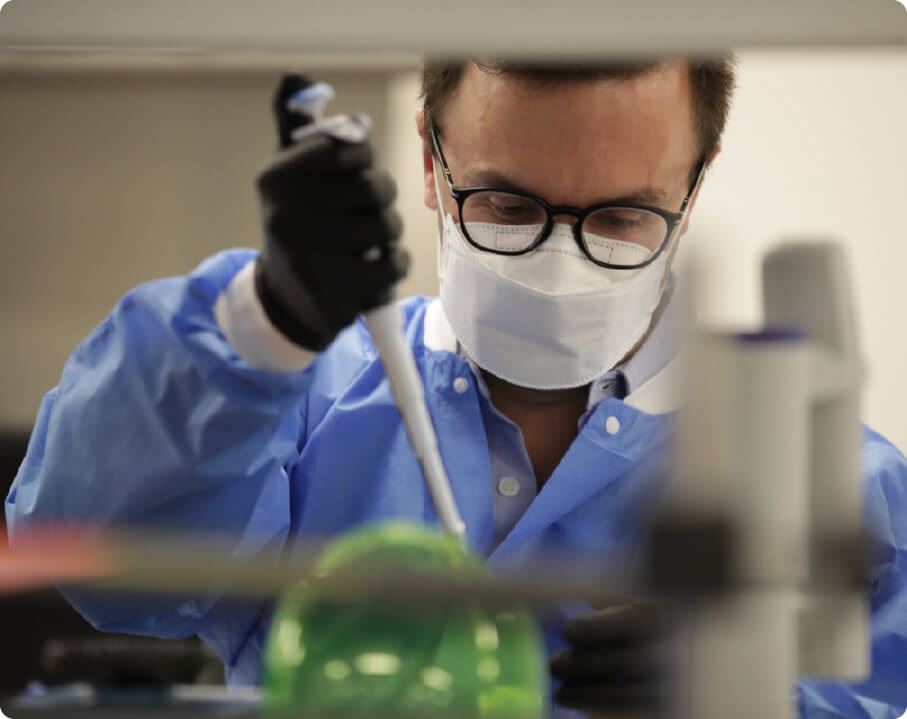
Kaja Wasik had a problem that would have made an excellent family scandal. While testing a sequencing protocol, she obtained results suggesting that her husband and his father were unrelated. Another volunteer’s ancestry was equally implausible. The explanation was considerably less theatrical: somewhere in the manual sample handling, she had made a mistake.
Wasik, a co-founder of genomics company Gencove, described those incidents in an early Opentrons customer interview. They made the case for removing an avoidable source of error. Gencove subsequently used an Opentrons OT-One S to transfer saliva samples into plates, followed by instruments from Formulatrix and Agilent. Automation entered through one troublesome doorway.
- The job: move small volumes of liquid reliably, then coordinate the surrounding lab steps.
- The appeal: modular robots, open software and several ways to author a protocol.
- The catch: buying the machine leaves protocol development, sample preparation and validation to be done.
The ancestry result that made no sense
“It’s shocking how expensive lab automation is,” Wasik said. She recalled alternative quotes of $200,000 to $350,000 for the task she wanted to automate. Those were her historical quotes, not a present-day market comparison. For a startup of three people, they were enough to make automation feel like somebody else’s privilege.
Opentrons Labworks sells a more approachable entry into that world. It manufactures liquid-handling robots, supplies the pipettes and modules around them, and provides software for telling them what to do. Its work sits in the practical middle of biology: preparing samples, distributing reagents and executing instructions repeatedly.
There is a reason this territory matters. A scientific paper usually gives the interesting result the last word. The process that produced it may have required somebody to remember which well was filled, which tip was changed and which sample was next. Attention becomes a piece of laboratory equipment. Unlike a machine, it cannot be purchased with a service contract.
A robot, not an entire factory
The OT-2 is the compact introduction: a benchtop robot with single- and eight-channel pipettes, an 11-slot deck and optional modules. It handles familiar jobs such as transferring samples and preparing reactions. The attraction is straightforward. A laboratory can automate a bounded piece of work without first designing a fully integrated facility.
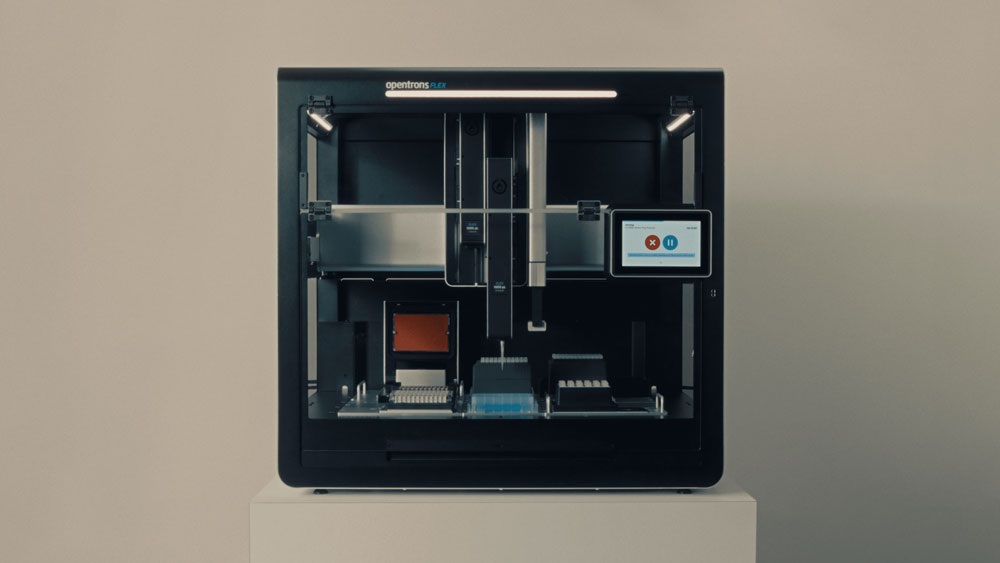
Flex, launched in May 2023, extends the idea. Its hardware is reconfigurable, with pipettes ranging from one to 96 channels and an optional gripper for moving plates. A touchscreen and automated calibration make operation more approachable. Heating, shaking, thermocycling and magnetic-bead handling can be assembled around a particular application.
A gripper sounds like an accessory until a plate has to change places halfway through an experiment. With the appropriate Flex configuration, PCR setup and thermocycling can be combined, or a plate can move onto and off a magnetic block. Each transfer that the machine performs is one fewer reason for a person to return to the bench.
Configured workstations package these capabilities for sequencing-library preparation, nucleic acid extraction, protein purification and proteomics. The important distinction is between a platform and a finished workflow. Pipettes and modules supply the actions; a protocol specifies their sequence and conditions.
The price of a usable afternoon
In the robot catalog checked on October 2, 2026, OT-2 starts at $15,950 and Flex at $24,950. The workstation catalog lists a Flex PCR bundle from $54,150 and an NGS bundle from $77,300. These are advertised starting prices in US dollars, not complete installation budgets. Opentrons’ marketing pages display different configuration prices, so a buyer needs a dated quote for the actual equipment.
US catalog starting prices • checked 02 OCT 2026 • configurations differ
The purchasing question is therefore more interesting than “How cheap is the robot?” It is how much useful work a configured system can do, how often it will run, and how much effort makes the method dependable. Tips and other consumables keep arriving on invoices. Development and validation occupy people. A machine that frees several hours during a frequent assay has a different value from one used for an occasional transfer.
Hamilton’s Microlab Prep is another compact liquid-handling option. Tecan’s Fluent addresses a wider range of automated workflows. Neither can be dismissed by comparing a base robot price with somebody else’s integrated system. The sensible comparison starts with the same application, required throughput, instruments and service expectations.
Cards between the wells
At Northwestern University, doctoral chemistry researcher Michael Rourke described using cards between wells to track progress during manual pipetting in a glove box. As reaction variables multiplied, keeping one’s place became increasingly difficult. Holding a pipette in that enclosure for hours also proved uncomfortable.
His lab adopted an OT-2 and Protocol Designer. Rourke reported completing 300 reactions in two and a half hours using a combination of single- and multichannel operations. That is a result from a particular chemistry workflow, not a speed guarantee for every laboratory. More revealing was the care around the machine: researchers printed a starting-deck screenshot and annotated it to make reagent placement clear.
The cards disappeared. The need to know exactly what was in each well did not.On Northwestern’s documented workflow
This is the useful lesson for readers outside robotics. Automation succeeds when a process is made explicit enough to hand over. The lab had to describe the layout, choose the operations and check the starting conditions. The machine relieved some of the physical and tracking burden; the scientists retained responsibility for the experiment.
Open code, real invoices
Opentrons gives users several entrances into protocol creation. Protocol Designer offers graphical authoring. The Python API supports customized instructions. Protocol and labware libraries help researchers find existing methods and describe the containers their robots will encounter. The public software repository invites bug reports and contributions.
That openness is a commercial choice as well as a technical one. A scientist who can inspect and modify instructions has more room to adapt a robot to new work. The company sells the physical platform, modules, consumables and services around it. Its application expertise helps turn a desired assay into executable steps. Open software and paid hardware can be perfectly comfortable dinner companions.
Opentrons announced a $10 million seed round in March 2018, led by Khosla Ventures, alongside the OT-2 launch. In September 2021, SoftBank Vision Fund 2 led a $200 million Series C, with Khosla participating. The latter financed a broader laboratory platform spanning robotics, assays and operations.
Its customers range from academic researchers to biotech and pharmaceutical laboratories. Public customer material includes Boston University, Retro Biosciences and VIB. The breadth matters: the same basic need to move liquid appears in very different scientific projects. A reusable platform earns its place by allowing those differences.
AI still needs a wet lab
The partnerships show where Opentrons is going. A January 2025 agreement with Merck pairs a custom Flex workstation with verified assay workflows. In February 2026, HighRes and Opentrons announced work connecting laboratory orchestration with robot execution, including a planned semi-automated qPCR demonstration. That description deserves to keep its “semi.”
Also in February, Opentrons announced integration of NVIDIA Isaac and Cosmos tools to develop physical-AI training data for laboratory environments. The ambition is to connect experimental design, execution and feedback. A hypothesis produced on a computer still needs a physical experiment before it can become evidence.
- 01DesignSpecify a question and protocol
- 02InspectSimulate the planned actions
- 03ExecuteRun the physical experiment
- 04EvaluateUse results to inform the next run
A conceptual workflow. Measurement and feedback require the appropriate instruments and integration.
In March 2026, Opentrons introduced Protocol Visualization for Flex. Researchers can step through a virtual run and inspect movement, labware positions, liquid handling and module status. This inspection layer is especially useful when generated protocols contain many actions. A preview can reveal execution problems; it cannot establish that the underlying biological method will work.
May brought Compliance Ready Software, adding authentication, access controls and signed audit trails to Flex. Opentrons explicitly leaves each laboratory responsible for validating its own compliant workflows. Better records and a successful assay answer different questions, and a laboratory needs both.
Start with the step that keeps going wrong
There are limits to the attractive idea of an endlessly adaptable robot. OT-2 protocols do not run directly on Flex. Deck locations and hardware references change; magnetic workflows may need different steps because a gripper and magnetic block replace the powered magnetic module. Switching platforms involves actual method work.
For a lab considering automation, the customer accounts suggest a modest starting point: identify a frequent task with a clear failure or attention burden, map its inputs and outputs, and establish whether a proposed configuration can perform it reliably. Compare results with the existing method before extending the workflow. Include the person who will maintain the protocol in the buying decision.
The economics are less persuasive when a task is infrequent, the method changes constantly, or the laboratory cannot spare anyone to develop and verify it. A liquid handler also needs compatible surrounding processes. Gencove’s mixed-vendor pipeline illustrates the point: one useful robot can improve a system without becoming the whole system.
Opentrons’ promise is appealing precisely because the work is unglamorous. Scientists have questions that require patience, judgment and imagination. Filling the next well requires a different sort of patience. There is a respectable business in helping them tell the difference.