A software demonstration is an unusually good place to meet Kishor Amberkar. There are no grand entrances. In a Learnsoft session about mobile learning, he begins by asking Jaisalyn for host access so he can share his screen. Permission granted, he gets on with it. The small exchange suits the subject: before anyone can learn anything, somebody has to make the system let them in.
Amberkar, the San Diego-based founder and CEO of Observatis, has spent years working on the machinery behind workplace learning. His public demonstrations cover course assignments, permissions, reporting, skills and onboarding. These are subjects with little chance of becoming dinner-party conversation. They are also the details that decide whether an employee spends an afternoon learning something useful or wrestling with a menu.
His more recent writing asks a larger question. If an organization says it values development, cooperation and good work, do its everyday systems encourage those things? The distance between a corporate intention and an employee's actual experience has become the subject of his next business. The screen has grown wider. The concern with how things work remains.
The founder who stayed close to the controls
Amberkar studied computer engineering at the University of Mumbai. His professional record includes software engineering and architecture roles before Learnsoft; the learning business became a substantial chapter. His TalentCulture biography describes a progression beginning as chief architect. Learnsoft identifies him as a co-founder in its webinars, and its September 2022 financing announcement uses a particularly precise description: founder of the Learnsoft technology platform.
That distinction matters. An established business and the software platform it develops can have different beginnings. Amberkar's contribution was building the technology that allowed the learning operation to serve organizations with complicated requirements. He was working on the underlying product, the place where a promise about flexibility has to survive contact with actual permissions, records and workflows.
In September 2022, Learnsoft announced a $16.7 million Series A led by Elsewhere Partners. Robbie Abt became CEO, while Amberkar remained president and CTO. The announcement described plans for product development, hiring and wider adoption. It also offered a concrete account of use: Kansas personnel director Kraig Knowlton described a relationship that expanded from one agency to the state's Executive Branch.
Learnsoft's announced Series A, led by Elsewhere Partners. Amberkar remained president and CTO.
A funding announcement records a business moment. The demonstrations that followed reveal his working vocabulary. He explains a problem, opens the application and walks through what an administrator or employee can do. The detail is often unglamorous. Anyone who has waited for a workplace system to recognize a changed role will understand its appeal.
One or two clicks, please
In a session on facilitating learning, Amberkar describes the different burdens a platform carries. Administrators need controls. Employees need to complete the task in front of them. He puts the employee's requirement plainly: “What they need is one or two clicks”. There is a useful product brief hiding inside that sentence. Complexity may be necessary backstage; the audience need not be given a tour of the ropes.
He discusses different ways to learn, access through mobile devices and reports that let learners see their own progress. The recurring unit is the person trying to do something, rather than the volume of functions available in the application. A sophisticated system earns its place by making an ordinary action manageable.
Mobile learning brings the same problem into focus. In his demonstration, Amberkar talks about older course material that was never prepared for a phone. Giving someone mobile access does not magically make the material usable on that device. The delivery mechanism and the content have to work together. A small screen has an efficient way of exposing a large assumption.
The opening request for screen-sharing access is memorable for that reason. Here is a technology executive encountering a tiny dependency in real time. It is a routine webinar moment, with no need for a heroic interpretation. It also happens to be a neat introduction to a career concerned with removing avoidable steps between a person and the thing they came to do.
“What they need is one or two clicks”
Kishor Amberkar, on the learner's experience
When the organization refuses to fit
In another webinar, Amberkar imagines an organization growing from 10,000 employees to 14,000 through an acquisition. This is an example he uses to explain a design problem, rather than a claim about Learnsoft's own headcount. The incoming employees may bring different procedures. Combining the organizations does not mean every process becomes identical on Monday morning.
His answer involves a shared learning system that can preserve local administration. In software terminology, he discusses multi-tenancy and permissions. In everyday terms, one part of the organization can manage its own training while central leadership retains a wider view. The structure needs to accommodate the institution's shape, including its awkward corners.
The practical question extends beyond size. Who can create a course? Who can run a report? Which part of the organization can an administrator see? Amberkar's examples treat those questions as design requirements. A large user count says little about whether the right person can perform the right action. Growth supplies more people; permissions decide how they coexist.
His onboarding demonstration takes the argument to a new employee's first day. Job attributes, location and role can determine assignments, with information passing between systems. The ambition is to have useful learning ready when the employee arrives. Nobody joins a company hoping their first accomplishment will be locating the correct orientation package.
The skill may already be in the building
A March 2023 webinar turns from access to capability. Amberkar walks through skills-gap analysis, linking what a role requires with what a person can already do. He distinguishes functional, knowledge and performance gaps, and discusses learning paths and succession planning. The point is to make development specific enough to guide an action.
One audience question asks whether a skill can have different levels. His answer uses Microsoft Excel: beginner, intermediate or expert. It is a refreshingly concrete example. A spreadsheet does not become more cooperative because a database has recorded that its user possesses “Excel” as a single, undifferentiated skill.
Another question concerns people holding multiple positions, each with its own requirements. Amberkar explains how the system can accommodate that. The exchange reveals a useful connection between architecture and employment: one individual can have several responsibilities, while a tidy record might prefer to give them just one. His demonstrations keep returning to the real arrangement.
The museum gets a review
His LinkedIn writing gives this product concern a sharper edge. In one post, he compares many learning management systems to museum exhibits, with outdated material poorly adapted to the work people actually do. It is a joke with a recognizable target: the course library that keeps accumulating material while relevance becomes harder to locate.
Observatis carries that concern into its Adaptive Knowledge Intelligence offering. The company describes an approach intended to identify gaps and direct learning toward workforce needs. The proposed move is from distributing a stock of courses to deciding which knowledge belongs with which person and situation. It is an ambition about selection as much as delivery.
Elsewhere, Amberkar asks whether organizations are measuring meaningful signals or merely visible ones. He writes about high performers disengaging from reskilling efforts and invites other people's observations. The question is open-ended. A recorded attendance or completed course can tell a manager that an activity occurred; deciding what it meant calls for more context.
The company teaches, even between courses
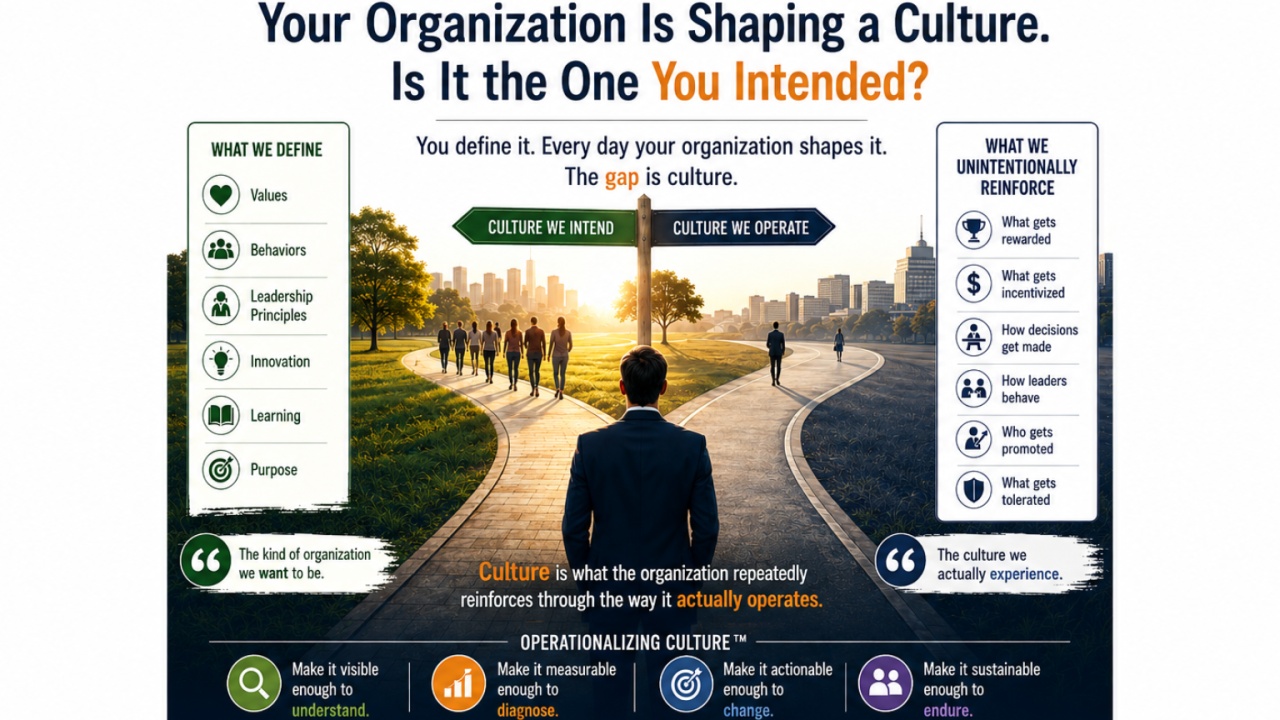
By September 2026, his writing had widened to workplace culture. In an essay about whether organizations create the culture they intend, Amberkar considers a company that promotes collaboration while rewarding individual competition. Its values may be carefully chosen. Its promotion and compensation decisions can deliver a competing lesson every working day.
This is a natural subject for someone who has worked on learning systems: employees learn from the organization outside the classroom too. The essay examines decisions, incentives, leadership behavior and development opportunities as parts of the same experience. A poster has its say. The next promotion may have a rather more attentive audience.
Observatis's Workforce Empowerment Platform groups engagement, performance, learning, compensation and talent within a connected approach. Its stated aim is to help leaders interpret information that otherwise sits in separate systems. The company's culture framework, COLERIS, extends that thinking through a recurring cycle of listening, understanding, alignment, development, reward, protection and adaptation.
Those are product intentions and management questions, with results dependent on how the approach is used. Their connection to Amberkar's earlier work is nevertheless clear. His demonstrations asked whether the learning system understood the employee's circumstances. His current argument asks whether leaders understand the circumstances their own systems create.
The thread through his career is a practical one: a platform should fit the work, and information should help somebody decide what to do. Amberkar's next chapter puts that idea to work across a wider set of organizational decisions. The employee who wanted one or two clicks now figures in a larger question: what, exactly, is this workplace teaching them?