Zeb Evans once expected Silicon Valley to look like “Vegas with startup lights.” Palo Alto did not oblige. The place where he hoped to build his next company was rather quieter than the attraction he had imagined. There is something pleasing about this disappointment in the life of a founder whose eventual business would promise to remove distractions. He had arrived looking for the lights. He would make his living worrying about the switches.
Today Evans is the co-founder and CEO of ClickUp, based in San Diego. His subject is the ordinary office day: the document nobody can find, the conversation stranded in another app, the task that exists somewhere between a message and somebody’s memory. These are small inconveniences with excellent attendance records. They turn up every morning. Evans has spent years trying to get them dismissed.
The ambition has survived several changes in software fashion. ClickUp began in 2017, before the present enthusiasm for workplace AI. Its underlying proposition remains recognizable: bring enough of work together that people can spend less time arranging to do it. What has changed is the scale of the business, and how far Evans is prepared to carry that argument inside his own company.
A business hiding in the housekeeping
Evans’s entrepreneurial education included selling Disney DVDs, running an entertainment business and building social media tools. He attended Virginia Tech and left without completing his degree. Fast Followerz, his social media marketing business, gave him experience of selling a service built around attention. Eventually he wanted to make something with a different kind of usefulness. The move to Silicon Valley followed.
One attempt, a video social network called Mimry, did not last. Another idea was a competitor to Craigslist. Before pursuing that marketplace, however, Evans wanted to fix the way his own team worked. The necessary preparation became the interesting business. In the history of office software, housekeeping occasionally acquires a valuation.
He and co-founder Alex Yurkowski built ClickUp around a frustration they knew personally. Work required too many separate tools. The team struggled to see what colleagues were doing and where tasks belonged. An internal tool offered a way to hold those pieces together. Its appeal began with the people building it, which gave Evans a practical place to start: his own working day.
That origin helps explain his resistance to the instruction to pick one narrow problem and stay there. A task, a document and a conversation may be sold as different software categories, but to the person finishing a project they belong to the same afternoon. Evans’s bet is that the boundaries between those products have become an expense customers should question.
The customer who actually pays
At the beginning, this broad ambition was awkward to finance. Evans has described investors struggling with a product that lacked a narrowly defined target market. Without outside money to settle the question, the team had to make the business sustainable. Profitability was a requirement with a much shorter deadline than a pitch deck’s vision of the future.
In one early episode, the company had about a month of money left. Evans remembers sending users a discount offer to upgrade to a paid plan. Enough accepted to make the business cash-flow positive and keep development going. It is a useful scene because the decisive response came from people with a bill to pay. Their approval had consequences that applause could not supply.
That experience sits behind his preference for iteration. His compact advice to entrepreneurs is “Work hard; iterate with urgency.” The phrase is brisk enough to fit on a wall. The harder part is deciding which changes deserve the urgency. Every additional feature can please somebody while making the whole product harder for somebody else to understand.
“Work hard; iterate with urgency.”
Zeb Evans, 2024
Evans’s early answer was to stay close to users. Listening meant identifying repeated problems rather than treating every request as an instruction. There is a distinction between a community helping to shape a product and a queue of customers independently designing it. The founder still has to decide where the common problem ends and the special request begins.
Money arrives. Complexity comes along.
On October 27, 2021, ClickUp announced a $400 million Series C, co-led by Andreessen Horowitz and Tiger Global. The round valued the company at $4 billion and brought total funding to $535 million. Those numbers describe a financing event in 2021. They also mark the distance between a tool made for an internal team and a company expected to operate internationally.
October 2021 · Company financing figures
Capital gave Evans resources to build more quickly. It also enlarged the job of keeping the organization coherent. A small team can share assumptions without realizing it is sharing them. Add offices, managers and new colleagues, and those assumptions start travelling badly. The founder’s certainty that everyone understands the mission becomes one more thing that requires checking.
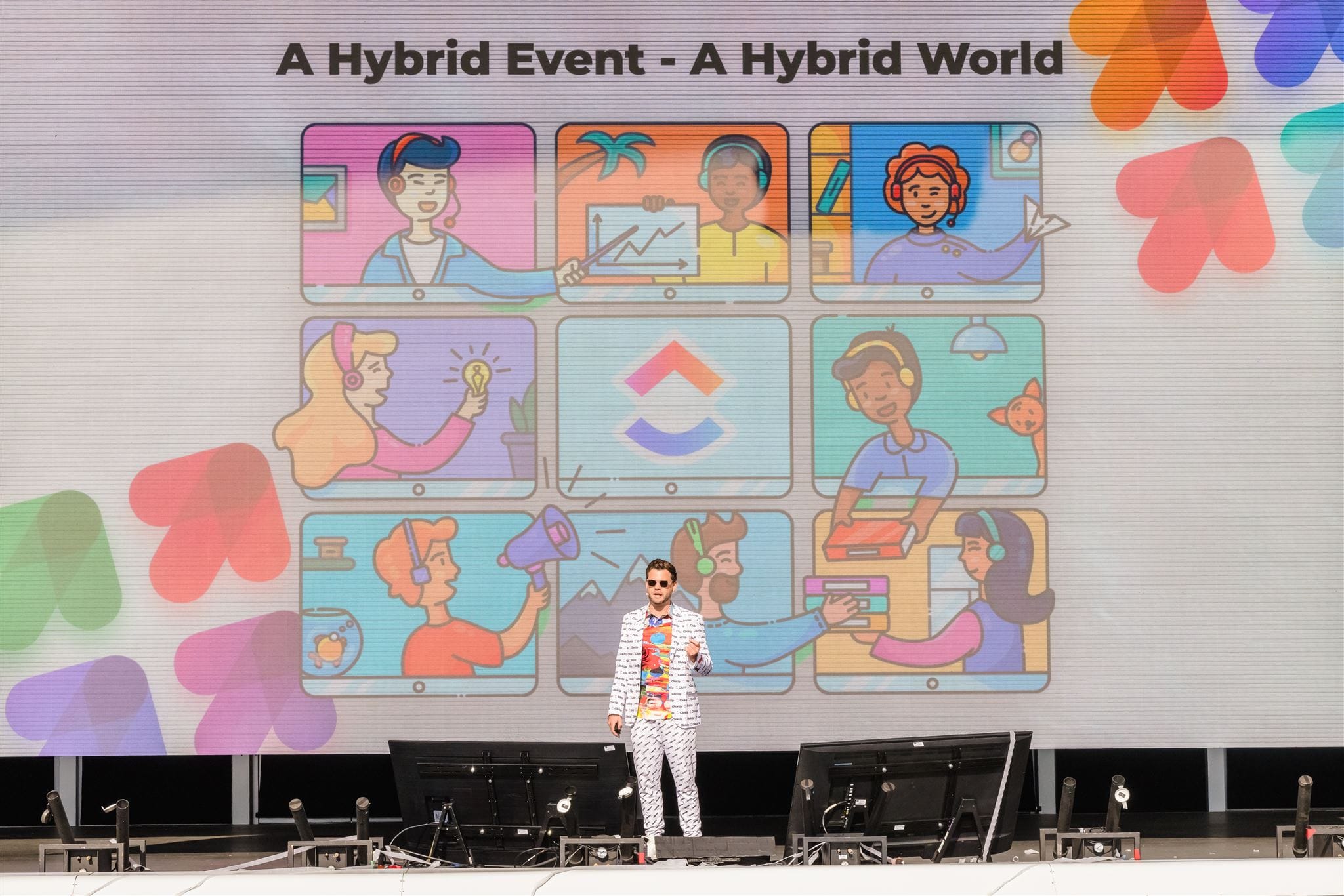
Evans has been unusually willing to discuss what growth complicated. In a 2024 conversation, he examined mistakes made while scaling headcount and acknowledged how the product had deteriorated as it expanded. A company selling simpler work can become difficult to operate itself. Success does not grant an exemption from the problem printed on the sales page.
His language about improvement has shifted, too. An early commitment to “progress over perfection” became “progress toward perfection.” It is a small edit with an operational argument inside it. Early customers may forgive rough edges in exchange for useful invention. Established customers depend on the product every day. For them, reliability is part of the feature.
The afternoon has an owner
Evans’s working habits offer a smaller version of the same struggle. In 2024 he described putting meetings before noon, leaving the afternoon for the broader responsibilities of being CEO and reserving evenings for focused product work. The arrangement reflects a founder who still wants to inspect what the company makes, even as the company produces more demands on his attention.
ClickUp’s own biography describes him as its de facto chief product officer as well as CEO. That is a revealing addition to the job title. For Evans, the product remains a place to work directly, rather than a subject to receive occasional updates about. His calendar has to make room for the detail that his title might otherwise keep him away from.
He also talks openly about having learned communication along the way. He has described himself as someone for whom it did not come naturally. Authenticity, conviction and the ability to communicate enthusiasm matter to him. It is an unglamorous account of leadership: a skill acquired through doing the job, rather than a quality conferred by becoming the person in charge.
There are lighter clues to the person behind the schedule. Evans drove a monorail at Disney World. His public X handle, DJ_CURFEW, carries an earlier life in music into his present one. The colourful shirts have remained. Software consolidation, apparently, does not require a consolidated wardrobe.
When the tool begins doing the work
By January 2025, Evans was arguing that workplace chat should sit beside the work it discusses. A conversation that produces a decision still needs a route into action. Moving between separate applications makes the user responsible for carrying the context. His objection is practical: the person doing the work becomes the courier between the tools.
AI extends that argument. ClickUp’s Super Agents are designed to use workspace information and carry out multi-step tasks, with controls over access and permissions. The proposition moves beyond gathering information on one screen. It asks whether the same connected information can help software perform part of the work. The administrative assistant acquires access to the filing cabinet.
On June 23, 2026, ClickUp announced Brain², built around company context, shared memory and access to multiple AI models. Evans put his emphasis on the information surrounding the model: “The model isn't the moat.” The product’s premise is that knowing the team’s decisions, documents and priorities can make a general AI model more useful in a particular company.
The premise has a familiar ancestry. His original team could not find its work. The later company wanted conversations connected to that work. Now Evans wants AI to understand the connections well enough to act on them. Each version asks the same uncomfortable question of the office: how much effort goes into recovering information that already exists?
The cost inside the promise
In May 2026, the argument took a consequential turn for ClickUp’s employees. Evans announced a 22 percent reduction in headcount and tied the restructuring to a different way of operating with AI. He said the decision was his and described plans for million-dollar salary bands for people creating substantial impact through AI systems.
Those were his plans and his explanation. The reduction itself affected people whose contributions had helped build the business. Any account of his ambition has to hold both facts together. A promise to increase productivity is also a set of decisions about jobs, rewards and whose judgment the organization considers valuable.
The test of Evans’s approach will be the work that follows: products people can rely on, useful decisions and time that customers actually recover. His earliest commercial proof was simple enough to recognize. Users paid because the tool helped them. For all the larger numbers and newer machinery, that remains a demanding standard. An afternoon returned to its owner is a fairly concrete result.
Keep the conversation going
More from Evans, and a longer conversation about building ClickUp.
Official biography ↗Explore ClickUp ↗LinkedIn ↗X / DJ_CURFEW ↗Instagram ↗Watch: how the original idea became ClickUp ▶Essays by Zeb Evans ↗Read: his argument for fewer workplace platforms ↗Brain² announcement, June 2026 ↗Read: the May 2026 restructuring ↗