In January 2019, Arash Hosseini Jafari published an essay about search engines. He opened with a declaration that Google was the “8th wonder of the world.” It is a pleasingly extravagant compliment for something most of us consult while looking for a misplaced recipe. But the subject suited him: a complicated technical system that had become an ordinary part of life. Years later, as the co-founder and CEO of Clearpol, he would describe a different kind of success in software: people beginning to treat a tool as simply the way they worked.
Between those two observations sit an engineering degree, work at two NASA research centers, a company built with a friend, and a funding announcement full of thank-yous. The route takes in satellite images and business paperwork. Its recurring question is a practical one: what happens after a clever idea leaves the laboratory and meets someone with a job to finish?
Jafari is based in San Francisco. Clearpol uses artificial intelligence to help organizations handle compliance and administrative work. That description carries less glamour than a spacecraft, but it puts technology close to a familiar source of frustration: the document that must be read, the requirement that must be understood, the task that must be done again tomorrow. Paperwork has a remarkable talent for surviving every prediction of its demise.
The search box before the startup
At the time of his search-engine essay, Jafari described himself as a graduate student in data engineering at the University of California, Riverside. He completed his Master of Science in Engineering there in fall 2019. The dates put the writing alongside his graduate education, before Clearpol became the center of his professional life.
The essay’s title, How Search Engines Work, is direct. There is no promise of a secret and no invitation to become rich before lunch. It takes a familiar object and asks what makes it function. His admiration for Google is visible in the opening; his choice to write an explanation places that admiration beside an interest in the machinery.
That combination gives the early writing a useful place in his story. A search box is easy to use precisely because so much complexity sits behind it. The person typing a question does not need to inspect the machinery first. As a way of thinking about software, this is a productive tension: the builder attends to complicated systems while the user attends to the result.
Read alongside his later comments about adoption, the essay suggests a continuity of interest. The student writing and the founder’s observations approach the same problem from different directions. In 2019 he was explaining a tool people already used. At Clearpol, he would be involved in building tools that needed to earn that place.
A name in the clouds
Before Clearpol, Jafari worked at NASA’s Jet Propulsion Laboratory and Langley Research Center. His graduate software engineering internship at JPL involved interplanetary physics and robotics simulation software. At Langley, his deep-learning work concerned severe-weather prediction using satellite imagery. These were concrete technical assignments with subjects rather larger than a browser window.
His name appears among the authors of a paper submitted for a January 2020 scientific conference: Automated Detection of the Above Anvil Cirrus Plume Severe Storm Signature with Deep Learning. The title is a small endurance test for the reader. The problem underneath it is easier to picture: detect a particular cloud formation in satellite images that can indicate a severe storm.
The research investigated automated recognition of a visual signal that a person could identify. Jafari’s affiliation was NASA’s internship program at Langley. He shared the author list with Charles Liles, Kristopher Bedka, Edward Xia, YuXuan Huang, Roshni Biswas, Connor Dolan, and Travis Smith. This part of his record belongs to a research team, with a defined problem and shared authorship.
For a reader looking back from Clearpol, the connection is the use of machine learning to help people find something consequential inside information. Satellite imagery and administrative documents are very different materials. They nevertheless make a similar demand on a system: an output must be useful to someone beyond the person who built the model. That is the thread worth following here.
- 01Search enginesExplaining a familiar system
January 2019 - 02Satellite imageryCo-authoring storm-detection research
January 2020 - 03Business documentsCo-founding Clearpol
2020
Two friends, one company
Clearpol was founded in 2020 by Jafari and Faddy Sunna. Jafari became CEO; Sunna is the co-founder and chief technology officer. Their partnership also has a less formal description. The pair, who are best friends, appeared together on DigitalOcean’s Making Work Work podcast in January 2023.
The episode belonged to a series called An Aha Moment, devoted to founders explaining where a business idea came from. For Clearpol, the subject was paperwork and the opportunity to apply artificial intelligence and natural language processing to it. Friendship and technical work sit together in this account of the company’s beginnings. Both matter to the shape of the story.
A photograph shared with their funding announcement puts the founders beside each other beneath the Clearpol logo. Jafari wears a light gray blazer; Sunna wears a dark shirt. It is an uncomplicated picture of a partnership. The company name looms above them, but the people occupy the frame. Even a business concerned with automation needs someone to turn up for the photograph.
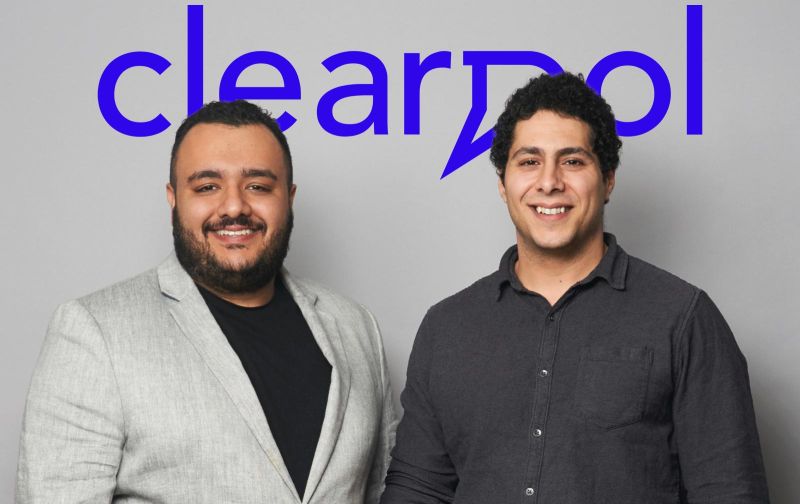
Berkeley SkyDeck became another part of their working world. Clearpol is an accelerator alumnus, and SkyDeck’s Batch 19 Demo Day page features both founders. The institutional connection is also visible in the company’s fundraising: when Jafari announced a new round, Berkeley SkyDeck was among the returning participants. The relationship extended beyond an appearance on a demo-day roster.
The number came with names
In November 2023, Jafari announced that Clearpol had raised $3.3 million, bringing its total funding at that point to close to $4 million. He named 25madison, 25m Health, and Vertex Ventures US in the round, alongside renewed participation from UC Berkeley SkyDeck. These are historical figures attached to that announcement, rather than a running total for the company today.
The number was only part of what he wrote. He singled out Jaja Liao, Rebekah Foster, In Sik Rhee, and Chon Tang for thanks, then extended his gratitude to family, friends, and partners. The announcement reads as a celebration involving a network of people. The capital has a figure; the help has names.
The announced round. Total funding at that time: close to $4 million.
Foster publicly congratulated both founders. Sidarth Radjou celebrated their progress and recalled time spent together at Berkeley SkyDeck. Those exchanges give some texture to an event that can otherwise become a solitary number in a company history. The founders were part of a community that had watched the business develop.
In March 2025, Sandra Pham described reconnecting with the Clearpol team at its San Francisco offices. Jafari replied by thanking her for her support and mentorship. The exchange is brief, but specific. It adds another relationship to the picture: someone whose continued involvement he acknowledged publicly. A founder’s network becomes easier to understand when it includes these ordinary conversations.
When the tool becomes the routine
At the turn of 2026, Jafari reflected on visiting a customer and watching initial skepticism give way to enthusiasm and advocacy. His account focused on how people introduced the software to colleagues. Adoption, in that telling, spread through people discovering a use for it and passing the discovery along.
The part of his reflection that travels furthest beyond his own business is his attention to “the people, the workflows, and the trust.” He also pointed to audit trails, privacy by design, and secure architecture. These are the quieter concerns of software that must operate every day. They offer a more grounded account of building than a discussion limited to what a model can demonstrate.
“the people, the workflows, and the trust”
Arash Hosseini Jafari, reflecting on software adoption
His measure of progress was the moment staff began treating the software as part of their usual work. It is a modest-sounding ambition with a demanding implication. A tool has to survive repeated use. It has to make sense when a colleague explains it. It has to offer enough value that someone wants to return to it.
This brings the story back to the search box. The 2019 essay admired a system whose complexity had become accessible. His later account of customers concerned a system becoming familiar. Set beside each other, the two moments suggest a path from explaining technology to observing how people make room for it. The machinery remains complicated; the experience can become familiar.
The next room has hard hats
On October 20, 2026, Jafari is scheduled to present a workshop at WCOE California’s conference called Hard Hats, Smart Tech. Its planned audience is construction business owners and executives. The agenda covers practical uses of AI for emails, action items, project information, meeting summaries, and proposals. As of this profile’s publication, the session is still ahead.
That is an apt next setting for this particular career. After graduate engineering, NASA research, and a company built around administrative work, he is preparing to discuss tools that people can use in the course of running a business. A meeting summary has little of the romance of a satellite image. It may still be exactly what someone needs. Jafari’s story keeps returning to that final encounter: the clever idea, and the person who has to make use of it.