The bank had a problem with people leaving. It could afford neither the turnover nor a psychologist interviewing every teller. In TalentQuest’s account of its early history, Frank Merritt proposed something less glamorous: paper assessments, sent back by fax for scoring. Repeated across tellers, the answers began to expose behavioral patterns associated with staying or going. The machinery was ordinary. The ambition was to make an expensive human judgment repeatable.
- Behavioral assessments feed hiring, coaching and team decisions.
- Performance, learning and succession tools give those insights somewhere to go.
- Energage acquired the software business in 2025; its platform story expanded again in 2026.
The fax machine came first
The constraint mattered. Merritt had experimented with BASIC in the 1980s, but the company’s history describes computing speed and missing internet infrastructure as obstacles. He acquired Robert Bleke’s consulting practice in 1992. Online assessments followed as the internet developed, then a software business. Read that sequence carefully: delivery became cheaper before the offering became broader.
Today TalentQuest is a division of Energage, selling software that helps employers select, manage and develop employees. Its distinctive thread is behavioral information carried across those activities. Hiring produces an assessment. That assessment can inform how a manager coaches someone, how a team is assembled, and where development attention goes. The person does not become a blank file again on their first Monday.
A report with somewhere to go
The assessment now marketed by Energage draws on a 16-trait personality and cognitive framework built on Cattell’s 16PF. Employers can construct a Peak Performer Profile from successful employees and supplement it with SmartProfile benchmarks for comparable roles. Interview guidance then gives the recruiter specific matters to explore. Energage lists availability in 12 languages. These are product capabilities; a particular employer’s hiring results still depend on how it uses them.
Talent Insights extends the idea into work. It offers individual guidance, coaching suggestions and team views; Team Builder lets managers model possible team combinations. The attraction is concrete: a supervisor can arrive at a conversation with prompts about the employee in front of them. A personality score by itself has little to say about what should happen at Tuesday’s check-in.

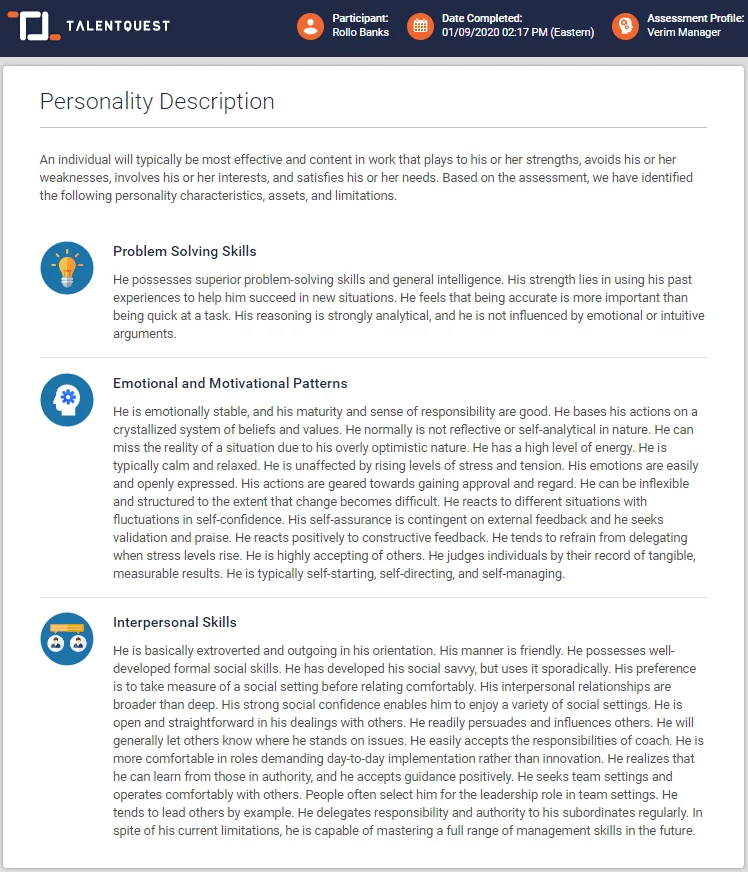
The surrounding suite supplies the routine machinery: goals, reviews, recurring one-to-ones, 360-degree feedback, learning administration, compensation and succession planning. Published bundles separate basic selection and performance needs from development or planning needs. The LMS handles certifications and retraining; succession tools include talent pools and a nine-box grid. Buyers can start with a defined problem rather than purchasing every possible HR ambition at once.
- 01AssessTraits + role needs
- 02DiscussCoaching + feedback
- 03ActGoals + learning
Information earns its keep at the next decision.
This places TalentQuest in the talent-management layer alongside an employer’s existing HR infrastructure. It advertises connections to HRIS and payroll systems. Jobvite documents an integration that launches assessments inside its recruiting workflow and places reports in candidate records. The company also offers consultants and Ph.D. psychologists for competency design, coaching and assessment interpretation. Specialist knowledge remains part of the service, even when the questionnaire travels by software.
A county puts numbers on the promise
Marin County provides a useful glimpse of the customer behind the product vocabulary. Its 2023 agreement specified access for 2,500 employees to profiles, goals, performance, Connect, learning, analytics and reporting, plus OpenSesame course access for 1,250 employees. This was a public employer buying a defined collection of working tools.
2,500 employees in the specified TalentQuest scope
1,250 employees with OpenSesame course access
The annual subscription was $149,345.04. The agreement capped total cost at $448,035 and ran from August 2023 through July 2026. Those figures describe that contract, not today’s price list. It also waived $5,000 of Connect and Analytics implementation fees and assumed a two-month implementation window. The commercial lesson: employee population, modules, content and setup belong in the same buying conversation.
For HR buyers, that makes the comparison practical. How well does the proposed suite preserve context between recruiting, reviews and development? How much configuration will administrators maintain? TalentQuest’s modular approach offers a way to consolidate those processes while keeping an existing HR system. The value depends on which handoffs currently consume time or lose information.
The buyer wanted the next step
Energage’s acquisition, announced March 25, 2025, gave this collection a broader setting. The company behind Top Workplaces already measured employee experience and helped employers communicate their culture. TalentQuest added tools for the decisions that follow measurement. The strategic logic is straightforward: discover where an organization needs attention, then give its managers a way to respond.
The transaction’s legal detail is revealing. It closed March 17 and covered talent-management software assets, including related assets of the Indian subsidiary. Learning-content business assets were distributed to an affiliated entity. Treating the deal as a purchase of everything TalentQuest ever offered would miss that distinction.
“Making the world a better place to work together.”
Energage’s stated mission
In July 2026, Energage announced a merger with Engagedly, extending the platform strategy into another talent-management system with learning, recognition and frontline workforce capabilities. For a prospective customer, the useful question now concerns the particular workflow being offered: which assessment, which performance process, which learning system, and how they connect in the proposed deployment.
The conversation still needs a manager
TalentQuest’s adoption strategy recognizes a familiar workplace obstacle: another application competes for attention. Its July 2024 Teams and Outlook announcement put access, notifications and check-ins inside tools employees already use. Its implementation process separately calls for requirements gathering, workflow design, administrator training, change management and continued adoption after launch. Installing the software is one event in that process.
The company’s stated culture puts accountability and customer centricity alongside innovation, respect and employee centricity. Those are employer declarations, but they fit the service model: implementation has named roles for project management, client services and product support. The buyer also has work to do. Someone must approve workflows, prepare data, learn the administration tools and help colleagues build a habit. A product demonstration compresses all of that into a few clicks.
The practical idea to copy is small enough for any manager: choose one recurring people decision, identify the evidence it needs, and attach a specific action and follow-up. That is an editorial lesson from the product’s design, not a promised return. It depends on managers making time, employees trusting the process, and someone owning the follow-through. Otherwise, even a carefully assembled assessment becomes another report waiting to be opened.