A raindrop has a modest ambition. It wants to go downhill. Long before Kewan Khawaja was helping run a software company across continents, he wrote software concerned with precisely that journey. An old GRASS geographic information system manual credits Kewan Q. Khawaja at MIT with r.drain, a program that traces a path through an elevation model. Give it a starting point and a landscape expressed as numbers, and it works out a route.
It is an unusually concrete beginning for a career spent amid the abstractions of enterprise technology. There are no corporate slogans in a drainage map. There is a surface, a set of constraints, and somewhere the water needs to go. Khawaja would go on to co-found Techlogix with Salman Akhtar in 1996, then help launch businesses in university software and digital lending. The problems grew more complicated. The appeal of finding a workable route remained.
The engineer takes a turn
Khawaja graduated in civil engineering from the University of Engineering and Technology, Lahore, in the class of 1986. At MIT, his graduate work moved into information systems. His research involved spatial analysis tools for the US Army’s geographic information system, supported by the Army’s Construction Engineering Research Laboratory. Concrete and steel had given way to another way of describing the physical world.
His working life in America supplied further variations on the engineering problem. At Steven & Associates, he developed vibration analysis software for power plants and facilities that manufactured chips. At Boston’s Cambridge Technology Partners, he built applications for American Airlines. These were systems with jobs to do, in settings where an elegant idea still had to survive contact with actual operations.
UET Lahore
Spatial analysis
Enterprise software
Digital lending
A company built across the map
In 1996, Khawaja and Akhtar founded Techlogix. Both were MIT graduates; their company connected engineering work in Pakistan with customers overseas. That arrangement required more than moving files between offices. Clients had to trust people they might seldom meet, and teams had to understand businesses operating far from their own desks. Geography was part of the business problem.
Techlogix’s remit eventually stretched across consulting, application development, business process work, and analytics. It now employs approximately 600 people across six delivery centers worldwide. Those figures give a sense of the organization Khawaja helps lead, rather than a personal scorecard. Keeping such an organization useful means making many individual decisions cohere: what to build, how to deliver it, and how to recognize when a customer’s problem has changed.
The co-CEO title matters here. Techlogix’s story has two founders at its center, and Khawaja continues to share the chief executive role with Akhtar. The company’s longevity belongs to that partnership and to the people doing the work. A founder biography can make a crowded enterprise look suspiciously like a solo performance.
Twelve weeks is a demanding unit of thought
Khawaja’s technical interests have included business process management, business intelligence, and the relationship between technology projects and corporate strategy. The vocabulary sounds comfortable in a meeting room. The underlying question is less comfortable: will this system make the organization work better, and can anyone demonstrate it?
Khawaja helped develop Techlogix’s methodology for implementing business process management systems, work he discussed through a BPMInstitute webcast. The methodology had been used at Fortune 500 companies for projects delivered in cycles of 12 to 16 weeks, with fixed costs and no schedule variance. That was a specific description of that methodology’s use, rather than a promise covering every Techlogix engagement.
It also described his work helping companies establish centers of excellence for continuous process improvement. There is an appealing lack of ceremony in the phrase “continuous improvement.” It assumes the first answer will need another look. For a consultant, the challenge is to leave behind an organization capable of asking the next useful question after the engagement ends.
The admissions office gets a second life
Techlogix made a strategic turn toward its own cloud software products in 2015. Its chronology places the launch of AlmusNet, a subsidiary building a cloud-native student information system, in 2017. A services company learns by solving other people’s problems. A product company must decide which parts of those problems recur often enough to build once and keep improving.
AlmusNet’s Campus on Cloud covered the student journey from admission through graduation, including academic and financial administration. The work sits close to the ordinary friction of university life: applications, enrollment, records, and payments. A university can contain remarkable intellectual activity while making a simple administrative task feel like an expedition.
Khawaja was identified as co-founder and co-CEO of AlmusNet in 2018. The appeal of this chapter is its specificity. He had studied at two universities; now one of his businesses dealt with the machinery that lets universities function. The student’s experience and the institution’s operating requirements had to fit on the same screen.
“Reading books on history, philosophy and poetry”
Kewan Khawaja’s listed hobbies, 2018
Ghalib belongs in this biography
Asked about his inspirations in 2018, Khawaja listed Albert Einstein, Steve Jobs, Nietzsche, and Mirza Ghalib. It is a lively committee. Physics, computing, philosophy, and poetry do not reliably reach a unanimous decision. His hobbies included reading history, philosophy, and poetry, along with listening to Sufi music. Switzerland was his favorite vacation destination.
These details make room for a person beyond the organizational chart. They also make his later advice to engineers more interesting. In an alumni TechCAST discussion, Khawaja argued for learning beyond the syllabus: literature, history, fiction, cinema, and social experience. Technical accomplishment alone could leave a graduate poorly equipped to communicate a complicated idea.
His emphasis was on developing a wider understanding of people and the world before entering professional life. A client does not arrive as a tidy examination question. The ability to understand context, explain a choice, and hold a conversation travels with the engineer into every assignment. The reading list begins to look rather practical.
The network outside the office
Khawaja served as president of the Organization of Pakistani Entrepreneurs in 2017-18. His earlier public roles included vice-president of the Pakistan Software Houses Association and membership of the Punjab Information Technology Board. He was also part of a four-person team that prepared the software export section of Pakistan’s IT policy.
These were ways of working on the environment around a company: the professional networks, institutions, and policy questions that affect whether businesses can grow. They required a different sort of coordination from a software project. A functioning industry needs routes for people and ideas as well as routes for customer work.
In July 2020, Khawaja joined a Pakistan-US technology cooperation webinar organized by Pakistan’s consulate in New York. Alongside NetSol’s Najeeb Ghauri and other speakers, he discussed experience working with Pakistan’s IT industry and opportunities for exports to the United States. More than 200 participants attended directly. The subject was familiar terrain: connecting capability in one place with commercial opportunity in another.
A bank account can tell a different story
In 2021, Khawaja co-founded AdalFi, a Techlogix spinout working on digital lending. The problem was recognizable to anyone who has encountered an institution that possesses information without being able to use it effectively. A customer can have an active bank account and still lack the credit history required by conventional lending models.
AdalFi builds credit scoring models around banking transaction data and connects lending journeys to banks’ existing systems. Its partner banks make the loans. The platform helps them assess customers and deliver credit digitally. In February 2023, AdalFi announced a $7.5 million funding round, with investors including COTU Ventures, Chimera Ventures, Fatima Gobi Ventures, and Zayn Capital.
The business model gives the software provider a continuing interest in what happens after approval. AdalFi shares revenue with its banking partners and shares losses in proportion to its participation. The lending decision therefore has consequences for the company providing the model. A successful demonstration is only the beginning; repayment matters too.
AdalFi provides the scoring and digital platform. Partner banks extend the credit. Revenue and risk are shared.
Khawaja has publicly promoted the venture’s ability to serve consumers with little or no credit history and small businesses. AdalFi’s board page identifies him as a founder alongside his Techlogix role. The connection between the companies is useful context: a new venture could draw on years of experience building enterprise systems, rather than beginning with the assumption that a bank would cheerfully replace everything it already ran.
Still in the conversation
On October 1, 2025, Khawaja was the announced guest for the inaugural ULEFUSA TechCAST, an alumni conversation about his journey from UET to the United States, MIT, and entrepreneurship. The format brought a long career back to an audience with a shared starting point. A graduate becomes an employer, then returns as someone the next generation can question.
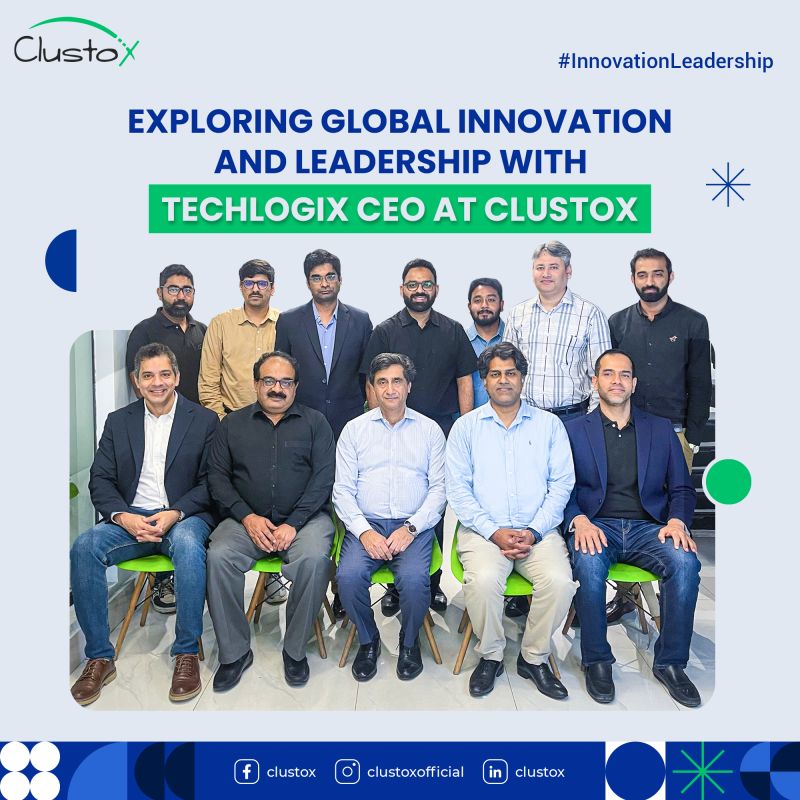
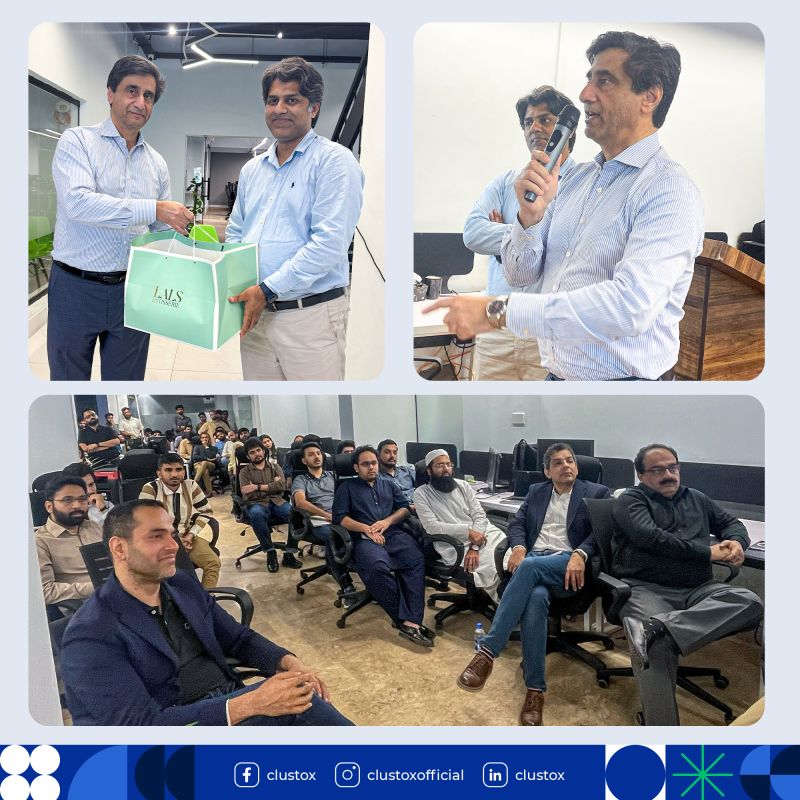
At a Clustox gathering, that conversation continued with Techlogix alumni and younger professionals discussing AI disruption and changing ways of learning. The photographs show the practical setting: a microphone, a room of listeners, colleagues gathered for a group picture. The work of explaining a career happens at human scale.
The early drainage program offered a clear destination: find the lower ground. Building companies offers less obliging terrain. Customers change, graduates arrive, institutions acquire new needs, and a useful system needs another revision. Khawaja’s career has kept returning to those moving parts. There is room in that work for the engineer who wants a precise answer and the reader who suspects the world deserves a longer look.