A dry-fruit wholesaler from Gilgit wanted to grow his business. He had never been considered for a loan. When he finally received one through Bank of Punjab, using AdalFi’s technology, he drove sixteen hours to Lahore to thank the team. The loan had arrived digitally. Gratitude, apparently, still preferred to travel in person.
Salman Akhtar told that story in 2023 while explaining the company he had co-founded. It is an unusually good introduction to a software business: cashews, pistachios, a long drive, and someone whose commercial ambitions had become possible to finance. No diagram of a banking platform could quite improve on it.
Akhtar’s working life has largely unfolded on the other side of the counter. As founder and co-CEO of Techlogix, he has spent decades helping institutions make their technology work. Banks, with their core systems, processes and layers of approval, became familiar territory. AdalFi emerged from that familiarity, and from a question that familiarity made difficult to ignore: why did so many existing account holders remain outside formal borrowing?
The distinction matters. A person can have a bank account, receive money, pay bills and run a business, yet still struggle to obtain a loan. Being visible as a depositor does not automatically make someone visible as a borrower. Akhtar built his second act around the space between those two identities.
Before the loan, the laboratory
Akhtar studied electrical engineering at the Massachusetts Institute of Technology, earning bachelor’s and master’s degrees. His master’s thesis research took him to IBM’s Watson Research Center and compound semiconductor physics. Before his career concerned the movement of money, it involved a rather different class of material.
Techlogix began in 1996. Akhtar and fellow MIT graduate Kewan Khawaja remain its co-CEOs. The company grew around enterprise software and the demanding work of making it function inside established organizations. Its present company overview describes roughly 600 employees and six delivery centers worldwide, a geographic spread far removed from a small local software shop.
The work is rarely photogenic. Integration, business processes and implementation methods do not naturally command a camera. Yet they determine whether an organization’s expensive systems cooperate, whether information arrives where it belongs, and whether a new service survives contact with daily operations. This was the practical world in which Akhtar built his career.
His technical biography credits him as the primary contributor to BPX, Techlogix’s methodology for delivering business process management and service-oriented architecture projects. The terminology carries the unmistakable weight of enterprise computing. Underneath it sits a straightforward concern: clever software still needs a dependable way to get built and installed.
- 1996Techlogix begins
- 2008Writing the implementation playbook
- 2015A move toward owned products
- 2021AdalFi spins out
An engineer with an interest in the instructions
In June 2008, Akhtar and Haleem Vaince published an article titled “Getting the Process of BPMS Right: The Need for an Implementation Methodology.” They argued that deploying business process management software required an approach different from a standard IT implementation. Even the title is revealing: here was a founder willing to spend time on the instructions.
A business process management system concerns the sequence of work: what happens, who acts, what information moves, and what happens next. Writing about how to implement such a system puts the machinery of organizational change under the microscope. It also supplies an early thread connecting his enterprise career to the lending business that followed.
A credit decision has its own sequence. Information must be gathered, assessed and turned into an offer. An approved offer must become money in an account. Improving one step while leaving the rest cumbersome can preserve much of the original frustration. Akhtar’s career makes that unglamorous middle of a transaction worth watching.
The long apprenticeship becomes a product
In 2015, Techlogix began reconsidering its business model and developing its own cloud-based software products. TLX Mobility followed in 2016; AlmusNet, a cloud-native student information system for colleges and universities, arrived in 2017. AdalFi was spun out in 2021. The sequence gives the venture a longer prehistory than a startup launch date suggests.
By January 2019, Akhtar was already discussing the move toward products in public. He described banking solutions as about 60 percent of Techlogix’s work at that time, including Oracle implementations. He also described how international perceptions of Pakistan could complicate selling services abroad. Products offered a different proposition for overseas buyers.
His account of artificial intelligence was similarly practical. Accessible toolkits were allowing firms to apply machine learning to existing problems. He distinguished advancing the research frontier from applying available methods broadly. In higher education, he described using machine learning to predict students’ final grades after midterms. The interesting question was what the technology could do once it left the laboratory.
That combination helps explain AdalFi’s origins: experience in bank infrastructure, an established move toward products, and an interest in applying models to a specific operational problem. A familiar customer base had exposed an unfamiliar commercial possibility. Years spent implementing systems had also offered years in which to notice their omissions.
A bank account has a story to tell
AdalFi’s starting point is the financial activity already recorded in a bank account. Deposits, payments and balances can help establish whether someone has the capacity to repay, including people whose borrowing history supplies little useful evidence. Its platform connects that assessment with a digital lending journey through a partner institution.
The borrower in the Gilgit story illustrates the intended result. A customer previously passed over for credit becomes eligible for an offer. A business can seek money for expansion without the entire process depending on an established record of earlier loans. The bank remains central to the relationship; the technology supplies another way of examining it.
In 2023, Akhtar described a process in which banks pre-score their deposit customers, contact those who qualify, and let them proceed digitally. He said the resulting application and disbursement could take less than sixty seconds. The timing is his description of the process, rather than a promise that every loan product or applicant receives the same experience.
For a customer, speed has a practical meaning. An opportunity to buy stock has a deadline. So does a supplier’s request for payment. A decision that arrives after the relevant moment may be perfectly documented and commercially useless. Banking has ample vocabulary for risk; a shopkeeper is equally entitled to a vocabulary for waiting.
A simplified view of AdalFi’s lending process. Eligibility and terms depend on the partner institution.
The difficult signature was the one removed
The delicate part was getting institutions to accept automated decisions. Akhtar has described persuading early chief risk officers to permit loans without the familiar manual review and vetting signature. Long relationships with banks helped open that conversation. Trust built through Techlogix became an asset that a new company could draw upon.
AdalFi also structured its business around sharing the economics of the loans. Its current description says it participates in revenue and bears losses in proportion to its share of the gains. For the institution considering a new model, that arrangement makes the technology provider answerable to the outcome.
The practical point is easy to miss amid talk of algorithms. A model can look convincing in a presentation while its incentives remain remote from a bank’s concerns. Sharing the consequences brings the commercial agreement into the engineering problem. Someone selling a decision system has an interest in what happens after the decision.
In February 2023, AdalFi announced $7.5 million in funding. That milestone gave the newer business its own public financial marker. Akhtar’s role now encompassed both the established services company and a fintech venture built from one of the gaps he had encountered inside its customers’ operations.
“The big leap was convincing the banks to adopt our scoring models.”
Salman Akhtar · 2023
Still inside the engine room
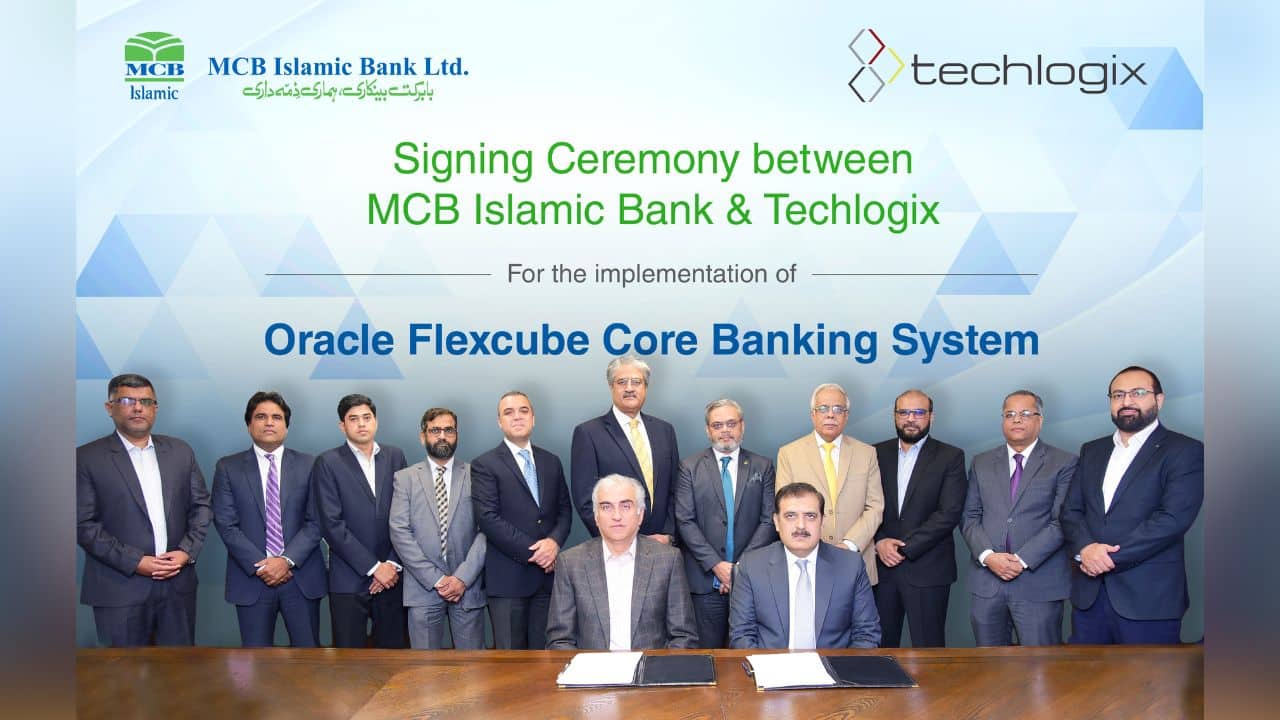
The newer venture did not erase Techlogix’s work. In May 2024, Akhtar participated in the signing of a partnership with MCB Islamic Bank for an Oracle Flexcube core banking upgrade. The group photograph is a familiar corporate tableau: executives, folders, a backdrop large enough to explain the occasion from the next room.
It is also a useful picture of continuity. Digital lending depends on what sits underneath the customer-facing experience. Accounts, transactions and the systems that maintain them keep doing their work after a launch announcement has disappeared. Akhtar’s two roles span those foundations and the newer services being built upon them.
His public work has extended into governance as well. He joined Pakistan Petroleum Limited’s board as an independent non-executive director in September 2017; its 2018 reporting identified him as chairman. That is a historical appointment, and another example of a career involving established institutions alongside software entrepreneurship.
In September 2025, he joined an underwriting discussion recorded at Money20/20 Middle East with ValU’s Walid Hassouna and Tarabut’s Abdulla Almoayed. The subject was how lenders can use changing financial information to understand risk and serve smaller businesses. The setting had shifted to a regional fintech stage; the underlying problem remained recognizable.
What the numbers mean to someone buying stock
AdalFi’s 2021–2026 impact report puts company-reported credit enabled through partner banks above PKR 110 billion. It reports 68,760 first-time formal borrowers and a 0.2 percent rate of defaults more than ninety days overdue. These are the company’s figures for its reported book, with their own definitions and reporting period.
The scale brings a different question into view. Can a system continue recognizing customers who fall between conventional lending categories as the portfolio grows? The report’s first-time borrower count is especially relevant to Akhtar’s original problem. It measures people entering a formal credit relationship, rather than simply more activity among people who already had one.
The name AdalFi contains its declared ambition: “Adal” means justice, while “Fi” stands for finance. Akhtar has spoken about extending the approach beyond Pakistan and serving small businesses that are banked yet poorly served by credit. In that aspiration, the account holder already has a relationship with an institution; the institution needs a better way to understand it.
There is an appealing modesty to the mechanism. Money coming in, money going out, a business continuing to trade: ordinary financial life becomes evidence worth examining. For Akhtar, the engineering challenge is to make that evidence useful at institutional scale. For the wholesaler, it was enough to make expansion possible. He brought the thank-you himself.
Company-reported figures, accessed October 2026. Credit enabled is lending by partner banks, not AdalFi’s own lending balance sheet.
Read, listen, follow
- Techlogix biography
- Techlogix’s product timeline
- Salman Akhtar on LinkedIn
- The Gilgit story and 2023 interview
- 2019 technology interview
- The 2008 implementation article
- 2025 founder interview
- AdalFi’s company and team
- 2021–2026 impact report
- MCB Islamic Bank signing coverage
- Listen: underwriting at Money20/20
- Watch: AdalFi funding coverage on YouTube