At Burque, a distributor of Nestlé products in Pakistan, the working day once had an awkward second act. Sales agents returned from their rounds and waited at branch offices while their orders entered the system. The selling was finished. The information still had a journey to make. In TLX Mobility’s account of the project, end-of-day data capture took six hours. After its software arrived, it took less than one. There is a useful way to think about that change: the company had found time hiding inside a queue.
TLX Mobility, a Techlogix subsidiary, makes enterprise software for precisely this territory: the distance between work happening and an organization knowing about it. Its TMX platform connects people holding smartphones to the business systems waiting behind them.
- The job: capture orders, applications and inspection records where the work happens.
- The buyers: distributors, consumer brands, lenders and industrial operators.
- The useful trick: keep working offline, then synchronize when connectivity returns.
The order has two journeys
Distribution involves moving goods and moving knowledge about those goods. A truck can reach a shop while the office remains remarkably poorly informed. Which products were available? Which promotion applied? Was payment collected? An order recorded without current warehouse stock can become tomorrow’s cancellation.
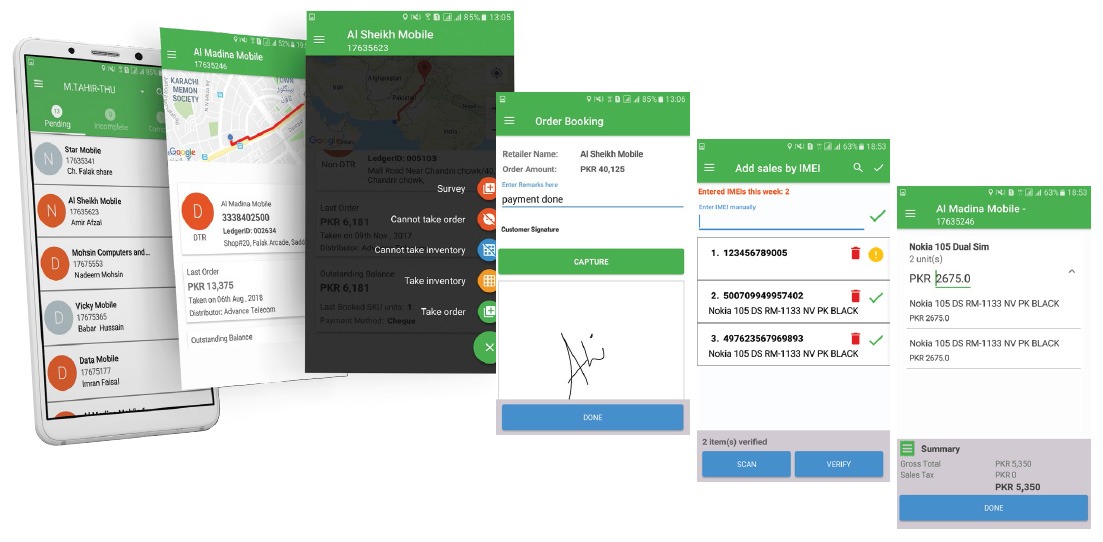
TMX Sales & Distribution handles the sequence from order booking through delivery, invoicing and collection. Field agents use mobile apps; managers use a web portal. Inventory, returns, distributor claims and retailer ordering sit alongside sales activity. The ambition is practical: give each participant enough information to finish the transaction.
At Burque, TLX connected Android devices to Oracle ERP. Orders travelled inward; prices, promotions and stock availability travelled outward. The case study reports a 20% improvement in order execution efficiency. Crucially, an agent could store transactions locally when a connection disappeared. A rural sales route did not have to stop where the signal stopped.
One transaction, carried through the business.
Even the empty bottle counts
Consider a less glamorous distribution problem: the bottle that comes back. TLX’s PepsiCo bottler case study describes an empty-bottle management system for bulk water, recording deposits, returns and sales for each customer. A sale leaves a small financial and logistical obligation behind. Someone must remember it.
The same deployment supports market surveys, warehouse transfers, route tracking and Power BI dashboards. Geofencing can require a representative to be at a customer’s location. These are specific answers to daily operating problems, including manual calculations, slow order processing and uncertainty about whether a route was completed.
Perishable stock adds a clock to the calculation. TMX’s inventory module supports first-expired, first-out handling, warehouse transfers and adjustments for damaged or expired items. Claims can move through digitized documents and controlled approvals. For a distributor, a return, a broken case and an expiring product each need a different entry in the books. The mobile transaction has to survive contact with that accounting detail.

A phone with a paper trail
Phones create another version of the problem. HMD’s Nokia handset distribution involved fragmented retail channels across the Middle East, Africa and Pakistan. TLX says TMX now supports more than 30,000 retail outlets in that deployment.
Its tools include geo-tagging shops, validating sales with handset IMEI numbers and customer identification, and giving retailers a portal. That is a different level of detail from counting a representative’s visits: the individual device can be followed through a transaction.
“Our ability to capture information accurately and monitor operations across the country is being transformed completely.”Naveed Sultan, CEO of Burque Corporation, in TLX’s customer testimonial
The loan file leaves the branch
Vitas Jordan had a core banking system. Its loan origination was nevertheless largely paper based. According to TLX’s case study, more than 100 field agents across over 17 branches faced incomplete applications, physical supporting documents and overlapping responsibilities between credit and operations.
TMX Digital Lending brought application capture into the field and supporting documents onto the system. Policy checks governed submissions. Approval responsibilities followed a defined workflow. Vitas also regrouped its loan products as part of adoption. The software project became a chance to simplify the process itself.
TLX reports approval turnaround falling from three or four days to roughly one. That is a customer case-study result, rather than a promised outcome for every lender. The mechanism matters: fewer incomplete submissions and clearer handoffs give an application fewer places to wait.
A services company makes a product bet
The corporate history helps explain this attention to handoffs. Techlogix dates to 1996. Its founders, Salman Akhtar and Kewan Khawaja, both studied at MIT. In 2015, the parent reconsidered its services business and began investing in its own cloud software products. TLX Mobility launched in 2016.
Its business model combines enterprise SaaS with implementation and integration work. Microsoft Azure underpins its cloud offering, while deployment options include private cloud and on-premises environments. The product line also covers field inspections: TLX describes an Al Khorayef Petroleum deployment with multilingual workflows and offline data capture across several regions.
Buy the handoff, then measure it
TLX’s current website also describes AI tools for shelf-image analysis and van-loading optimization. Their appeal follows the same operating logic: turn information collected on a route into a useful next action. Buyers still need to test those capabilities against their own stores, products and data.
TLX operates in a crowded market. FieldAssist and BeatRoute also combine sales-force automation with distributor management. Salesforce offers offline retail execution. Offline access alone therefore offers little distinction. TLX’s case for consideration rests on its particular integrations, operational detail and experience spanning distribution, lending and inspections.
The bill needs the same operational scrutiny. Evaluate subscription, configuration, integration, devices, training and support together. A buyer should ask for the total deployment cost and measure it against a concrete delay, such as time spent entering orders after a route.
The lesson to copy is straightforward: trace one transaction from capture to completion. Find every re-entry, queue and missing document. Then test whether the mobile workflow actually removes them. Offline capability still requires eventual synchronization; bad inventory records still need correction; approval rules still need owners. A business with little fieldwork or few repeated handoffs may have little to gain. For the right operation, the prize is wonderfully ordinary: finish today’s business today.
Follow the work
Explore TLX’s products and the operating details behind its customer stories.