Consider the modest act of recording a doctor’s visit. A representative enters a name, a conversation, perhaps a follow-up. Somewhere else, a brand manager studies sales. Somewhere else again, somebody updates the doctor’s workplace. Each person has information. The interesting question is whether they are describing the same world. Proxima Research has built its business around connecting those views, supplying pharmaceutical companies with the records, software and research needed to plan commercial activity and then examine what happened.
- The ingredients: healthcare directories, pharma CRM, market audits and analytics.
- The buyers: pharmaceutical teams, pharmacy chains, distributors and institutions.
- The useful lesson: test one working process before exporting it across countries.
A directory with consequences
The company’s Axioma database contains information about physicians, pharmacies and healthcare institutions. Proxima describes daily validation, duplicate checking and a combination of automated processing and human review. It also offers matching and cleaning when customers move from another provider. That sounds like housekeeping. In a sales organization, housekeeping determines whether a carefully planned visit starts at the right address.
The documentation makes the work pleasantly concrete. An administrator requests an Axioma package by country, language, region and institution type, with optional filtering by professional position. Records become available to users who have permission to see them. Behind the broad promise of better engagement sits a more practical proposition: give the right employee a usable list of the right people.
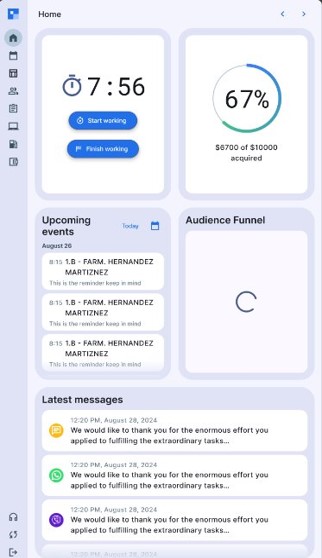
Cloud CRM supplies the working environment around those records: visit planning, activity reporting, presentations, consent management and other field tasks. GeoForce addresses territory planning. Omnichannel tools connect communications across channels. The appeal is the relationship between these functions. A directory supplies context for a visit; the visit supplies information for the next decision.
The Spanish test: 118 people
Adamed Spain gives that proposition a useful scale. The pharmaceutical business needed a CRM for more than 100 users, integration with sales information and IQVIA’s OneKey database, and a system suited to Spain’s market. Proxima’s published case describes a Spanish-language implementation, full data transfer and workflow tools. It reports 118 active users and three years of continuous use.
OneKey is the revealing detail. Proxima sells its own healthcare directory, yet this customer case connects its CRM to another provider’s data. Buyers do not necessarily arrive with empty cupboards. The ability to work with what they already use can matter as much as the list of products a vendor would like them to buy.
Three years of continuous use reported
This places Proxima among specialized suppliers serving pharmaceutical commercial operations. Veeva offers another life-sciences CRM route; broader enterprise platforms such as Salesforce offer configurable alternatives. Proxima’s pitch combines sector-specific workflows, healthcare data and implementation services. The customer’s real comparison concerns the fit of that combination, including the cost of connecting it to existing systems.
A pilot earns its passport
Grindeks illustrates the expansion process. Proxima’s case describes a successful Kazakhstan pilot involving CRM and Axioma, followed by a contract with the group’s Latvian headquarters and a global tender. The subsequent project included CRM implementation in 12 European countries and Axioma usage in five. A local working relationship became evidence for a broader purchase.
- 01Kazakhstan
Test the workflow - 02Group tender
Earn the expansion - 0312 European countries
Deploy the CRM
Acino provides a different trigger. Its published case says the pandemic created an additional need to integrate remote communication with MedAcino, an educational and information portal for healthcare professionals. Proxima connected CRM, Axioma and its OCM communication platform with that portal. Pilots were used to configure the processes before implementation. The change was specific: registration and remote interaction had to join the existing commercial workflow.
The copyable part is the sequence. Choose a process small enough to test, configure it with the people doing the work, and establish the integrations before expanding. These cases support that approach. They do not establish that software alone caused a sales increase, and adoption figures should not be mistaken for measured financial returns.
What the seat price buys
Proxima’s live CRM pricing, checked on October 21, 2026, lists Basic at $57, Advanced at $88 and Enterprise at $124 per user per month. Advanced adds marketing functions, including a digital journey builder and webinars; Enterprise adds territory alignment and sales-plan allocation. Custom organizational offers are available. The public seat price is useful arithmetic, but it does not specify a particular customer’s complete rollout budget.
The wider business also sells data access, research, business intelligence implementation and consulting. This makes Proxima a software-and-services supplier with several entry points. A pharmaceutical team might need cleaner reference records, a replacement field system or help interpreting a market. Those are related purchases, with different implementation demands.
The number behind the number
Market measurement completes the picture. Proxima supplies retail audits, promotion research through PromoTest and prescribing research through RxTest. Its October 2026 Kazakhstan analysis offers a neat example of why separate measures matter: first-half market value rose 1.2% in tenge, while consumption fell 16.2% in packs. A larger money total can accompany fewer packs sold. Reading only one number changes the story.
“We combine technology and research to achieve tangible success for our clients.”Proxima Research’s stated Results value
The newer tools extend that ambition. PharmXplorer AI works with prepared analytical datasets and queries. AI MedRep Trainer lets representatives practice text or voice conversations with simulated doctors, then receive scoring across nine criteria. One of the available personalities is a skeptic. Even the imaginary customer wants a better explanation.
For buyers, the useful questions remain concrete: does the data cover their territory and specialties, can existing records be matched, and will employees use the configured workflow? Poor coverage, incompatible systems or weak adoption would undermine the proposition. Proxima’s distinctive idea is that commercial decisions improve when records, activity and market evidence can be considered together. Its customer cases show the patient work required to make that possible.