Two hours is long enough for a software problem to become somebody’s daily routine. At a national healthcare benefits administrator, claims processing took 120 minutes. Enrollment depended on files acquired from multiple outside sources. Errors were common. The in-house development team had tried to solve the problems, without success. Then Aperia changed how the files arrived, how they were checked, and how their progress could be seen. The company reports that claims processing fell to eight minutes.
- The work: connect operational data, legacy software, and the people who use them.
- The buyers: payment institutions, government agencies, healthcare administrators, and port operators.
- The proposition: branded SaaS products plus the engineers to make the connections work.
- The lesson: inspect the handoffs before buying another dashboard.
That modest-sounding intervention is a good introduction to Aperia. The Dallas company makes software for organizations whose information has accumulated across systems, departments, and acquisitions. Its origins are in payments data and reconciliation. Its present work stretches from merchant reporting to investigative case management. The recurring question is wonderfully unglamorous: why must someone do manually what the systems ought to do together?
01 / The eight-minute clue
In the healthcare project, Aperia describes software that ingested and monitored incoming files, generated processing statistics, and normalized data through a rules-based validation engine. In ordinary language, it made the inputs more consistent and the process more visible. Those are different jobs. A file can be correct and still arrive too late; a fast process can still produce something unusable.
Aperia says it scoped, designed, and delivered the solution in four weeks, at half the cost of the other bids. That establishes a relative price for this engagement, rather than a price list for the company. It also gives the story a useful shape: earlier fixes had failed; the eventual intervention addressed ingestion, validation, and visibility together.
The transferable move is to follow an item through the entire process. Where does it wait? Who checks it? Which error sends it backwards? A fast screen at the end cannot rescue a slow, unreliable journey through the middle. Aperia’s case suggests the middle was where the opportunity lay.
02 / Acquisitions leave software behind
Payments make that journey particularly complicated. An international processor in another Aperia case handled millions of transactions a day across multiple processing platforms. It wanted acquired portfolios to share a common set of applications. Corporate users, independent sales organizations, and merchants needed reporting, risk management, and customer service without having to navigate the underlying patchwork.
Aperia built a white-label SaaS layer that merged data from those sources. It connected legacy backends, including mainframes, using existing API calls and new connections where necessary. The company reports a 50% reduction in merchant support call time and an 80% reduction in new-hire training time. The customer’s acquisition history had been creating work for people answering the phone.
Company-reported results from one payment-platform integration.
There is a second kind of fragmentation: data that exists, but cannot be compared usefully. An international hotel chain had unexplained variation in payment costs and chargebacks. Aperia’s analytics work introduced property segmentation, drill-down reporting, and trends over time. It reports identifying more than 600 properties paying higher processing fees than the portfolio comparison, and a 125-basis-point decrease in discount fees. The practical gain was the ability to find the outliers and ask why.
03 / The brand on the screen belongs to you
Aperia occupies an interesting place in the payments market. It sells technology to the institutions serving merchants. Its VisionWeb platform provides a secure, white-label environment for merchant portfolios. The institution can present the experience under its own brand. Aperia supplies the machinery; someone else gets the familiar face at the counter.
The portfolio also includes CompliAssure for 1099-K management, taxpayer identification number matching, and tax reporting. Alongside the products sit custom applications, API development, analytics, consulting, and managed engineering teams. Buyers can purchase a platform, commission a connection, or bring specialists into an existing organization. This is a B2B software-and-services business built around continuing operational needs.
The choice is therefore broader than a contest between dashboards. A buyer could build internally, hire an integrator, or assemble specialist tools. Aperia’s pitch combines payments knowledge, integration work, and configurable products. The cases give that positioning substance: old backends remain in the picture, while the experience above them becomes more coherent. Its development services explicitly cover high-volume transactions, ETL, performance tuning, and platform integration.
A corporate distinction matters here. In December 2024, Aperia Compliance merged with IXOPAY. The deal announcement explicitly excluded Aperia Solutions, which continued under the Aperia brand. PCI Apply belongs to that separate compliance business. Treating the whole of Aperia as an IXOPAY acquisition would give the reader the wrong company.
04 / A payment network meets a container port
The connection between payments and port investigations becomes clearer when you look at the unit of analysis. A transaction means more when connected to a merchant’s history. An incident means more when connected to a person’s earlier activity. Aperia’s Tapestrii ICM links cases, profiles, evidence, and operational events so investigators can recover that context.
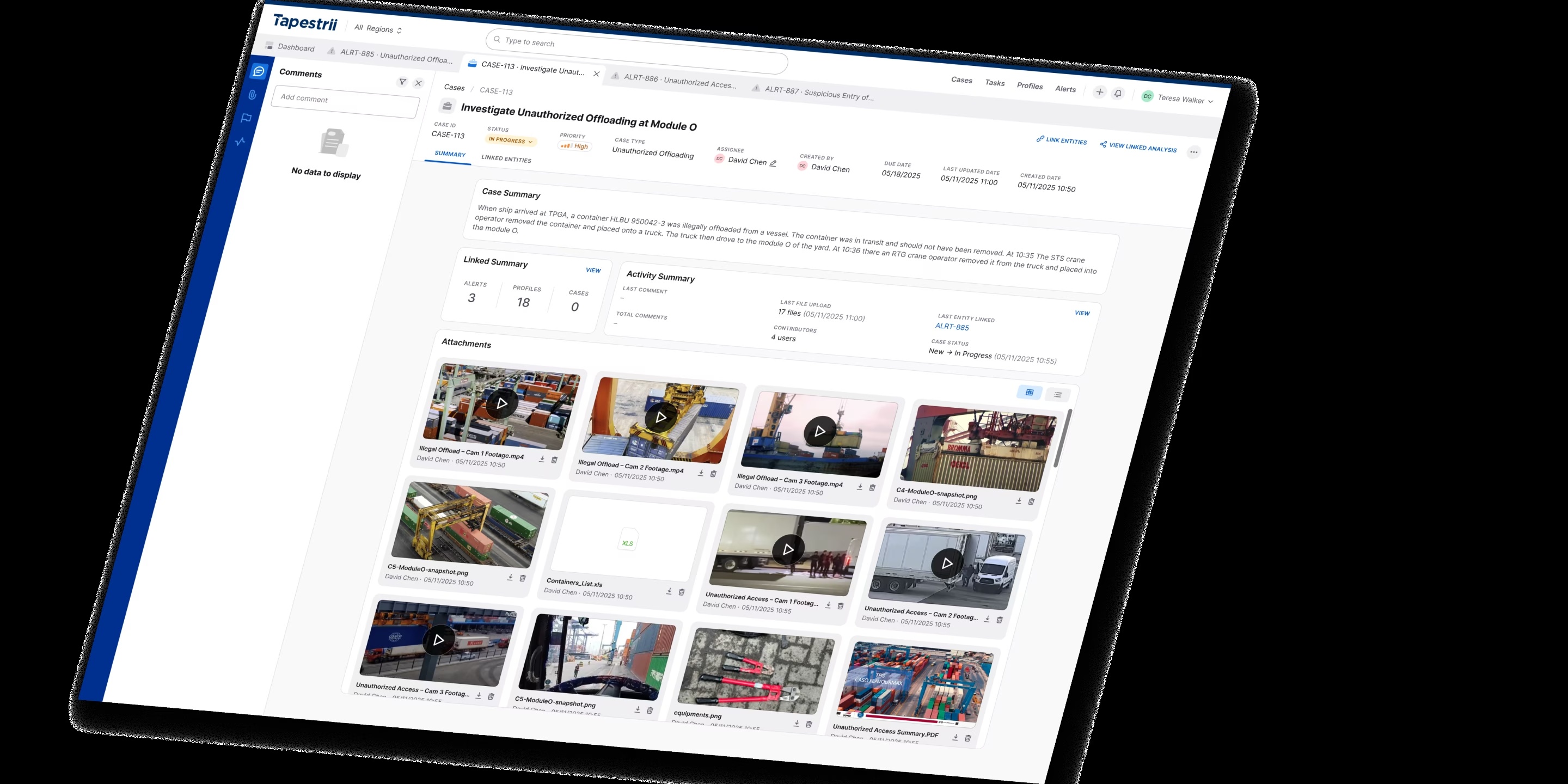
In its April 2026 port customer account, Aperia describes persistent entity profiles that carry history across cases. Another operational account focuses on replacing spreadsheet and email handoffs with tracked activities, timelines, documentation, and role-based access. The appeal is continuity: the next shift, or the next terminal, can work with the record already assembled.
“the biggest challenge isn’t a lack of data, it’s that the data lives across disconnected systems.”
James Kuykendall · former DEA Assistant Regional Director and maritime security consultant, quoted by Aperia
There is precedent in payments. The 2018 Datafusion announcement combined G2 Web Services’ merchant history and crawling data with Aperia’s transaction data. One lead reportedly exposed 22 front merchants and 28 front websites. Different records described different pieces of the same network. Bringing them together changed what could be seen.
05 / Titan is a proposition, with a waitlist
Aperia’s next merchant-management platform, Titan, extends the consolidation idea. Advertised capabilities include onboarding, merchant CRM, pricing optimization, risk monitoring, payouts, and a document repository. Its proposed AI assistant, Ask Nanci, would let teams ask questions of their data. The product page also describes Mastercard Merchant Score, Visa VAMP ratios, and ADP payout integration.
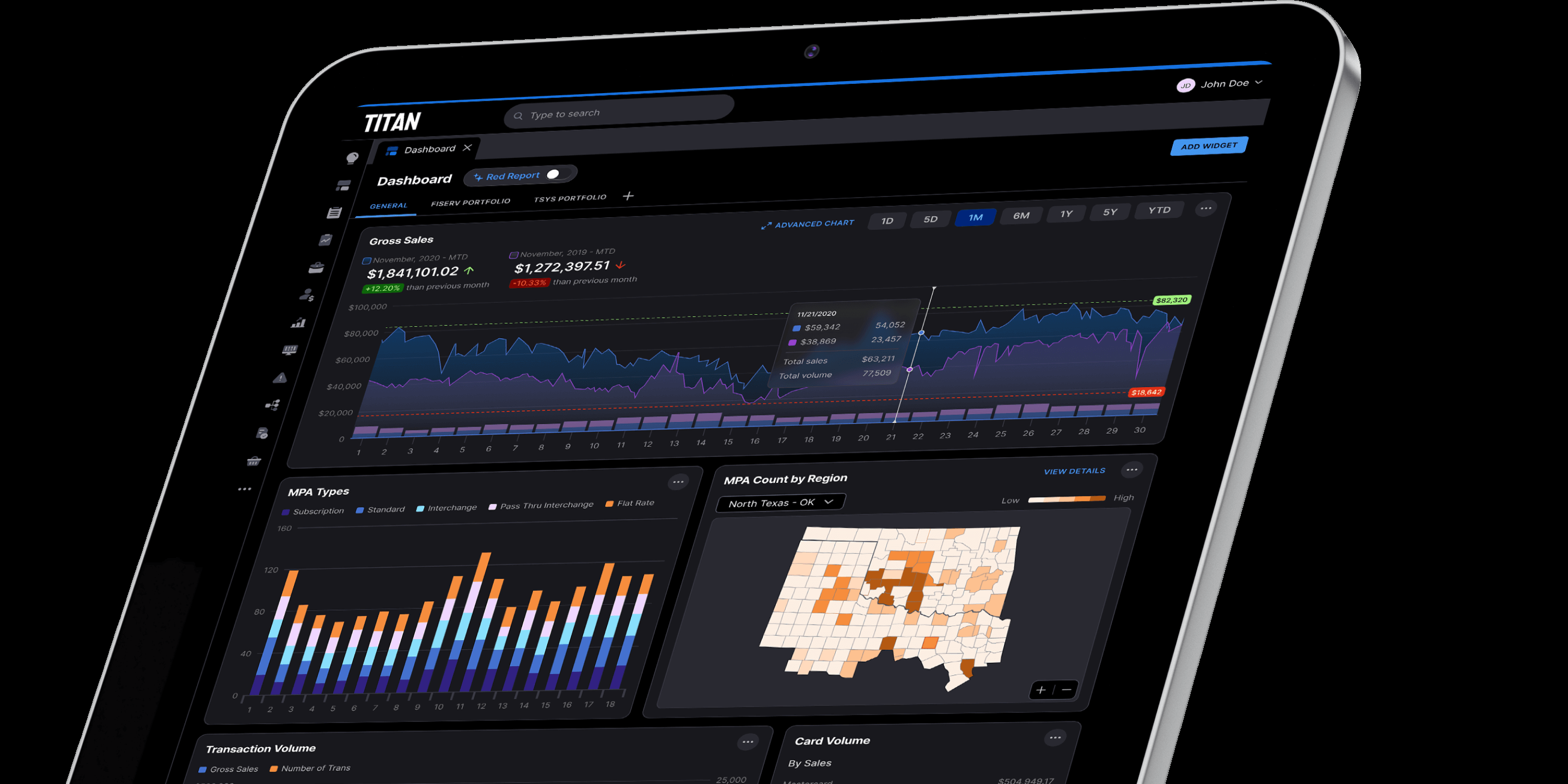
The waitlist is a useful boundary around these claims. They describe the planned offering, rather than demonstrated customer results. For an acquiring bank or independent sales organization, the sensible demo would follow a merchant from application through pricing, monitoring, and payout. Each step should carry the same identity and history. Otherwise, consolidation merely moves the handoffs into a prettier room.
06 / Copy the question before the software
Aperia’s own working process starts with discovery: business objectives, features, estimated cost, timelines, and communication. Design follows, then incremental development, QA, deployment, and maintenance. The company reports an average senior-management tenure of 18 years. That continuity fits work in which understanding a client’s systems takes time and remains useful after launch.
Its December 2025 design-team experiment offers a smaller, candid example. The team reports an average design cycle 30-40% faster after introducing AI into early concepts, prototypes, and content. It also describes imprecise visuals and inconsistent prompts, and a shared prompt library intended to improve consistency. Faster drafts still required review.
The same restraint should guide a buyer. Integration depends on access to usable records and agreement about what those records mean. A simple business already working well in one system may have little to gain from a broad integration project. An organization with disconnected records but no owner for the shared workflow can buy the software and retain the confusion. These are practical conditions for judging the approach, rather than reported Aperia failures.
The question to copy is specific: which decision is slow because the information arrives in pieces? Establish the baseline, connect the necessary inputs, and measure the same task again. Aperia’s eight-minute claims case makes the attraction plain. When the work between systems gets better, the people at either end get their time back.