Kevin Caldwell had a physics education, an economics education, and a law degree. He also had a problem that no diploma could settle: he did not want the professions that appeared to follow naturally from them. Universities are good at awarding credentials. They are less inclined to include instructions for changing your mind once you have earned them.
He enjoyed the study of law. Summer experience at law firms helped him discover that practicing it held less appeal. The distinction mattered. An interesting subject and a satisfying working life can occupy different addresses, even when the stationery suggests they ought to be neighbors.
Eventually, Caldwell began choosing by a different measure. Instead of letting intellectual interest alone determine his next move, he considered what would make him proud when he looked back on his life at ninety. It was an unusually distant horizon for a career decision. It led, through investing and consulting, to the company he still runs.
A question the degrees could not answer
Caldwell is CEO, President and Co-Founder of Ossium Health. That title can make the earlier turns look like a carefully arranged preparation. His own account leaves room for uncertainty. At each stage, he had learned something about a subject and something about himself. Those were separate discoveries.
At MIT, he studied physics and economics. Harvard Law School followed. The resulting résumé could accommodate several explanations of what he was going to become. For a while, its owner was still considering them.
He has described replacing his earlier career criterion with a search for meaningful work. It is a small change in wording with considerable consequences. Interesting work can keep a person occupied. Meaningful work asks that person to decide what the occupation is for.
“what’s the most meaningful thing I can do”
Kevin Caldwell, on rethinking his career
There is a cost to revising a plan after acquiring the qualifications to carry it out. You have to accept that an education can remain useful even when it stops supplying your job title. Caldwell’s path makes that possibility concrete. The lawyer’s training stayed with him; becoming a practicing lawyer did not.
The farm, and the habit of paying attention
Before those institutions came Tennessee. Caldwell lived in Nashville during the school year. Summers, long weekends, and holidays often took him to his grandparents’ farm in West Tennessee, roughly ninety minutes outside the city. He spent time working there and learning from them.
“I learned everything I could about living and working on the farm from my grandparents,” he recalled. That is a useful early scene in a career usually introduced through the names of universities and employers. A farm gives learning a location, a task, and people who can tell whether the task has been done.
Science also appears early in his public record. From April 2001 to July 2004, he volunteered as a team leader at the Adventure Science Center. Years later, his Harvard record included Dean’s Scholar honors in Federal Civil Litigation and Corporations.
His public profile also lists a team-leader role with Harvard Defenders. Alongside the science-center volunteering, it adds a form of participation that a list of degrees can miss. The record contains work done with other people as well as subjects studied in a classroom. There is no need to turn every activity into a rehearsal for management to see that his education extended beyond examinations.
The juxtaposition has its charm: a science center, a farm, and corporate law. None needs to be converted into a childhood prophecy. They are simply places where Caldwell spent his attention before a company demanded most of it.
Three weeks to understand a business
At Bridgewater Associates, Caldwell worked in quantitative research for global macro investing. The work involved studying economic systems. His next employer would bring him closer to the individual companies operating inside them.
He joined McKinsey in San Francisco in 2014. Acquisition diligence became part of his education: examining a business, going through its information, speaking with its people, and making a recommendation under a short deadline. He has described assignments lasting about three weeks, with days running to sixteen hours, seven days a week.
Afterward, he would take a couple of days to sleep, then begin again. Consulting has many polished descriptions. His version makes room for the pillow.
The assignments offered repeated exposure to company decisions before he had to make them as a founder. What is valuable here? What deserves another investment? Which assumptions will survive closer examination? Those questions belong to the evaluator, but they eventually follow the operator home.
His work also included growth strategy and restructuring. That range matters to the shape of his career. Before he became responsible for keeping one organization moving, he had spent time examining organizations at different stages of their lives. A compressed assignment could teach him a great deal. Founding would change how long he had to live with the answer.
A conference, a colleague, a company
In February 2015, Caldwell met Erik Woods at a conference in San Francisco. They became friends. On February 8, 2016, Ossium was incorporated, and both founders soon left their existing jobs to work on it full-time.
The dates leave a year between meeting and incorporation. That interval resists the tidy version of entrepreneurship in which an idea arrives, someone nods, and a company springs into existence before the coffee cools. Here, the record gives us a meeting, a relationship, and a subsequent commitment.
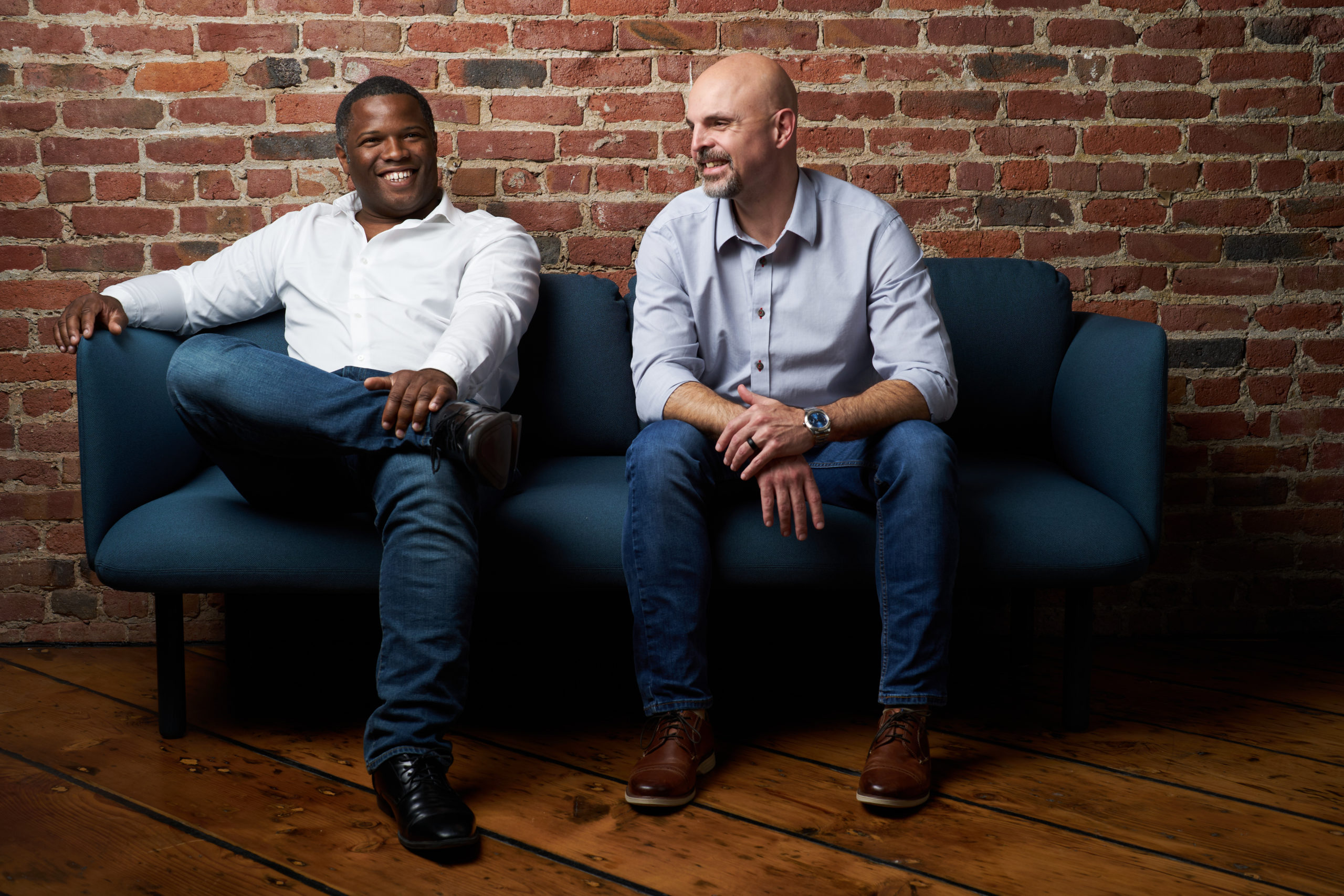
Woods brought a scientific career and previous company-building experience. Caldwell brought investment research, legal training, and consulting. Their backgrounds gave the partnership different kinds of expertise to draw upon. A co-founder can extend the range of decisions a company is equipped to make.
The partnership also puts a limit on the solitary-founder version of this story. Caldwell could bring a wide education to the table and still need someone whose experience lay elsewhere. Woods had already built and led a company before Ossium. Their collaboration connected two working histories, rather than asking either founder to provide all the expertise himself. The photograph catches them seated together; the business required them to keep working together.
By 2026, the commitment had lasted a decade. Incorporation is a memorable date because it is precise. The many decisions needed to remain in business are harder to put on an anniversary card.
- 2015A conference in San Francisco
- 2016Ossium is incorporated
- 2023$52M Series C announced
- 2026Ten years of company building
The work between the funding rounds
In July 2023, Ossium announced a $52 million Series C led by CPMG. Vivo Capital, First Round Capital, Manta Ray Ventures, Alumni Ventures, and Asahi Kasei also participated. The roster brought together investors with different backgrounds and perspectives.
For Caldwell, raising capital had become part of operating the business. Money creates room for plans to become work: recruiting people, expanding capacity, and carrying projects through the time they require. The announcement supplies a number. The organization has to decide how to turn that number into something it can keep doing.
Led by CPMG, with five other named participating investors.
Ossium’s published biography credits Caldwell with more than fifty business relationships and five successful fundraisings. Those are cumulative measures. They suggest a calendar containing plenty of conversations whose outcomes could not be settled in one meeting.
The company also has a geography. Caldwell’s public professional profile places him in the San Francisco Bay Area. Ossium’s production, quality, and research operations are anchored in Indianapolis. The business therefore exists in the distance between its public identity and the place where much of its daily work happens.
In September 2026, Ossium hosted U.S. Representative Erin Houchin at the Indianapolis facility. The visit brought public attention to the operation and its team. It was another view of the founder’s job: explaining an organization by showing people what it takes to run it.
Ten years after the change of plan
Recognition arrived from several directions in 2026. In March, Ossium announced its second appearance in three years on Forbes’ America’s Best Startup Employers list. In July, it joined the publication’s Next Billion-Dollar Startups list.
The second title looks ahead. The employer recognition draws attention to an organization that already exists. Taken together, they put expectation beside the daily experience of the people doing the work.
Caldwell responded to the employer recognition by crediting his colleagues: “This recognition is a direct reflection of our team and the culture we’ve built together”. A founder’s story can become crowded with the founder. His acknowledgment brings other people back into the frame.
That matters when looking at the long route to Ossium. The early decisions were largely about what he wanted to learn and how he wanted to spend his life. Running a company adds other people’s working lives to the calculation. The question becomes more demanding once colleagues have joined you in trying to answer it.
Caldwell’s career allows room for both revision and persistence. He changed direction after studying subjects he enjoyed. He then committed years to the organization that followed. Neither part makes much sense without the other.
The ninety-year-old looking back is still an imagined figure. Meanwhile, the company has reached ten, there are colleagues to work with, and there is an ordinary working day to get through. A distant question has acquired a very present tense.