Before Myong Lee became a founder, he wanted to find out what happened inside a company after the financial analysis was finished. He was working in New York, in mergers and acquisitions and stock research. He could study businesses. Running one was a different proposition, and it interested him enough to change his career.
A recruiter from WellCare provided the opening. Lee would be entering unfamiliar territory. The attraction was the chance to learn an industry with complicated economics, changing requirements, and consequences beyond the balance sheet. Around 2007, he took the turn that would eventually lead to Clever Care, where he became a co-founder, founding chief operating officer, and later chief executive.
Read backward, the sequence can look inevitable. Read forward, it contains a series of jobs he had to learn. That distinction makes his career worth examining. The founder did not arrive fully assembled. There was finance, then operating responsibility, then the problem of putting different kinds of experience to work in the same organization.
The attraction of the unfamiliar
Lee’s formal education gave him a business foundation: undergraduate study in business administration and economics at Franklin & Marshall College, followed by an MBA from Arizona State University. His early work involved evaluating companies and transactions. He then moved into roles where the numbers depended on relationships, agreements, and execution he helped manage.
His record includes senior responsibilities at Inspira, Clover Health, and agilon health. At Inspira, finance and operations shared space in his remit. At Clover, he worked on special projects and operations. At agilon, he led payer contracting. The job descriptions differ, but each concerns the machinery connecting an organization’s intentions to its revenue and daily work.
That is a useful apprenticeship for a future COO. A contract can look settled until someone must implement it. A financial assumption can look reasonable until a team has to deliver against it. Moving between responsibilities exposes the seams. A business rarely has the courtesy to fail neatly within one department.
“I just kept doing new things.”
Myong Lee, in conversation, March 2023
Three founders, an operating problem
In 2019, Lee co-founded Clever Care with Dave Firdaus and Hiep Pham. The early allocation of responsibilities was clear: Firdaus was CEO, Lee was COO, and Pham was CFO. The company’s founding story therefore begins with a team and complementary operating jobs, rather than one person collecting every title.
Lee brought experience in building relationships and negotiating agreements. Those responsibilities are less photogenic than a launch announcement, but they determine whether a young company can function. Founders can agree on an idea in an afternoon. Creating the organization that will carry it requires rather more diary space.
The distinction also helps explain Lee’s eventual move to CEO. He had worked across several organizational functions before helping establish Clever Care. By September 2021 he was president and COO; by June 2022 he was publicly appearing as CEO. The title changed after years spent close to the operating details.
What the money was for
In September 2021, Clever Care announced more than $71 million in Series B financing, bringing its stated total capital raised to $96 million. Health Velocity Capital led the round. Existing investors Norwest Venture Partners and Global Founders Capital participated, alongside additional backers. Lee was president and COO at the time.
In March 2023, with Lee as CEO, the company announced a $42 million Series C led by GV. Point32Health joined the financing, and the stated cumulative total reached $138 million. Karen Walker Johnson joined the board. Money, new relationships, and governance were arriving together.
Two rounds. Two points in the build.
The organizational decisions around those announcements give the numbers some texture. In March 2022, Clever Care hired Unmesh Srivastava as chief technology and digital innovation officer and Nishant Shukla as vice president of marketing. Lee connected the appointments to investment in the technology stack and marketing capabilities.
In 2023, Martina Lee Strickland joined as chief growth officer and Richard Greene as CFO, while co-founder Hiep Pham continued as market CFO. The expanding leadership group reflected an expanding set of jobs. A founder’s responsibility includes recognizing when the next stage requires people with experience different from his own.
There is a temptation to treat a financing round as the end of a business story. For the people inside the company, it introduces a fresh set of decisions. What should be built? Who should be hired? Which commitments can the organization now support? Lee’s chapter includes the appointments as well as the amounts.
At Clever Care’s 2022 Product Digital Enablement Demo Day, Lee spoke about digital innovation, workflows, and efficiency. Technology chief Unmesh Srivastava described plans for a centralized data warehouse. The event included colleagues responsible for information technology, program management, analytics, and business analysis. It provides a concrete glimpse of the work underneath an executive announcement: several specialties trying to make information more useful across the company. The participants had distinct responsibilities, and the proposed systems had to connect them. Lee’s role in that conversation fits the broader operating history: helping different parts of an organization work together.
A company has to speak to someone
Lee is the son of immigrants from South Korea. His Korean American background belongs near the center of his business story because culture and language were explicit concerns in the company he helped create. Clever Care’s identity was tied to the communities it intended to serve.
One practical expression was physical presence. In September 2021, the company announced community-center openings in Koreatown, Little Saigon, and the San Gabriel Valley. Those are specific places, with distinct local identities. They gave an organizational idea an address and people a place to have a conversation.
For an operator, a commitment to language has consequences throughout a business. It affects recruitment, written material, customer conversations, and the expectations placed on staff. A statement about understanding a community creates work for multiple departments. Keeping those departments coordinated is part of the assignment.
This is where Lee’s background in agreements, finance, and operations becomes relevant to the personal story. A culturally attentive company still needs budgets, systems, colleagues, and accountability. His career put him in contact with those different responsibilities before he took on the task of bringing them together.
A morning at the White House
On April 26, 2023, Lee attended the White House welcome ceremony during the Republic of Korea’s state visit. President Yoon Suk Yeol and First Lady Kim Keon Hee were in attendance. The occasion marked the relationship between the two countries, including the seventieth anniversary of their alliance.
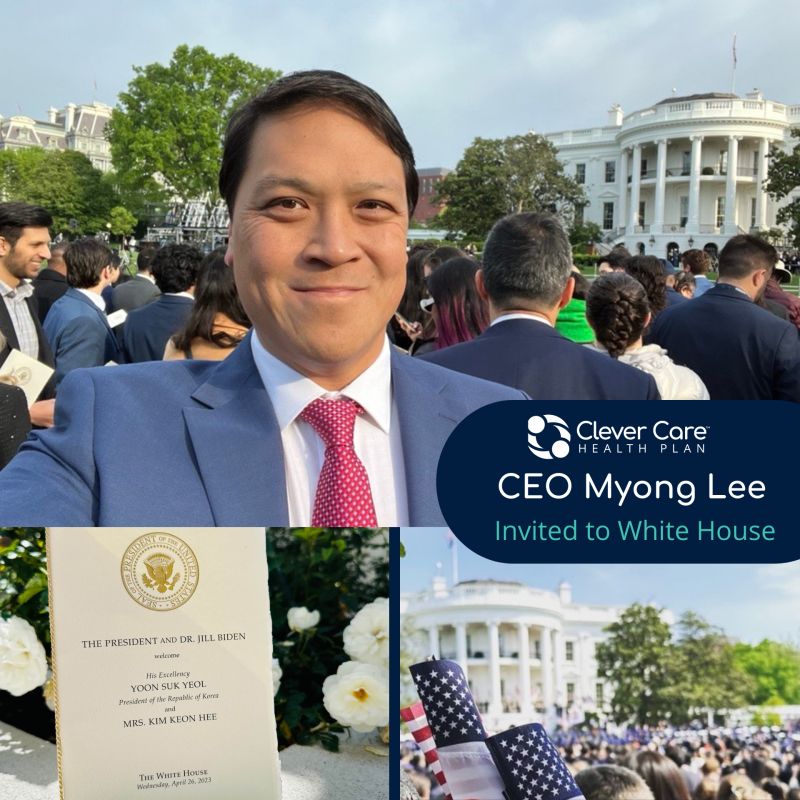
The photograph has the cheerful specificity of an actual day out: a blue suit, a pink tie, a crowd, and the White House behind him. The accompanying collage includes the invitation and a wider view of the ceremony. For once, the executive photograph comes with considerably more architecture than a headshot.
Clever Care thanked the Council of Korean Americans for making the opportunity possible. Lee had joined the council in 2020. The visit brought his professional position into the same frame as his family’s origins and his connection to a wider Korean American community.
Another, quieter detail appears in the notes for his June 2022 conversation with Beth Bierbower: he was reading The Essays of Warren Buffett: Lessons for Corporate America, edited by Lawrence A. Cunningham. Between a book about corporate decisions and a ceremony about national ties, there is room for a person whose interests extend beyond his job title.
The founder leaves; the work travels
In March 2024, Clever Care announced that Karen Walker Johnson would become interim CEO. Lee’s tenure as chief executive had ended. The company also announced changes in its operating leadership. His position in the founding story remained; the responsibility for the next chapter moved to other people.
In June, he became CEO of Seoul Medical Group, effective June 1. The appointment brought him into an organization connected with Ascend Partners and executive chair Richard Park. It was also a familiar business relationship: Lee later explained that SMG had been among the first organizations he contracted with at Clever Care.
By May 2025, he was discussing the operational work of Advanced Medical Management, SMG’s sister organization, where he was CEO. The conversation concerned fragmented software, administrative workflows, and adoption of a common platform. These are recognizable operating problems: information exists, people need it, and the route between them is unnecessarily complicated.
A partnership with Elation put technology adoption on the agenda. Lee wanted broad uptake while acknowledging the difficulty of changing established working habits. The ambition involved persuading people and improving everyday processes. Buying software can be an event. Getting an organization to use it well takes longer.
By August 2026, Lee had moved into another assignment: senior advisor at McKinsey & Company, supporting clients on strategy, operations, and acquisition diligence. The role brings his career back into contact with the analytical questions that interested him in New York, after years of responsibility inside organizations.
The August biography also described him as pursuing further graduate study at Harvard. Alongside the advisory appointment, it adds another turn to a career that has repeatedly involved learning something unfamiliar. The accumulated experience now travels into other companies’ decisions.
Lee’s story is most revealing when the titles stay in sequence. Researcher, operator, co-founder, chief executive, advisor: each asks for a different relationship with the work. He began by wanting to understand how a company runs. After helping build one and leading elsewhere, he is still finding new places to apply the answer.