Ask a founder to name his proudest accomplishment and you might expect a sale, a ranking, a number followed by several obedient zeroes. Roy Bejarano chose something harder to put in a spreadsheet: “Making talented people happy to share in my vision and be excited to come to work.” For someone whose career has passed through investment banking, company ownership and executive management, it is an unexpectedly domestic measure of success. Do the people want to be here?
There are numbers in his story, of course. In 2022, SCALE Healthcare, the firm he co-founded with Jason Schifman in 2019, placed first on Consulting Magazine’s fastest-growing firms list. Its reported revenue growth over the preceding three years was 626.76 percent. A handsome result. Also a potentially misleading place to end the story of an executive whose work keeps returning to a less photogenic question: what happens inside a business after it gets bigger?
Bejarano’s career is interesting at that junction. He has helped build a company, worked through its sale, joined a larger organization and started again. Along the way, the transaction has gradually acquired an unwelcome companion: everything that must be done afterward. Anyone can admire the ribbon. Someone has to make sure the doors open.
The education after the education
He attended the University of Manchester and Columbia Business School. His early professional life included Citigroup/Salomon Smith Barney and Houlihan Lokey, followed by the Beige Group, where he was a co-founder and chief executive. His experience before entering his present industry covered 12 years across investment banking, private equity, corporate development, consulting and asset management.
That is a useful education in how organizations are financed, valued and bought. It also gives the later career a particular shape. Bejarano did not arrive at company building as someone encountering a balance sheet for the first time. He had already spent years around the financial machinery. His next move put him on the side of the enterprise that had to keep operating once the financial arrangements were settled.
At Frontier Healthcare, he became co-founder and president, working alongside fellow founders Jordan Fowler and Oleg Gutnik. The company was organized in late 2010. By May 2013, it was reporting eight newly developed centers and partnerships with more than 90 professionals. Four locations had opened within three months. Even stripped of the celebratory language of an expansion announcement, the pace makes the operational demands apparent.
A location on a map is wonderfully tidy. Opening one requires a less tidy sequence of decisions, permissions, people and deadlines. Opening several tests whether the method survives repetition. This was the part of Bejarano’s career in which growth became something with an address, an opening date and employees who needed answers.
- 01Learn the capitalCitigroup / Salomon Smith Barney · Houlihan Lokey · Beige Group
- 02Run the companyFrontier Healthcare · Sale in April 2017 · Physicians Endoscopy
- 03Build againSCALE with Jason Schifman · Founded 2019
What survives the sale
Frontier’s sale to Physicians Endoscopy came in April 2017. Bejarano subsequently served as chief strategy officer and co-president of the buyer’s management-services initiative. He helped lead its first partnership transaction with Capital Digestive Care. The progression took him from building a regional business to working on how a larger platform would organize its next stage.
A sale is a satisfying punctuation mark in a founder’s biography. Here, the sentence continued. His responsibilities after the transaction kept him close to questions of management, ownership and integration. Those subjects recur in his later appearances: minority owners after a deal, the state of the acquisition market, the practical difficulties of running organizations across locations.
In November 2023, for example, he joined Venable partner Ari Markenson for a conversation about professional practice management. The advertised agenda included acquisitions, scrutiny of investment and operational challenges. It is a compact description of the territory Bejarano had already occupied from several directions. Money enters an enterprise with expectations. Management inherits the task of making those expectations coexist with an actual working week.
He has also worked with the Beekman Group on more than a dozen platform transaction proposals, and its biography lists him as a board member of Twin Boro Management Holdings. These connections extend the same career thread: a continuing involvement with investment decisions and the organizations expected to deliver on them.
626.76 percent, with a question attached
In 2019, Bejarano and Schifman founded SCALE. Its original proposition drew on their experience with management teams facing overlapping responsibilities. A business might need financial expertise, recruiting help, analysis and execution at the same time. Hiring advice in one department did not make the neighboring departments disappear.
The firm’s early materials laid out a broad set of capabilities, including finance, marketing, talent search, corporate development and analytics. The organizing idea was that a management problem could cross several boundaries inside a company. SCALE offered expertise across those boundaries. The name was concise enough to fit on a business card; the work behind it required considerably more room.
Reported revenue growth over the preceding three years
The ranking arrived three years after the founding. During 2022, the company also announced additional subsidiaries and an educational platform. Bejarano spoke publicly about further expansion, including an ambition to enter Europe. At that point, the business was growing both in reported revenue and in the range of activities collected under its name.
There is a temptation to let a number like 626.76 percent do all the talking. It speaks loudly enough. But a revenue-growth ranking answers a defined question about a defined period. It cannot tell us whether a team enjoys its work, whether a new department runs smoothly or whether a business has become easier to understand. Bejarano’s own definition of accomplishment leaves room for those less cooperative measures.
The founder as matchmaker
Partnerships form another recurring interest. In a September 2022 Fast Company article, Bejarano argued that strategic partnerships were an underdeveloped route to creating value. The attraction was the possibility of a relationship tailored to the participants, with benefits beyond what a conventional market transaction might provide.
That position fits a career spent between operators and investors. Buying a company is one way to gain a capability. Working with another organization is another. The second route asks a different set of questions: what can each side contribute, what makes the arrangement worthwhile and what will keep it useful after the first enthusiastic meeting?
His advice to aspiring founders places similar weight on choosing operating partners and owners. The people involved are part of the business model. It is an appealingly inconvenient observation for anyone who would prefer entrepreneurship to consist of one clever idea and a tasteful logo. Other people arrive early in Bejarano’s account, and they stay.
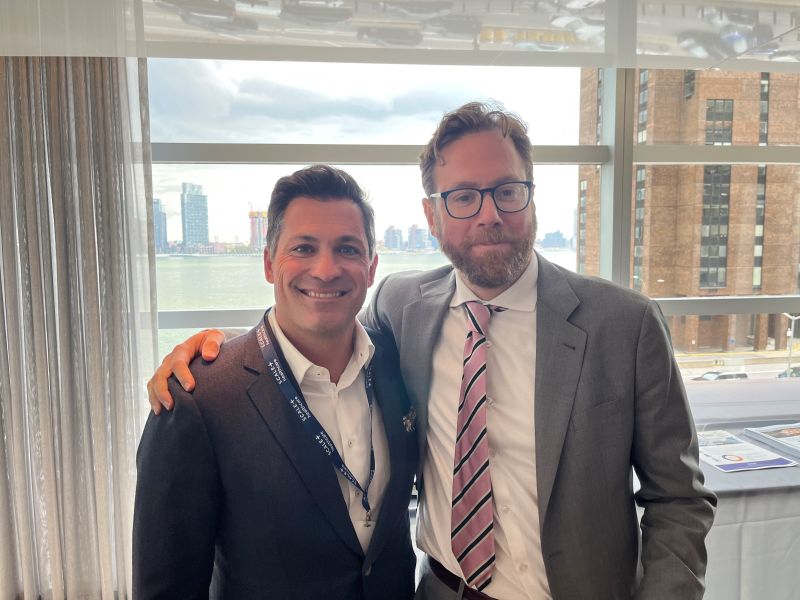
Giving the questions a microphone
Bejarano has turned some of that interest in other people into an interviewing practice. An early leadership-series conversation in April 2019 featured Andrew Welch, a managing director at Revelstoke Capital Partners. Later appearances brought Bejarano into the interviewer’s chair with executives, investors and public figures. With Schifman, he hosts the Analyzing Healthcare podcast.
The guest list includes entrepreneur Mark Cuban, investor Lee Shapiro and former senator Richard Burr. These are different kinds of authority: the founder who builds a business, the investor who chooses which businesses to back, the legislator accustomed to the constraints of public institutions. Bringing them into conversation makes the differences in perspective visible without requiring everyone to share a job description.
SCALE Community extends the format through executive roundtables, a summit and retreats. For Bejarano, the community sits alongside the operating business. The connection is easy to understand: executives have knowledge that travels poorly in a formal presentation but more readily in a discussion with someone facing a similar decision. A good question can make that knowledge available.
His appearances reach beyond friendly introductions. The November 2023 Venable discussion explicitly included scrutiny of investment. More recently, an October 2026 episode with Clearwater president Baxter Lee examined cybersecurity and enterprise value. The subject changes; the attention to what can go wrong inside an organization remains recognizable.
A smaller word for a larger ambition
By 2026, Bejarano was describing SCALE’s commercial work in more focused terms, with an emphasis on billing operations and artificial intelligence, alongside the executive community. In an interview recorded at a McGuireWoods conference, he returned to a basic management test: do leaders understand how their departments are performing? Expansion could leave that understanding behind.
“You can scale well and you can scale poorly.”
Roy Bejarano, in conversation with Stewart Gandolf
Read against the 2022 ranking, the observation adds a useful complication. An executive can celebrate expansion and still insist on inspecting it. Bejarano’s career has repeatedly taken him into that inspection: from finance to ownership, from a sale to a larger management role, from broad advisory work to a more focused operating business.
In a conversation with Paul Dio about legacy, he framed entrepreneurship around useful contribution and the value a business creates. That is an aspiration, rather than a trophy one can place beside the growth award. It requires the work to keep justifying itself. For Bejarano, the next company, partnership or conversation becomes another opportunity to try.
His shorter advice to founders supplies the less ceremonial ending: “prepare to give up weekends.” It is a dry little bill presented after the vision. The ambitious founder gets the idea, the partners, the company and, if things go well, a ranking. Monday still expects him.