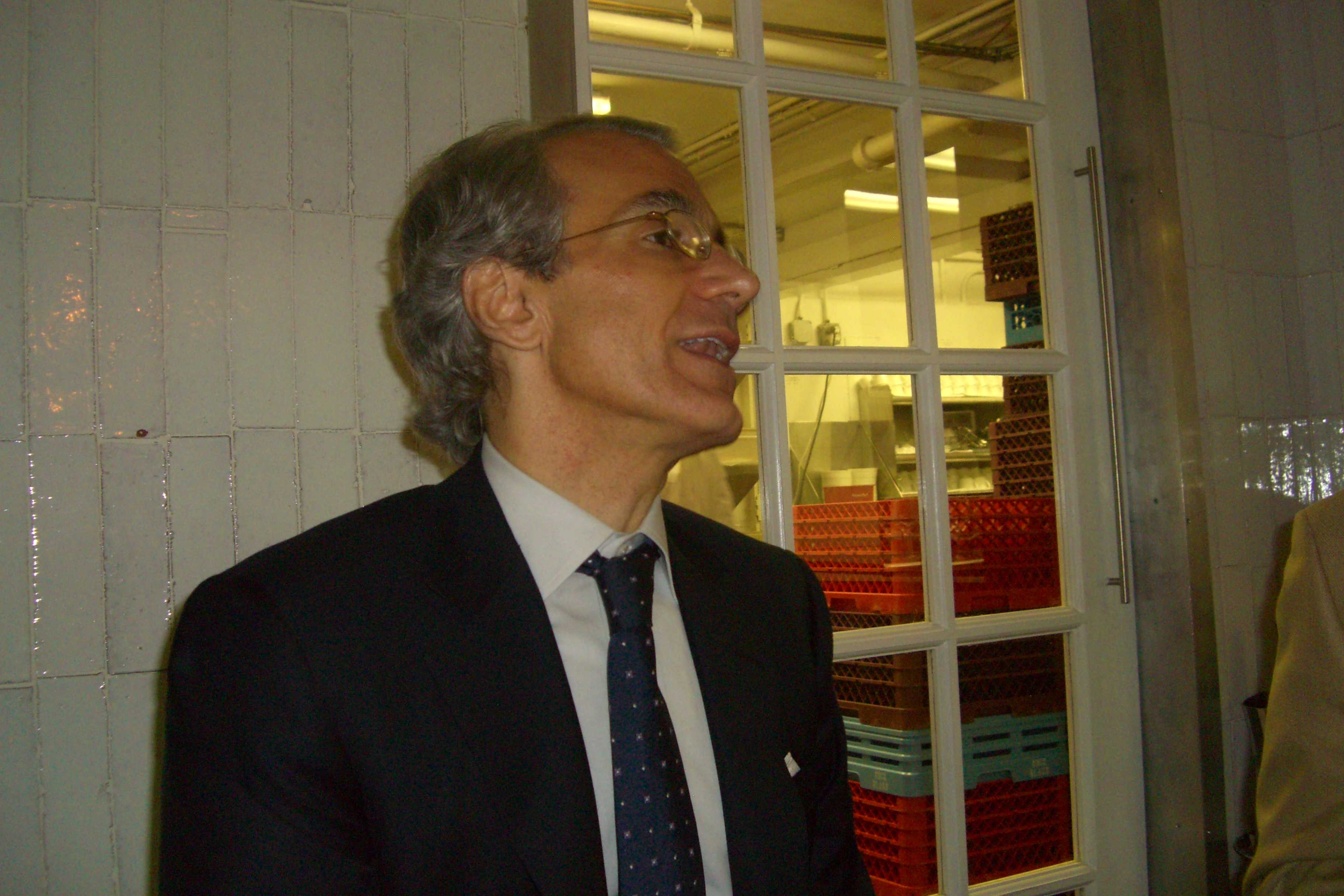
In February 2008, Esther Dyson photographed Giovanni Colella beside a window, wearing a suit and tie, caught in conversation. She called the picture “free at last!” He had recently left McKesson to run another startup. There is a pleasing economy to that caption. It gives a corporate departure the air of an escape, and a new company the promise of open country.
Castlight Health would be founded that year. Colella would lead it through an initial public offering and remain its CEO until 2017. But the photograph catches him before those events have arranged themselves into a résumé. He is between things. For someone whose working life has involved so many beginnings, this is a useful place to meet him.
Founders tend to acquire tidy biographies. Every earlier experience becomes preparation; every detour turns out to have been a shortcut. Colella’s own accounts leave room for a less orderly life. There were artistic ambitions. There was an immigrant’s difficult first year. There were companies sold, companies started, and mistakes he now describes with considerably less ceremony than a corporate biography would permit.
The first ambition had no boardroom
Colella grew up in Milan. His father was a photographer, and art had a place in his early imagination. He once thought he might become a professor of history or aesthetics. The young person in that picture of the future would have spent his days considering how people understand the world, perhaps with fewer fundraising meetings.
He arrived in the United States in 1984. New York did not immediately roll out a welcome carpet. He has recalled limited English, knowing nobody, and working as a waiter and taxi driver. The city did offer compensations: jazz clubs and opera. Even in the awkward business of finding his feet, he was finding things worth staying for.
There is nothing inevitable about the distance between driving a taxi and running a listed company. Describing the two as stages on a single ladder makes the ladder look suspiciously well designed. His recollections preserve the uncertainty: the plan to stay for a few years, the difficulty of being new, and the gradual discovery that the temporary stay had become a life.
His education eventually included an MBA at Columbia Business School. His business career included Boston Consulting Group and senior positions at Sapient and SAI. Those are recognizable entries in a conventional executive biography. They sit alongside the less conventional ones: the would-be aesthetics professor, the newcomer navigating New York, the person whose interests never became entirely corporate.
Six years between the idea and the ticker
Before Castlight came RelayHealth, where he served as founder, president and CEO from 2000 until its acquisition by McKesson in 2006. That gave him experience of taking a company into a larger organization. It also puts Dyson’s 2008 photograph in context: he was leaving an employer that had bought a business he had built.
For Castlight, the founding group included Todd Park and Venrock’s Bryan Roberts. Colella took the CEO role. A founding team is worth naming in full, particularly in a story about a person who has repeatedly credited the people around him. The familiar shorthand of a single founder can make company building sound like an unusually complicated solo hobby.
The calendar gives a more grounded account of the work. Castlight was founded in 2008, started building its first product in 2009, and completed its first customer sale and implementation in 2010. Substantial investment in sales and marketing followed in 2012. The public offering came in March 2014. The milestones were separated by years of work that a stock chart cannot display.
The completed offering brought approximately $185.6 million in net proceeds into Castlight. That figure matters because it describes resources available to a company, after underwriting discounts, commissions and other expenses. The prestige of going public is easier to photograph. The money left after the expenses is rather more useful when there are people to pay.
A public offering changes the audience for a founder’s decisions. Customers, employees and early investors are joined by public shareholders. A company’s promises acquire a reporting schedule. Colella’s Castlight years crossed that boundary: he led the business when it was being assembled and when its results had to be explained in public filings.
The prospectus set the offering price at $16 a share and described two classes of stock. Their economic rights were the same, but voting rights differed in specified circumstances. Even at the moment a company opens itself to public ownership, someone has to decide how control will work. The architecture behind the celebration can be as consequential as the celebration is memorable.
Returning to the beginning
In April 2017, Colella became Castlight’s executive chairman and John Doyle became CEO. The board described the value of Colella’s historical knowledge of the business and his executive and financial experience. The change gave him a different seat at a company he had helped establish nine years earlier.
That same year, he co-founded OODA Health. Seth Cohen, an early Castlight employee, was among his partners. The sequence is revealing without requiring a theory about his private motives. After the founding phase, the public offering and the transition to chairman, he was willing to enter the founding phase again.
Cedar completed its acquisition of OODA in June 2021 for $425 million. An acquisition is another kind of transition: a business that has developed its own team and direction becomes part of someone else’s plans. Cedar welcomed OODA’s employees and clients and set out an expanded product roadmap. The transaction was a company milestone, rather than a disclosed measure of Colella’s personal proceeds.
Cedar’s acquisition price for OODA Health.
Transaction completed June 2021.
His other founding work includes Brightline and Vanna Health; his current business interests also include SanLuca. The accumulation of names can make a career appear frictionless. Colella has supplied a corrective himself. In a public reflection on six companies, he set down the decisions he regretted, including hiring difficult people, accepting inflated valuations and getting too involved in his teams’ work.
He has discussed the journey from starting a business to scaling and exiting it on a TEDMED panel with Josh Stein, Juan Enriquez, Michael Weintraub and Nina Nashif. Those three stages make a useful sequence, though the same person need not do the same job throughout. Colella’s record contains examples of staying at the center and examples of moving to a different role.
The founder edits his own legend
There is a small but consequential difference between a founder admitting that mistakes happened and a founder identifying his part in them. Colella’s account takes the second route. Its subject is his own judgment. The difficult hire had seemed tempting. The financing terms had seemed flattering. The extra intervention had seemed useful. Each decision had an explanation at the time.
That is why the account is more interesting than a list of business maxims. Advice usually arrives with its awkward history polished away. Here, the adviser is also the person who needed the advice. Experience has given him material to reconsider, including decisions he might once have defended with confidence.
“I have started 6 companies.”
Giovanni Colella, reflecting publicly on his mistakes
He has spoken just as plainly about the occupational romance surrounding startups. In 2018, he rejected the idea that founders have a monopoly on long hours. Different work brings different pressures. The particular exposure of an entrepreneur, in his telling, is that the organization itself might vanish. There is little glamour in that distinction, which makes it rather useful.
He also resists the obligatory revelation scene. He did not describe a morning on which he suddenly discovered he wanted to be an entrepreneur. He described a sequence of events and the good fortune of finding people who could challenge him. That version of a career allows for luck, companionship and correction. It sounds more inhabitable than destiny.
A different chair, and room to listen
On June 8, 2026, Vanna announced that Liz Kwo would succeed Colella as CEO. Kwo had joined as president that February. Colella moved to executive chairman, retaining an active role in strategy, partnerships and governance. The announcement made the division of responsibilities explicit: the founder would remain involved while another executive led the organization.
For a repeat founder, succession is part of the work. Starting a company gives someone authority to make decisions; building an organization eventually requires deciding which decisions belong to other people. Colella’s latest transition adds another example to a career already marked by changes in responsibility, ownership and company size.
He has also been writing beyond the immediate business of running companies. In an April 2026 essay, he considered how people talk about powerful technology executives they have never met. His argument asked readers to distinguish criticism of someone’s actions from certainty about that person’s character. He brought the subject home by considering what his son learns from adult conversation.
It is an interesting concern for someone who has spent years occupying the role of CEO. A job title gives outsiders a convenient way to identify a person, while leaving much of that person’s life outside the frame. Colella’s own frame contains family, books and an enduring appetite for Italian motorcycles. In 2018, he counted five bikes and named the Ducati Multistrada as a favorite.
Poetry and opera belonged to the interval before Castlight. They deserve their place in the story after it, too. A founder can be ambitious about a company without making the company the only interesting thing about himself. The photograph from 2008 remains an apt place to leave him: turned toward a conversation, with another beginning still ahead.