A truck can cover a long stretch of Japan and still have a troublesome appointment at the end of it. The cargo belongs at a particular loading bay. The vehicle must get there. In May 2026, Kenji Nakashima put that final part of the journey into the conversation about autonomous logistics: accurate access to a bay, smooth movement through a facility and an operation that joins those tasks to the highway trip.
It is a fitting destination for a career spent around the business of software. Nakashima is Applied Intuition’s Japan Automotive & Business Lead and an executive officer of Applied Intuition G.K. His earlier work took him through Oracle Japan and Google. Automotive customers run through those chapters, connecting enterprise systems, maps, cloud computing and the software now being developed for moving vehicles.
The place that brings this work into focus is Heiwajima, in Tokyo’s Ota district. Applied Intuition joined other autonomous driving businesses in a council based at Tokyo Distribution Center. Here, the discussion has a location and a use: companies can conduct demonstrations, gather data and work on areas where cooperation makes sense. A freight facility gives an ambitious technology a very practical set of errands.
Before the truck, the automotive customer
Nakashima’s automotive work predates his arrival at Applied Intuition. At Oracle Japan, he had global responsibility for strategic customers in the automotive industry. At Google, he worked on business development involving enterprise Google Maps and Android Auto, then on building Google Cloud Platform business with enterprise customers. Different products; a recurring industry.
By 2018, his responsibilities covered western Japan, including Osaka and Nagoya. That March, he was the overall host for a Google Cloud executive summit at InterContinental Osaka. The programme put cloud technology, customer examples and business discussion together in an evening aimed at executives. His contribution was part of a setting designed to bring the platform into a company’s decision-making conversation.
Other appearances give that period texture. In July and August 2018, programmes for Google seminars in Osaka and Nagoya listed him introducing Google’s culture and ways of working. In November, an Osaka event organised by OGIS-RI listed him as Google Cloud’s western Japan sales lead, presenting the platform’s latest developments and local activities. The calendar shows a business leader moving between product discussion and the organisations expected to use it.
The cloud years had a public stage
In 2019, Nakashima appeared on the programme for Hiroshima IT Expo as a Google Cloud Japan leader responsible for western Japan within the manufacturing and industrial business. His opening seminar addressed the relationship between corporate culture and cloud technology in digital transformation. The description promised concrete examples of helping customers innovate and develop their businesses.
That same year, a Nagoya digital innovation programme listed him in a keynote about business uses of AI and machine learning, including efficiency through Cloud AutoML. These were organised presentations for business audiences. They placed technical products alongside the question of what a customer could do with them.
Those details matter because a modern job title can make an older career look as though it began yesterday. Nakashima’s current work in vehicle intelligence follows years of automotive business development and enterprise technology discussions. The vocabulary has expanded. The earlier programmes already show him working where a software company’s offering meets another company’s plans.
“We are hiring in Tokyo!!”
By 2022, Nakashima had moved into APAC sales leadership at Applied Intuition. His current public title places Japan’s automotive business at the centre of the role and also identifies his executive position in the Japanese entity. The company connects his Tokyo base with an international vehicle software business. His public posts move between Japanese explanations and English messages, directing readers to product information, career opportunities and gatherings where automotive executives can hear from software industry participants.
His own posts offer glimpses of the work around that title. In March 2024, he shared a Tokyo office event featuring a fireside chat with Applied Intuition CEO Qasar Younis. The discussion covered autonomy, AI, Silicon Valley and career advice. Nakashima’s accompanying message was delightfully economical: “We are hiring in Tokyo!!”
We are hiring in Tokyo!!
Kenji Nakashima, March 2024
The double exclamation mark does a little recruiting of its own. The post sends readers toward a team and a place to join it. Around a conversation about autonomous systems, there is the familiar business of making introductions, gathering people and opening the door to the next colleague.
He also celebrated Applied Intuition’s appearance on a Nasdaq billboard following its Series E funding announcement. In his accompanying English message, he linked the funding to delivering customer value through products and engineering. The public celebration had a destination beyond the photograph: the work the company intended to do for customers.
When Applied Intuition announced its off-road autonomy stack, his response led with pride in the teams and congratulations to the people who had worked on it. He provided a Japanese product link and pointed readers toward hiring. In a short post, a product launch became an occasion to recognise colleagues, explain the offering and invite people into the company.
Fourth from the left, with company
On May 22, 2025, the Heiwajima Autonomous Driving Council formally launched. Nakashima represented Applied Intuition at the ceremony. The gathering included representatives of Turing, Sony Honda Mobility, Wayve, the Development Bank of Japan, the Japan Economic Research Institute and Tokyo Distribution Center. Autonomous driving development sat beside finance, research support and the organisation providing the facilities.
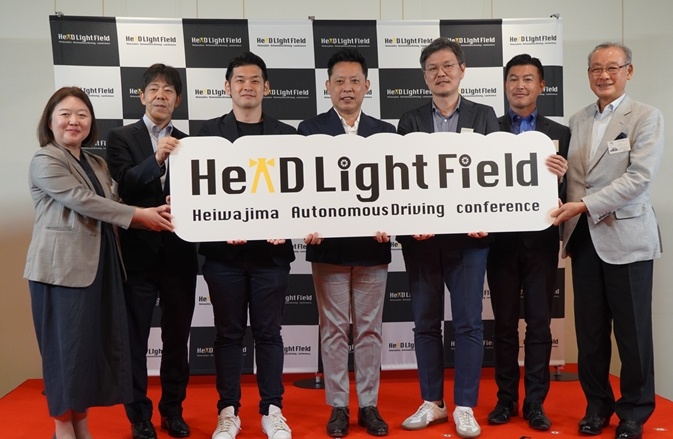
The ceremony photograph has the pleasingly ordinary choreography of a business occasion: seven people holding a broad sign between them. Nakashima stands in the middle, fourth from the left. It is a useful image for work that depends on several organisations participating in the same undertaking. The sign requires rather more hands than a software demonstration.
At the launch, he spoke about working with different companies to help solve social challenges. The council’s purpose includes demonstrations at the site and cooperation among autonomous vehicle developers. Japan Economic Research Institute handles the secretariat; Tokyo Distribution Center provides and operates the facilities. These are specific roles in a shared effort, rather than a single company’s project wearing several name badges.
A railway station becomes an invitation
Nakashima’s public communication also extends beyond conference invitations. After the 2026 People and Cars Technology Expo in Yokohama, he thanked visitors to Applied Intuition’s booth and described a promotion at nearby Minatomirai station. Applied Intuition Japan had used the station to make the company more visible during the exhibition.
He explained the aim in straightforward terms: he wanted a wider group of Japanese engineers to know about Applied Intuition and its work with the industry. An exhibition booth asks someone to enter a hall and find you. A station promotion catches people on the way. In this case, the software conversation began beside the journey to it.
It sits comfortably beside his earlier invitations to industry events. In 2023, he encouraged automotive executives and other participants to attend Applied Intuition’s Intersect gathering in Silicon Valley, pointing toward discussions about changing vehicle architectures. The station campaign and the executive event address different audiences, but each makes a public invitation around the company’s work.
The destination has an address
By spring 2026, Applied Intuition and Isuzu were describing a new phase of autonomous trucking in Japan: second-generation vehicles and a 450-kilometre commercial route between Tochigi and Aichi. Their public-road operations had begun in 2025 with a safety driver. The announced expansion included freight, highway driving and movement through logistics hubs.
Tochigi to Aichi: the commercial route announced by Applied Intuition and Isuzu in March 2026. Existing public-road operations used a safety driver.
The project’s description connects road data to simulation, improvements and validation before updated models return to the fleet. It also identifies the variety of environments the trucks encounter, including toll gates, intersections and low-speed hub operations. These are the companies’ engineering programmes; Nakashima’s business role puts him alongside the organisations working to deploy them.
His May 2026 comments brought that deployment discussion back to the facility. He welcomed the availability of high-precision mapping data at Tokyo Distribution Center and described further checks on compatibility and use. He also identified work with partners on operating rules and conditions. The sequence is practical: understand the setting, verify how to use it, then establish how the operation should function.
That gives his career story a clear present-tense concern. Oracle’s automotive accounts, Google’s maps and cloud business, recruiting in Tokyo, a council ceremony and a railway station campaign all belong to the professional record. Now there is another destination in view. The truck needs to make its final turn, reach the bay and put the freight where the business expects it. Arrival deserves the same attention as departure.