The prototype began with an extravagance: a phone that could throw a screen and keyboard into the world. It was a fine idea, provided one ignored the battery. Projectors wanted power, and power was precisely what a pocket computer could not spare. Soulaiman Itani did what engineers do when physics sends back a curt note. He changed the geometry. If the display could not travel across the room, perhaps it could move closer to the eye.
That adjustment became Atheer, the augmented-reality company Itani started in 2012. By the following year, he and a small team were demonstrating a mobile three-dimensional interface controlled by hand gestures, voice and head motion. In one early proof of concept, two Android phones helped create a button that could be pressed in empty air. The contraption had the cheerful audacity of a laboratory trick and the serious intent of a new computing interface.
Itani named the company for the Arabic word for ether. The name carried the thesis: digital information did not have to remain captive behind glass. It could occupy the space around us, available to a worker looking at an engine or a technician whose hands were already busy. “The digital world shouldn’t be limited to screens any more,” he said at the time. “It should be all around you and customized to you.”
A theory of motion, hiding in plain sight
The glasses were new. The underlying obsession was not. From Beirut and trained first at the American University of Beirut, Itani moved to MIT for graduate work in electrical engineering and computer science. His research lived among dynamic systems: vehicles that must reach targets, routes shaped by speed and turning limits, mathematical problems in which the shortest line is not necessarily a line the machine can travel.
His 2009 doctoral thesis, Dynamic Systems and Subadditive Functionals, sounds austere because it is. Yet its questions are physical. How should a moving system visit points efficiently? How do constraints change the answer? What can be guaranteed when a world is dynamic rather than politely still? These are close relatives of the questions that confront an autonomous vehicle. The scenery changed over his career. The mathematics kept recognizing the road.
After MIT, Itani spent several years in postdoctoral work at UC Berkeley, applying computational models to complex networks. His publication record ranged across causal structures, applied mathematics and vehicle-routing problems. The variety could look like restlessness. Itani supplies a better word: curiosity. He has written that he loves stretching his mind “in different directions.” The directions were different, but they shared a method. Observe a system. Model its relationships. Work out what it can do next.
The recurring loop
The future arrives wearing a polo shirt
At D11 in 2013, Atheer put its interface onstage. A virtual globe turned with a finger. A three-dimensional newspaper could be lifted and paged through by gesture. The demo invited comparisons with science fiction, which is flattering until customers ask when the invoice produces a return.
Itani understood the trap early. Atheer researched the market in late 2013 and early 2014 and concluded that consumers would take time, persuasion and more mature hardware. Enterprises had urgent work, budgets and outcomes that could be measured. A mechanic, warehouse employee or field technician had a practical reason to see instructions without putting down a tool. Glamour migrated from the headset to the job.
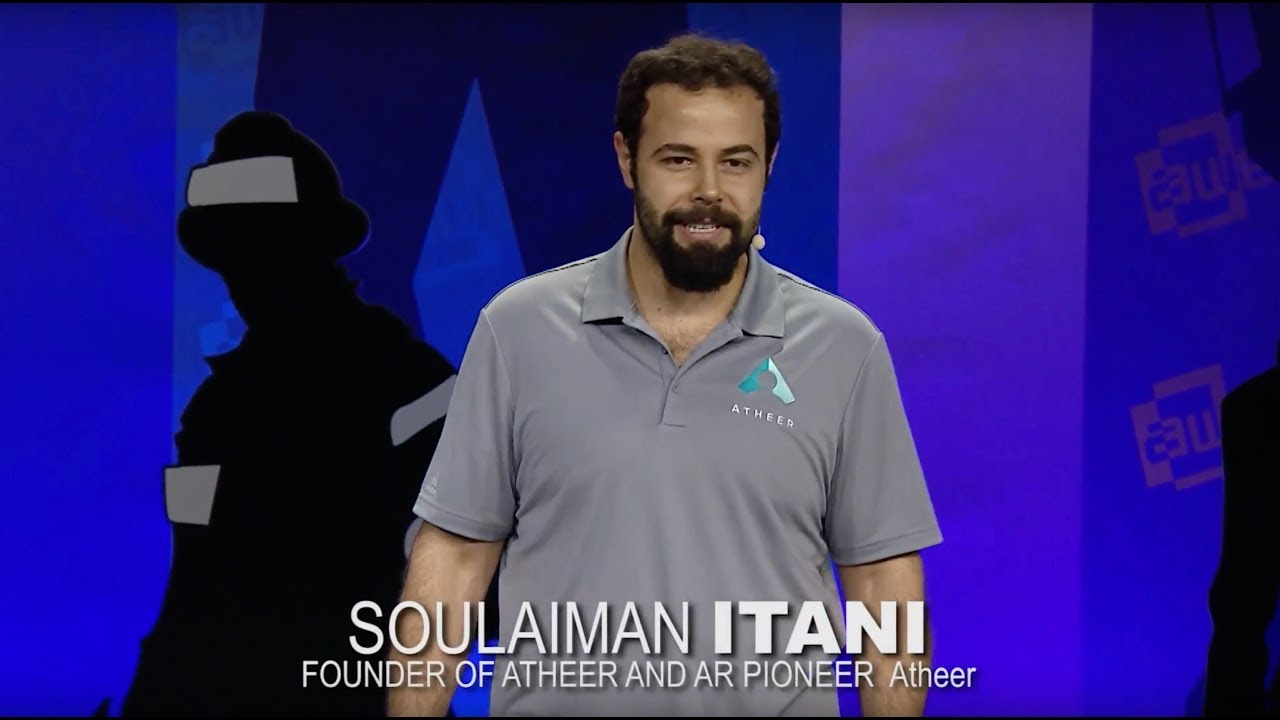
The move was consequential. Atheer stopped treating hardware as the whole business and emphasized software that could work across devices. “We are not a hardware play,” Itani said. “We are software, but there was nothing out there for us to put the software on.” Building reference glasses was therefore less a declaration of industrial destiny than a practical response to an empty shelf.
His roles shifted with the company: founder and chief executive, then founder and chief technology officer, then chief executive again. He led product and intellectual-property work, cultivated technology partnerships and helped assemble a research-heavy team. More important, Atheer learned the unfashionable discipline of fitting technology to the room in which it would be used. Factory floors are rude reviewers. They care little for metaphors and a great deal for latency, comfort and whether the instructions appear at the correct moment.
Scale changes the interface
In 2018, Itani joined Google as a software engineering manager. His work there included teams in fast-growing products and applied AI. He helped launch the first user-facing instance of LaMDA and led an advertising product through a sharp increase in revenue. These are different measures of scale: one cultural, one commercial. Both demand that an experimental system behave for people who were not in the room where it was designed.
He also accumulated connective roles. He joined boards associated with accessible vision technology, augmented storytelling and media. StoryGiants, the studio founded by novelist Lauren Oliver, presented him as its technology lead. In 2025, he announced Incantor AI with collaborators including Laura Schechter, Clifford C. and Patrick Manasse. Its first product focused on audiovisual localization and lip synchronization, using a different model architecture to make dubbed performances travel more naturally between languages.
The projects widen the portrait without breaking it. Whether the object is a gesture, a line of dialogue or a truck, Itani gravitates toward the seam between a digital model and a physical result. His preferred technology is not secluded. It must arrive in a field of view, on a face, along a road. It has somewhere to be.
MIT research on dynamic systems, routing and causal models.
Atheer begins turning free-space gestures into a mobile interface.
Google adds the problem of product and AI scale.
Incantor AI applies new model ideas to media localization.
Applied Intuition brings the work to moving machines across the Middle East.
When the computer weighs several tons
Itani now serves as General Manager and head of Middle East at Applied Intuition. The company builds software and systems for “physical AI,” the broad category that includes machines able to perceive, reason and act in the world. Applied Intuition’s tools span simulation, testing, vehicle software and autonomous systems. The company’s subject is no longer merely what a person sees through a display. It is what the machine sees, how it decides and whether that decision can be trusted before steel begins to move.
The Middle East role gives the career a geographic echo. Itani left Beirut for Cambridge and built companies and teams around Silicon Valley. He now works between that technology base and a region investing heavily in logistics, industry and autonomy. In September 2026, Applied Intuition and Saudi AI company HUMAIN announced plans to build toward thousands of autonomous trucks on key Saudi logistics routes by 2030. The collaboration contemplates later work in robotaxis, ports, mining, manufacturing, agriculture and construction.
Itani’s gloss was characteristically plain: “AI that does actual work.” It is a four-word manifesto against the floating cleverness of software that never meets resistance. A large vehicle supplies resistance abundantly. So do heat, dust, traffic, regulations, unusual road behavior and the long tail of events a simulation has not yet imagined.
Applied Intuition and HUMAIN are targeting deployment across Saudi logistics corridors by 2030, with a broader physical-AI program expected to follow.
This is where the continuity in Itani’s work becomes clearest. His doctoral research asked how dynamic vehicles should move through constrained worlds. Atheer asked how a human hand could give an instruction in three-dimensional space. Google asked how an intelligent product behaves at enormous scale. Applied Intuition asks all three at once: motion, interaction and scale, now attached to machines with engines.
The useful future is usually less tidy
There is a temptation to tell technology careers as a sequence of correct predictions. Itani’s is more instructive because it contains revisions. A projector used too much power. Consumer AR would mature too slowly. There was no hardware good enough for the software, so the company built reference devices. The dazzling interface found its earliest value not in leisure but in work. Each correction narrowed the fantasy and enlarged the possibility.
Itani describes team building with an unusually sensible boast: surrounding himself with people smarter and more talented than he is. It reads less like modesty than systems design. Hard physical problems punish the lonely-genius pose. Optics, machine learning, controls, safety, product, regulation and local operations must agree sufficiently for the machine to leave the laboratory.
Two decades after studying vehicles at MIT, Itani is again concerned with routes and constraints. Only the canvas has grown. The button in mid-air has become a truck on a national logistics corridor. The computer is no longer worn on the face. It is rolling down the road, and the physical world, as ever, gets the final review.