In Sun City, Arizona, the first invitation to ride without a driver came with modest terms. A selected group of residents could request a Toyota Sienna on weekday afternoons, travelling between designated stops. The fare was zero. The destination might be a medical appointment. An industry fond of promising the whole world had found a useful corner of it.
May Mobility began those rider-only trips in December 2023, after operating with safety personnel earlier that year. The progression is worth lingering over. A retirement community presents a transport problem with an identifiable customer: someone who needs to get somewhere, without depending on another person’s availability. For that passenger, the empty driver’s seat matters less than whether the ride turns up.
- May builds autonomous driving technology and brings it to market with transport partners.
- Its roots are in community shuttles; its next market is ride-hailing.
- MPDM compares possible traffic futures before choosing a maneuver.
- A proposed public listing brings fresh capital ambitions, alongside substantial cash consumption.
Start with the trip that matters
The instructive place to look is Grand Rapids, Minnesota. This is the rural community, not its Michigan namesake, which also hosted a May service. The goMARTI deployment’s 2023 case study describes five vehicles, three with wheelchair access, more than 70 pickup and drop-off points, and over 35 miles of roadway service. Riders could book a free trip through an app or a local telephone service.
That is a surprisingly concrete answer to the question of what autonomous transport is for. It connects residents to destinations in a place where conventional coverage can be limited. Accessibility changes the vehicle choice; weather changes the engineering; a rider without an app changes the booking arrangements. The service must survive all three. A clever driving algorithm alone does not take someone shopping.
A company born beside the test track
Founded in 2017 by Edwin Olson, Alisyn Malek and Steve Vozar, May came out of a Michigan engineering network unusually close to the problem it wanted to solve. Olson was a University of Michigan computer science professor; Malek and Vozar were alumni. Their founding roles divided the work among a CEO, an operating chief and a technology chief. The company’s expertise sits at the junction of robotics, vehicle integration and running a service people actually use.
The early proposition was fleet transport. In 2018, May began carrying Bedrock and Quicken Loans employees in Detroit. A specified route and a known employer give a young autonomous company a manageable assignment. They also give it someone to answer to when a vehicle is unavailable. Commercial experience can be a stern tutor: the passenger rarely accepts an interesting research problem as an excuse for being late.
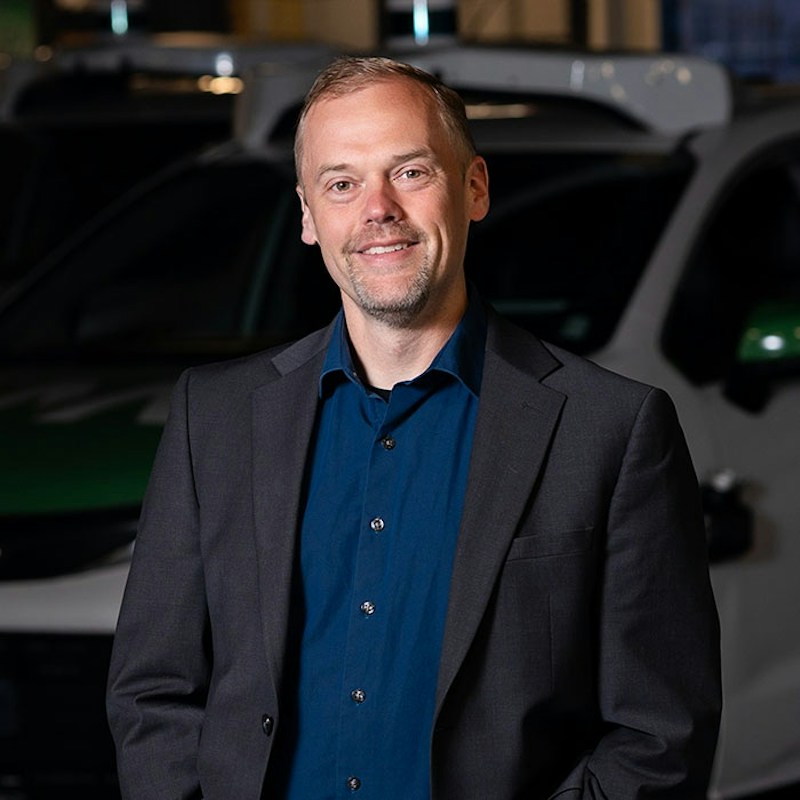
FROM ROBOTICS TO RIDESOlson’s background includes MIT’s 2007 DARPA Urban Challenge team and autonomous vehicle work at Toyota Research Institute and Ford. Photo: May Mobility.
Providence supplies the awkward chapter
The tidy version of this history would move straight from a pilot to a larger pilot. Providence deserves a place in between. May’s Little Roady shuttle service stopped in March 2020 as COVID arrived. A public evaluation describes concerns about the small vehicles and passenger proximity, and says the rationale for permanent suspension was not negotiated with Rhode Island transport officials.
The agency still had a route to serve. RIPTA put a replacement shuttle on it after two days without service. That episode supplies a practical distinction: a technology company can suspend an experiment; a transport authority inherits the missing journeys. The pandemic was an extraordinary circumstance, but responsibility for continuity is an ordinary procurement question.
Later milestones show changes in platform and market: Toyota integrations, on-demand services and eventually ride-hailing partnerships. Those changes are visible. Assigning them to a single moment of revelation would be too neat. What a buyer can take from Providence is simpler: specify who supplies the service when the autonomous fleet cannot.
Several futures, one steering wheel
May’s technical argument turns on Multi-Policy Decision Making, or MPDM. Consider its own demonstration: a car approaches a curve, another vehicle and a cyclist. The difficulty lies in their interaction. The cyclist might move left. The other car might pass. Each choice alters what a sensible autonomous vehicle should do next.
MPDM simulates possible actions and their consequences, scores outcomes for safety and comfort, and selects a maneuver. In the demonstration, easing off and moving right creates room for uncertainty. The ambition is to handle unfamiliar combinations by reasoning through them. It is an appealing idea because streets keep producing arrangements that refuse to repeat themselves politely.
the road
interactions
policies
a maneuver
Fresh observations restart the loop. Diagram explains the approach; it does not measure safety performance.
The hardware claim is equally practical. May describes using commercially available lidar, automotive radar and cameras, with a modular driving kit. It argues that its software approach reduces the burden on bespoke hardware and enormous models. That is the company’s competitive case, rather than an independently established cost advantage over every rival.
“We prioritize safety, comfort, and autonomy—in that order, and we are committed to continuous improvement on all fronts.”Edwin Olson, CEO and co-founder, September 2025
Its safety materials describe multiple layers of protection and alignment with UL 4600. Deployment still depends on an operational design domain: the conditions in which a particular service is intended to operate. A successful trip in one zone does not make every road, speed or weather condition fair game. Buyers should ask about that boundary before admiring the simulation.
Borrow the audience, supply the driving
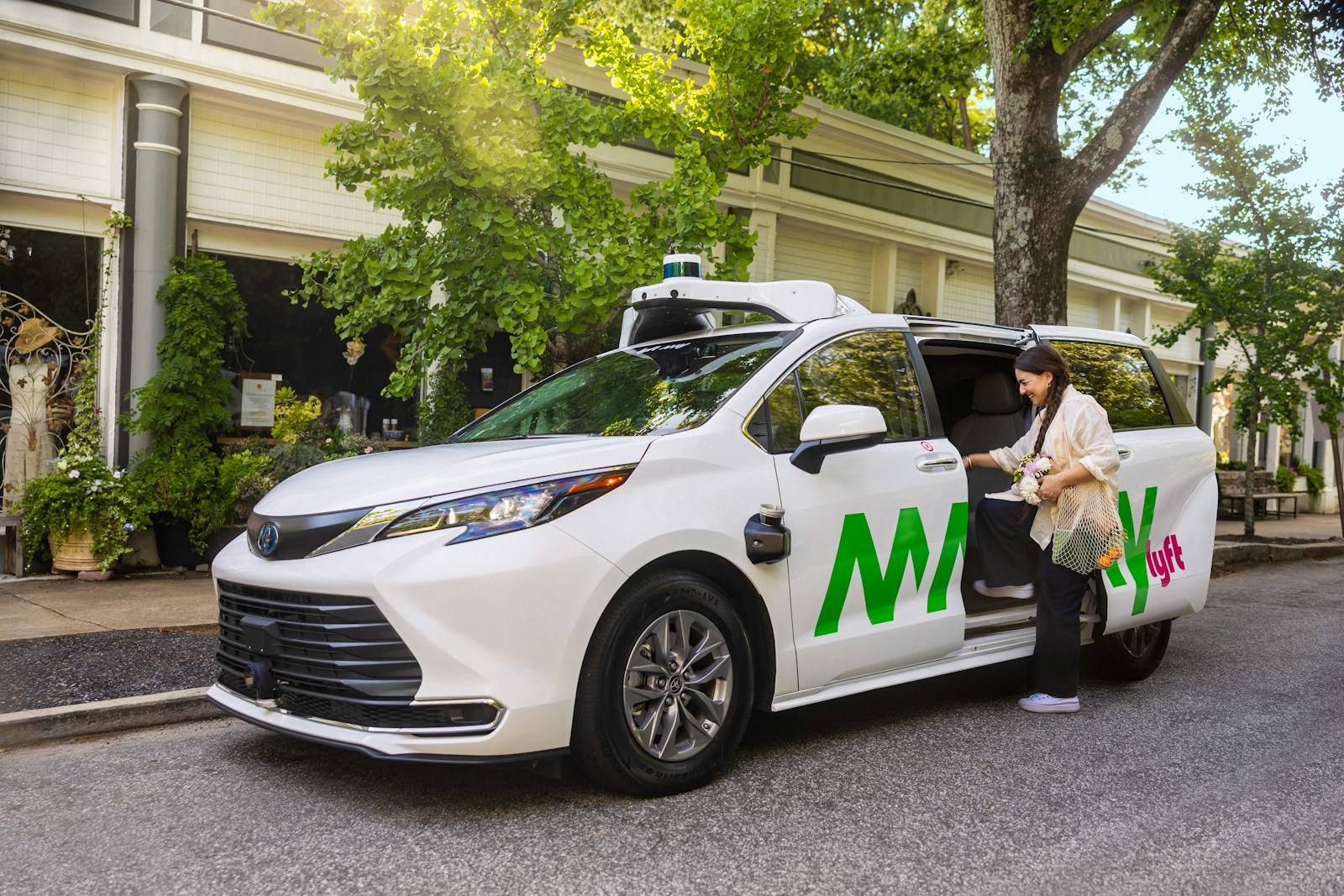
In September 2025, May’s Lyft pilot brought its Toyota Siennas to Atlanta. Riders requesting eligible trips in the service area could be matched with an autonomous vehicle through the familiar app. Launch vehicles carried standby operators able to take the wheel. The app supplied access to passengers; May supplied the driving system and a staged introduction to it.
Uber’s May 2025 agreement added another distribution route. The original announcement planned an Arlington launch by the end of that year. May’s September 2026 update instead targeted the fourth quarter of 2026 or first quarter of 2027. A schedule moving is evidence worth retaining. Announcing thousands of future vehicles and placing them into commercial service are separate pieces of work.
May calls its broader model Autonomy-as-a-Service. Vehicle manufacturers, fleet owners, operators and ride-hailing platforms become partners around the driving technology. NTT licenses the technology for Japan; Toyota supplies vehicle platforms. This puts May in a different commercial position from a business trying to own every part of the passenger relationship. Waymo is an obvious ride-hail alternative; for a transit buyer, staffed microtransit may be the more useful comparison.
The bill arrives before the breakthrough
The capital trail is substantial. May raised $111 million in a July 2022 Series C and $105 million in a November 2023 Series D led by NTT. By September 2026, it reported approximately $445 million raised since inception. Those figures purchase development time and deployments; they do not establish that a ride pays for itself.
Common dollar scale. Annual revenue and cash burn are different accounting measures, shown here to make the funding requirement visible.
The proposed combination with ACP Holdings implies about $1.4 billion in enterprise value. It includes a committed $120 million private investment and potential gross proceeds of up to $337 million, depending on shareholder redemptions. As of this profile’s October 2, 2026 research date, the transaction remains conditional. A proposed Nasdaq ticker is a plan, not a closing bell.
Free passenger fares deserve the same discipline. They describe what the rider pays, while agencies, partners or investors still fund vehicles and service. A transit official evaluating May needs local operating costs, coverage and reliability. An investor needs a route from deployment spending to durable revenue. Both should resist mistaking the existence of a ride for proof of its economics.
Useful somewhere before everywhere
Japan offers another test. In September 2026, May and NTT Mobility announced plans for public-road Toyota e-Palette deployments, following private-site demonstrations. The partners aim to achieve Level 4 certification. The electric platform expands the vehicle choices available to communities with different capacity needs; the regulatory and operating work remains part of the assignment.
For a prospective passenger, the next step is wonderfully undramatic: check the live service map, hours and fare. May’s current locations page lists Atlanta through Lyft, Grand Rapids in Minnesota and Eden Prairie in Minnesota. For a prospective customer, start with the journeys people cannot make today, then test whether a bounded autonomous service can fill them reliably.
The transferable lesson is an editorial inference from May’s history: choose a useful assignment, use partners with something you need, and measure each stage separately. The limits are just as concrete. A region outside the approved service conditions, a weak vehicle platform, or economics that require full driver removal before it is ready can undo the proposition. The ordinary trip is an exacting customer. It expects the future to arrive on time.