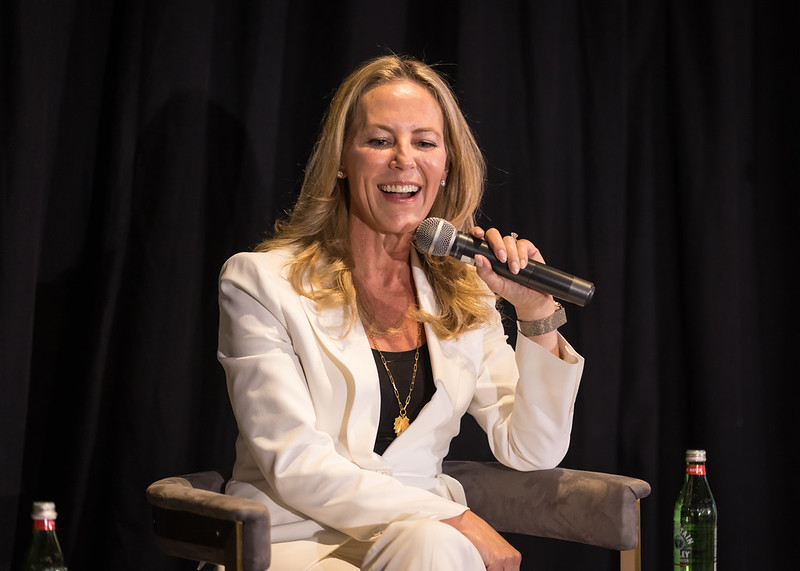
The Prosecutor Who Became Crypto's Most Credible Insider
In 2012, a supervisor at the U.S. Department of Justice handed Kathryn Haun an unusual assignment: figure out if Bitcoin could be used for money laundering. At the time, she was a federal prosecutor with a spotless trial record - organized crime, RICO cases, Hells Angels, drug cartels. She had clerked for Justice Anthony Kennedy. She had graduated from Stanford Law with honors. She knew nothing about Bitcoin.
She concluded that it was "like prosecuting cash." That sentence, delivered in a government memo, turned out to be the beginning of one of the most unusual career arcs in American finance. What started as a skeptic's investigation became a ten-year obsession - and eventually, the foundation of a $2.5 billion venture capital empire built on the premise that the DOJ had stumbled onto something bigger than a money-laundering tool.
Today, Katie Haun runs Haun Ventures from Silicon Valley with the same methodical intensity she once brought to federal courtrooms. In 2025, she raised a fresh $1 billion fund focused on next-generation financial infrastructure, tokenized assets, and what she calls the "agentic economy" - the emerging world where AI systems execute financial transactions on behalf of humans. It is a thesis only someone who has prosecuted financial crime, sat on Coinbase's board through its IPO, co-led a16z's crypto franchise, and watched three generations of crypto boom-and-bust could credibly assemble.
Web3 is the new era of the internet, and it deserves a new era of investors.
- Katie Haun, on launching Haun VenturesFrom Egypt to Anthony Kennedy's Chambers
Haun grew up moving. Her father was an oil executive, which meant childhood spread across Egypt, Greece, and France before she landed back in the U.S. for Boston University, where she graduated summa cum laude, Phi Beta Kappa, with more than 800 classmates in her department. Stanford Law followed - honors, Managing Editor of the Law Review - and then the most selective post in American law: a clerkship for Supreme Court Justice Anthony Kennedy.
She briefly went to Sidley Austin before the DOJ pulled her in. It was there, working national security and terrorism cases out of the Eastern District of Virginia, then organized crime in San Francisco, that she developed the prosecutorial style she still describes as "fearless and egoless" - a phrase she attributes to her mentor, Wil Frentzen, an AUSA known for holding even the largest tech companies accountable without flinching.
She never lost a trial. Not one. It is the kind of record that sounds like hyperbole until you realize the DOJ doesn't assign prosecutors to trials they expect to lose - and that Haun kept that record through organized crime cases, RICO murders, public corruption, and eventually the most novel criminal territory the federal government had ever navigated: digital asset theft.
The Silk Road Discovery That Changed Everything
The Silk Road investigation is where Haun's crypto conversion happened - and where things got genuinely dramatic. While working the case, she discovered that federal agents from the Secret Service and the DEA were stealing Bitcoin from the very investigation she was running. She had to report malfeasance within law enforcement to her superiors. It was the kind of situation that ends careers, or defines them.
It defined hers. The case required her to understand Bitcoin at a level that few in government had attempted. The blockchain's transparency - its permanent, public, auditable trail of every transaction - struck her not as a feature for criminals but as a liability for them. "Digital breadcrumbs," she called it. Traditional cash left no trace. Bitcoin left everything. The government, she realized, had been given an investigative superpower and didn't know it yet.
In 2014, she founded the DOJ's first digital currency task force. It was an institutional first - the government formally acknowledging that digital assets were here, were consequential, and required dedicated expertise. The task force she built is now a permanent fixture of federal financial crime enforcement.
A16z, Coinbase, and the Path to Founding Her Own Firm
In 2017, Brian Armstrong - Coinbase's founder - recruited Haun to the company's board as its first independent director. She became the architect of its global regulatory strategy, guiding the exchange through years of regulatory ambiguity and ultimately through its landmark direct listing on Nasdaq in 2021. She chaired both the Nomination and Governance Committee and the Audit and Risk Committee. She stayed for seven years and three board terms - stepping down in 2024 only because, as she put it, both Coinbase and Haun Ventures were in "remarkable expansion states" simultaneously.
Meanwhile, in 2018, Marc Andreessen and Ben Horowitz brought her to a16z as its first female General Partner. She co-led the firm's crypto franchise across three funds with billions under management. Co-chaired the $2.2 billion Crypto Fund III. Oversaw investments including OpenSea. Co-authored a stablecoin regulatory framework whitepaper that has become something of an industry reference document.
Then, in December 2021, she left. The $1.5 billion she raised for Haun Ventures - split across a $500 million early-stage fund and a $1 billion acceleration fund - was, at the time, the largest debut fund ever raised by a solo venture capitalist. In a market already thick with crypto capital, she raised it in months.
Debut Haun Ventures fund (2022) - the largest ever raised by a solo VC at the time
New 2025 fund targeting crypto infrastructure, tokenized assets, and AI agent economy
Combined Mastercard (BVNK) and Stripe (Bridge) acquisition values for Haun portfolio exits
Personal investments including Anthropic, OpenAI, SpaceX, Figma, Databricks, Revolut
On Coinbase's board, from pre-IPO company to publicly traded crypto giant
a16z crypto funds co-led, each larger than the last, totaling billions under management
What She's Building Now
The 2025 fund carries a three-part thesis. First: financial infrastructure is being rebuilt from scratch - the plumbing of global money movement, not the applications on top. Second: tokenization is moving from crypto-native assets to the broader economy - real estate, private credit, commodities. Third: AI agents are about to become economic actors in their own right, executing transactions, managing accounts, and operating with financial autonomy that existing infrastructure wasn't designed to support.
It is, characteristically, a view from the structural layer. Haun has never been a consumer app investor. Her instinct has always been toward rails - the systems that other systems depend on. The same logic that made her focus on blockchain transparency as a prosecutorial tool in 2012 now makes her focus on the infrastructure stack beneath the visible crypto economy in 2025.
She is also vocal on policy in ways that most VCs carefully avoid. She has written publicly that OFAC cannot sanction open-source software - a position directly relevant to the Tornado Cash case and one that required genuine legal argument, not just advocacy. She called the GENIUS Act, the bipartisan stablecoin regulatory framework that passed the Senate in 2025, "a watershed moment for U.S. financial innovation." She is, in the clearest sense, a policy participant - not just a policy observer.
For the first time, Congress has advanced a comprehensive, bipartisan regulatory framework for stablecoins. This also represents a symbolic turning point in how the U.S. makes technology policy.
- Katie Haun on the GENIUS Act, June 2025The Mold She Didn't Fit
Silicon Valley venture capital was invented by a certain kind of person: engineers-turned-investors, or operators who had built companies and wanted to back others. Haun is neither. She is a prosecutor-turned-investor, and she has made that identity central to her firm's positioning - not as a novelty, but as a competitive advantage.
Her read on regulatory risk is more precise than anyone who hasn't prosecuted financial crime. Her network spans DOJ, the National Security Division, the FBI, the SEC, and Treasury in ways that no former operator could replicate. Her instinct for institutional risk - the kind that sinks companies not through competition but through enforcement - comes from having been on the other side of it for a decade.
The team she assembled reflects that logic. Chris Lehane, Airbnb's former head of global policy. Tomicah Tillemann, a Biden White House official. Rachael Horwitz, who has run communications at Twitter, Google, Facebook, and Coinbase. The firm is deliberately cross-sector - a rare thing in an industry that rewards specialization above all else.
She is a lifetime member of the Council on Foreign Relations. She teaches at Stanford Graduate School of Business - the school where she once studied. She lists herself, in her own bio, as an adventure traveler. She grew up in three countries and clerked for a Supreme Court Justice and took down corrupt FBI agents and built a $2.5 billion fund. The mold, to put it plainly, was not going to hold her.