Leaving a corporate job can look wonderfully romantic from a safe distance. The salary disappears; the responsibilities develop excellent attendance. For Karunya Sampath, the move into entrepreneurship brought a different sensation: liberation. She wanted to create something, take chances and answer more directly for what happened next. In 2005, she co-founded Payoda in New York with Anand Purusothaman. The freedom came with work attached.
That beginning offers a useful way into her story. Sampath had already worked in technology, products and services. Her experience included S&P Global, and her education included a master’s degree in computer software engineering at PSG College of Technology in Coimbatore. She came to company-building with experience of both software and the business arrangements that allow software to reach customers. A good idea, after all, still needs somebody to mind the accounts.
Twelve years on their own steam
Payoda was bootstrapped for its first twelve years. Its early life combined building products with doing work for clients, across fields including insurance, network infrastructure and security. That combination gave the business two kinds of problems to solve: the demands of a customer’s brief and the longer, less predictable work of developing something of its own. Both required engineering. They also required patience.
Founded in New York. Bootstrapped through its first twelve years.
The company’s history includes AppViewX, developed inside Payoda and subsequently spun out. The distinction matters in understanding Sampath’s working world. A services engagement has a client, a scope and a delivery obligation. A product acquires a life beyond its first assignment. Moving between those worlds demands attention to customers and to the organisation doing the building.
Sampath’s own responsibilities crossed technical management, product management, human resources and finance. Those are often described as separate departments once a company can afford enough doors. In a founder’s life, they can be consecutive items on the same day’s agenda. Her career makes the operating side of entrepreneurship visible: recruiting people, developing leaders, organising delivery and keeping the enterprise financially coherent.
Her AppViewX experience also included the chief operating officer role, with responsibilities in global delivery, process improvement and corporate initiatives. It is a career concerned with how work travels through an organisation. The software may be the thing a customer buys; the ability to deliver it repeatedly is a substantial part of what the founder has to build.
“It was a feeling of liberation”Karunya Sampath, recalling the move into entrepreneurship
The first customer cannot buy your reputation
Looking back on Payoda’s early challenges in 2024, Sampath singled out credibility and trust. A new firm had to demonstrate that it could deliver reliably in a competitive market. Her answer was repeated delivery and stronger client relationships, alongside the constant work of keeping the team’s skills current. The early problem was familiar and awkward: customers wanted evidence, while a young business needed customers to produce it.
Her description of product development starts with understanding users and their goals. Research leads to concepts and prototypes; testing and refinement come before deployment at scale. This is an unglamorous sequence with a useful habit of catching expensive misunderstandings early. In Sampath’s account, close client collaboration continues through the process. The customer’s problem has to survive the journey from discussion to working software.
She has also described a client’s appreciation for work that changed the team’s attitude towards innovation as particularly memorable. That is a revealing choice of feedback. Financial results matter in her account, but so does what happens to the people using the system. An engagement can leave behind a different appetite for trying things. For an entrepreneur who began by wanting to create, that is an understandable reward.
A recruitment plan with room to learn
By August 2022, the conversation had turned to hiring in an uncertain technology market. Sampath described candidates with multiple offers and companies competing for the skills they needed. She argued for broadening the talent pool to include BSc graduates, rather than depending on a narrow route into technical employment. She also favoured internships and practical problems for engineering students still completing their degrees.
The proposed work-and-learn approach connected recruitment to preparation. Employers could participate in making people ready for the work, instead of waiting at the end of an educational pipeline and complaining about what arrived. It is a practical extension of her interest in learning: the organisation has some responsibility for developing the capabilities it expects to hire.
At the time, she spoke of up to 200 openings and an ambition to bring the team to between 400 and 600 over the following three to four years. Those were plans expressed in 2022. Their value in her story is the question they raise about scale: as a business grows, how does it keep producing people who can take on the next piece of responsibility?
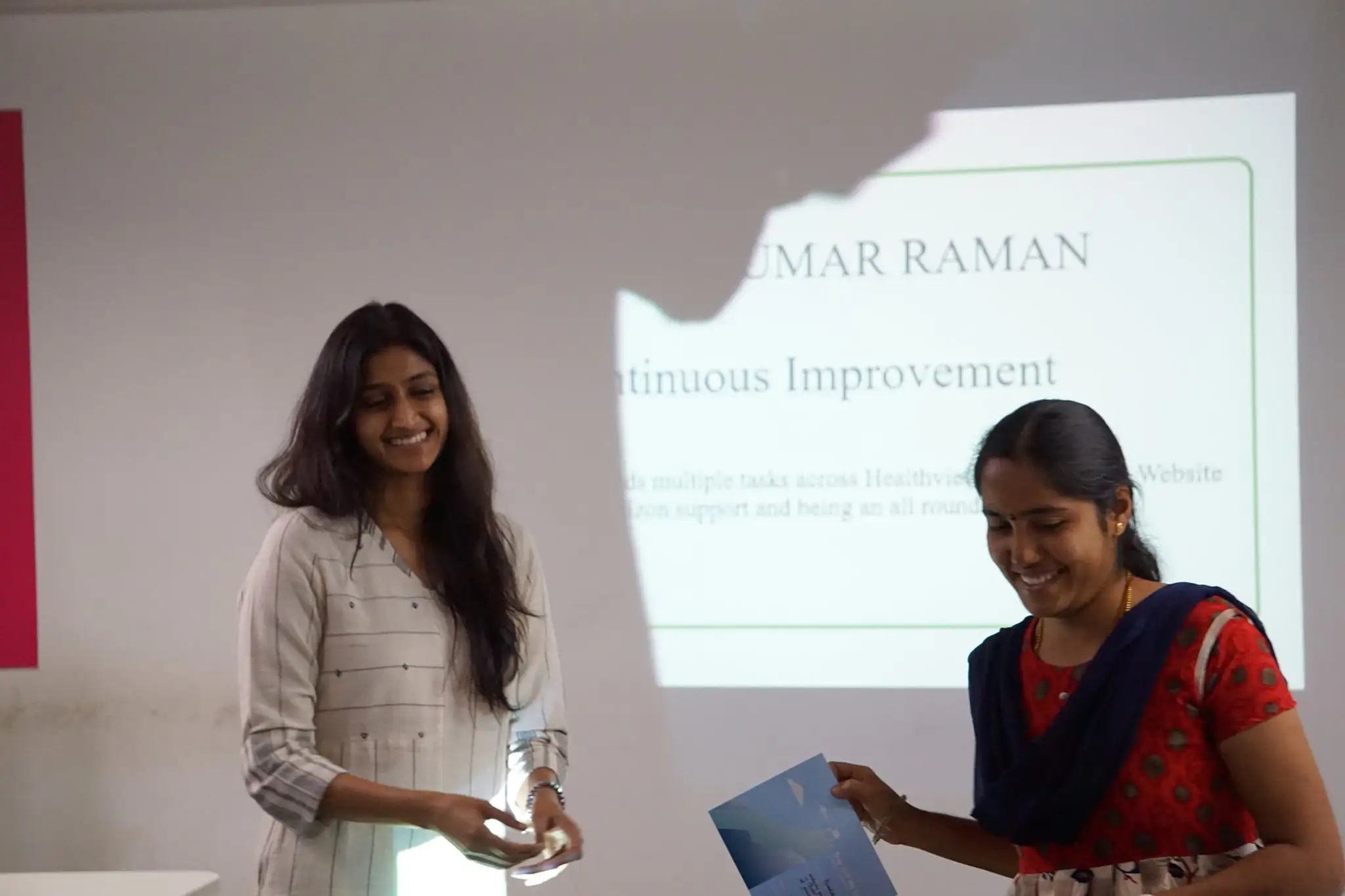
Her public comments on individual development plans in 2023 put employee growth on the agenda again. These plans give learning an individual shape: someone’s goals, the capabilities they need and the steps towards them. The topic fits the rest of her management thinking. A company’s ambition is easier to announce than to distribute across the people expected to fulfil it.
Give curiosity somewhere to sit
When Sampath discussed leadership in June 2024, she emphasised adaptability, empathy and strategic thinking. She linked an open culture to giving people a voice and encouraging them to take risks. Workshops and innovation labs were among the mechanisms she described. In other words, curiosity needed a place in the working week, with opportunities to turn a suggestion into an experiment.
That qualification is useful. Almost any organisation can admire curiosity in a presentation. The interesting question is what an employee is allowed to do with it on a Tuesday. Sampath’s emphasis on cross-team collaboration, research and development, and learning opportunities suggests an effort to make experimentation part of ordinary company life. It also makes leadership responsible for the conditions in which ideas are offered.
Her LinkedIn activity provides a later example. She shared Payoda’s Launchpad 2025 innovation programme, which ran across more than eight weeks and drew over 25 ideas. The company described workshops and mentoring around AI work; her own shared update celebrated five winning teams. These were internal teams applying themselves to problems, with colleagues helping them turn the work into something presentable.
A programme of workshops, mentoring and experiments in AI.
The appeal of such a programme is easy to understand in the context of her career. People get to practise more than a technical skill. They have to frame a problem, collaborate and explain what they have made. A company that wants initiative must occasionally give initiative something more useful than permission. Time, feedback and an audience are a respectable start.
AI still has to fit the customer
Sampath’s account of AI has included a pleasingly everyday example: clothes that do not fit. In 2023, she described Payoda’s work on a mobile application for a US retailer whose customers were returning purchases because of sizing problems. The application offered personalised fashion guidance and fit recommendations. The problem began in a customer’s wardrobe and ended on a retailer’s returns desk.
She reported improved satisfaction and fewer returns. The story makes her commercial interest in AI tangible: a capability earns attention by helping with an identifiable inconvenience. There is considerably less glamour in a parcel sent back to a warehouse than in a conference demonstration, but the parcel is a useful reminder of where the costs collect.
She has been equally explicit about people retaining responsibility for judgement, particularly around strategy, ethics and interpreting machine-produced results. Her discussion of implementation included training-data quality, privacy protections, bias checks and regular reviews. In that account, adopting AI involved the care surrounding a system as well as the system itself.
“human judgment remains crucial”Karunya Sampath on AI in software delivery, 2023
Her manufacturing commentary in the same year ranged from anticipating equipment failures to finding defects and improving supply-chain decisions. She also raised constraints around generative AI: rights over content, biased training material and the computing resources required. This was an interested adopter’s view with a list of practical complications attached. Technology, in business, has a habit of arriving with both an invitation and an invoice.
Keep the founder a student
Beyond company operations, Sampath has mentored people through life-skills workshops at corporate and educational institutions. Her support for developing talent also appears in a testimonial for the Sri Sri Rural Technical and Innovation Campus, where she describes the value of training rural young people for employers. It extends the same question beyond Payoda’s walls: who gets the preparation needed to participate?
Her stated ambitions in 2024 included expanding Payoda’s international reach and building deeper expertise in emerging technologies. She proposed judging progress through customer satisfaction, financial performance, market share and innovation milestones. Those measures bring her aspirations back to the operating disciplines that have occupied so much of her career. Expansion has to be managed; expertise has to be earned.
The thread through Sampath’s story is an appetite for creating, accompanied by a willingness to do the organisational work creation requires. The corporate employee became a co-founder. The co-founder worked across functions. The leader kept talking about how other people learn. Twenty years after Payoda’s beginning, the interesting continuity is that learning remains unfinished business. There is always another problem to understand, and somebody who could use the chance to try.