Furqan Aziz once had to sell the office furniture. A co-founder had stepped back from their first business, leaving him to settle debts and his partner’s share. In his telling, the venture ended with the sort of transaction that seldom appears in a founder’s pitch deck. Chairs have a way of making the balance sheet feel personal.
He recounted that episode in December 2025, long after he had become the founder and CEO of InvoZone. It is a useful place to begin his story because it gives the later talk of teams some weight. When Aziz discusses commitment, he has an actual bill behind the word. A promising idea can survive many indignities. A partnership requires people to keep turning up.
Today his work connects software engineers with businesses that need them. There is artificial intelligence, game development and a company operating across borders. Yet the recurring subject in his public conversations is surprisingly ordinary: finding people, agreeing on responsibilities and delivering what was promised. The technology changes with considerable enthusiasm. The human arrangements keep demanding a meeting.
A developer’s career. Two early failures. An organization built around keeping commitments.
Hasilpur, Lahore, and the habit of making things
Aziz comes from Hasilpur. He studied computer science at COMSATS in Lahore from 2008 to 2012, a stretch of education that sits behind a career often described in the language of entrepreneurship. Before the title on the door, there was the work on the screen. He says he began programming at eighteen.
His own account of his earlier working life includes software engineering, team leadership, people management, project management and quality assurance. Those are different seats around the same troublesome table. Someone must decide what to build; someone must build it; someone must ask why it behaves so strangely when a customer finally touches it.
An older Stack Overflow profile preserves the programmer’s vocabulary. He lists Node.js, Angular, React, Elixir, Ruby on Rails and Python, alongside PostgreSQL and MongoDB. He expresses an interest in maintainable code and common design patterns. These are fairly revealing interests for someone who would later sell engineering services. Maintenance concerns the morning after the demonstration, when the applause has gone home.
That technical background helps explain the business he chose. Software development offers a pleasing illusion that the difficult part ends when the code works once. A developer who has also managed projects has had opportunities to lose that illusion. Aziz’s career gave him experience on both sides of the handover: the people responsible for building and the people responsible for explaining the delay.
The degree. The attempts. The return.
- 2008-12Computer science at COMSATS Lahore
- 2014First venture attempt; InvoZone’s stated launch year
- 2017A second venture fails; technical leadership follows
- 2026COMSATS entrepreneurship alumni award
Two attempts, then a problem he recognised
His entrepreneurial chronology contains more than a clean launch date. InvoZone dates its official launch to 2014. Aziz has also described unsuccessful ventures in 2014 and 2017, with problems of collaboration between partners. Later, working in technical leadership roles for American startups, he saw a gap between their demand for engineering talent and the talent available in Pakistan.
The distinction matters. A company’s anniversary is tidy; learning to run it is usually less obliging. In Aziz’s account, the eventual business took shape through repeated attempts and working experience. He could see the problem from the customer’s chair because he had occupied it. An engineering leader with a deadline needs a dependable team, preferably before the deadline becomes an apology.
His June 2026 conversation with Jonathan W. Buckley returned to unreliable freelancers and missed commitments. The answer he pursued was a dedicated software organization in Lahore. The same conversation covered two earlier startup failures and the difficulty of earning confidence from customers who had already had a poor outsourcing experience.
This gives his sales proposition a human starting point. Buyers bring memories into a meeting. A quotation may describe the next project, but a cautious customer is also remembering the last one. Aziz has discussed client references, verified reviews and trials as ways of letting prospective customers examine the work. Trust gets a chance to become something more useful than an adjective.
The bench has a job, too
One detail of his operating model deserves more attention than the familiar photographs of offices. In 2023, Aziz explained that engineers between client assignments remained full-time employees. They spent time developing their skills while waiting for the next project. He gave the example of expanding a cloud engineer’s expertise across additional cloud platforms.
This is the company’s bench: capacity kept available before a customer needs it. In his explanation, engineers could join a client’s existing team or work on a product managed within InvoZone. When an assignment finished, they could return to the pool. The arrangement makes availability part of the product being sold.
There is something almost unfashionably practical about this. A client wants speed, but useful speed requires preparation somewhere. Keeping people ready gives that promise an operational meaning. Training also means that an interval between projects can contain actual work. In software, today’s spare capacity can become tomorrow’s missing expertise with embarrassing speed.
At scale, however, the founder cannot personally inspect every handover. Aziz now describes the need for executive leadership, clearer processes and specialist business functions. Finance, accounting and revenue leadership all enter the story. The organization becomes more elaborate because a larger promise needs more people capable of keeping it. Even an engineering company eventually discovers the engineering of its own administration.
Between projects, keep learning.
Passing the lesson across the table
Aziz’s interest in training extends beyond employees waiting for an assignment. He founded InvoLearn to help young technology enthusiasts connect education with industry practice. His personal site presents it as an affordable way to develop skills and encounter the working world. It is a fitting extension of a business built around the readiness of engineers.
In April 2021, COMSATS Lahore announced a webinar and internship drive with InvoZone. Aziz was the speaker, returning as an alumnus to discuss his path from student to entrepreneur. The announced subjects included risk-taking, failure, time management, self-learning and technical skills. Students could apply for paid internships as part of the event.
That combination gives the visit some substance. Career advice is easy to distribute; a route into work requires an employer to participate. The event paired the founder’s account with an application process. For students, the distance between hearing about an industry and entering it could become a little shorter.
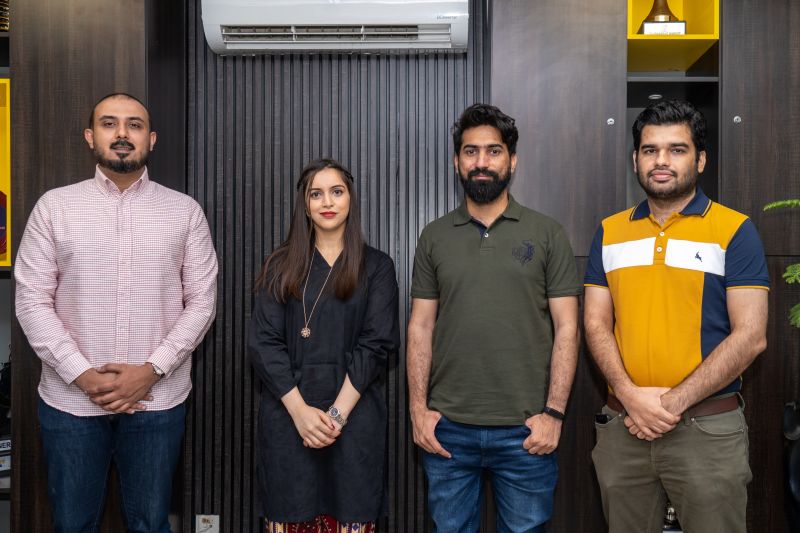
A separate meeting with Ali Pasha and Ahmad Ali of Cherry Byte Technologies offers a smaller view of the same outward-facing role. Pasha described a discussion at InvoZone about the technology sector and scaling their business. There is no need to turn a meeting into a grand alliance. Sometimes the useful thing a more experienced founder can offer is an afternoon and an answer.
AI arrives at the developer’s desk
Aziz was discussing generative AI publicly in 2023, including its place in software development. His more recent writing keeps returning to the effects on engineering work. Articles published under his name in July 2026 address remote developer performance, vetting developers and using AI in mobile applications. The subjects remain close to the practical business of getting software built.
By August 2026, he was a guest on Awais Ali’s podcast for a conversation titled “AI-First Business: The Truth Beyond the Hype.” Its agenda included what AI can do, its cost compared with hiring, and where smaller businesses should begin. The questions have the virtue of being answerable in a budget as well as on a stage.
For a founder whose company supplies engineering talent, those questions carry particular significance. If tools change the work, the company must consider what customers need from its people. Faster production alone cannot decide which product deserves to exist, what a customer meant by a requirement, or who will take responsibility when a release disappoints. Those remain useful questions to bring to any discussion of automation.
Aziz’s stated ambition is to make InvoZone a company businesses turn to for engineering talent they trust. He also argues for Pakistan’s software sector to broaden its markets, including Japan, Singapore and the wider Asia-Pacific region. It is an outlook consistent with his own passage from a Pakistani town to work organized across national borders. More destinations mean more relationships to maintain.
Trust is built through consistency.
Furqan Aziz
An award, and the messages waiting afterwards
In June 2026, COMSATS Lahore announced that Aziz had won the Innovation and Entrepreneurship category at both the campus and university Alumni Excellence Awards. The recognition brings the story back to his university, this time with the former student being congratulated for the company he went on to build.
There is room here for an achievement without pretending that an award finishes a business story. Companies need another delivery, another hire and another customer willing to stay. Recognition provides a photographable moment in work whose most consequential parts often happen without a camera. A well-run handover rarely receives evening dress.
Aziz’s earlier description of a Monday morning was considerably less ceremonial. He checked messages from colleagues and clients on waking; if nothing urgent needed attention, there was breakfast with his family before returning to work. He said Monday felt much like the rest of his working week. The glamorous founder ritual turns out to involve finding out whether anybody needs a reply.
His answer about success was broader: “For me, success means making a difference in the world.” The sentiment earns its place beside the less polished details: a failed partnership, furniture sold, engineers trained between projects, students offered a way into employment. Those details make the ambition possible to examine. Aziz’s story is still being written in the commitments his company makes, and in the people available to keep them.