Tomasz Kułakowski went to the University of Warsaw looking for people to build an auction website. Professors could have pointed him towards perfectly capable students and sent him on his way. He wanted partners with rather more formidable credentials. The website was the immediate business proposition; the people would prove to be the more durable investment.
That distinction runs through his working life. Kułakowski had already helped sell airline seats across Central Europe before he co-founded CodiLime in 2011. He understood markets, publicity and the awkward business of persuading people to try something unfamiliar. His prospective colleagues understood mathematics and algorithms. Between them lay the possibility of a company in which neither side had to pretend to be the other.
There is something pleasingly practical about this origin. The business began with an idea for cheaper shopping, then found a larger purpose in the capabilities of the people assembled to make it work. A founder can fall in love with his first product. Kułakowski's more consequential commitment was to the partnership.
An airline education, with a change of seats
His formal training was technical. He earned an MSc in telecommunications at Warsaw University of Technology, later adding an Executive MBA with distinction through its Business School's joint programme with London Business School, HEC Paris and NHH Bergen. The combination of engineering education and commercial work would become useful when his customers and colleagues spoke rather different professional languages.
Ryanair supplied a brisk education in expansion. Between 2005 and 2008, he worked from its London office on business development in Central Europe, covering countries including Poland, Slovakia, the Czech Republic, Hungary, Croatia, Slovenia and Romania. That meant working across several markets while the airline was extending its reach. A route announcement had to become public attention, and attention eventually had to become bookings.
He then crossed to LOT Polish Airlines, taking responsibility for sales and electronic commerce in 2008. Moving between rivals is an unusually literal way to see both sides of a market. At Ryanair, he had been associated with a campaign bidding farewell to LOT. Subsequently arriving at LOT required a certain professional composure. Aviation, like the theatre, sometimes asks its cast to change costumes quickly.
Nordic Gaming Group followed, with a regional brand role involving the launch of Tobet in Poland, Hungary and Romania. The industries changed, but the work retained a common shape: take a business into a market, make its offer intelligible and win customers. By 2011, Kułakowski was preparing to do that on his own account.
The auction was only the beginning
The auction venture used a reverse-bidding mechanism: users paid a small amount to check an item's price, and those checks pushed the selling price down. For its technical development, Kułakowski sought introductions through University of Warsaw professors Krzysztof Diks and Jan Madey. He was interested in bringing programmers into ownership, rather than simply purchasing a finished website.
Wojciech Śmietanka and Tomasz Kulczyński joined the effort alongside Piotr Niedźwiedź. The young programmers brought competition experience and the prospect of careers with established technology employers. The partnership offered a different proposition: they could help decide what to build and what kind of business would surround it. Equity made the invitation concrete.
CodiLime's subsequent direction gave those abilities a broader commercial outlet. Advanced software work for other companies could bring in revenue while the group developed projects of its own. The original consumer idea gave way to a business selling technical expertise. This was a substantial change of destination, even if the essential travelling companions remained.
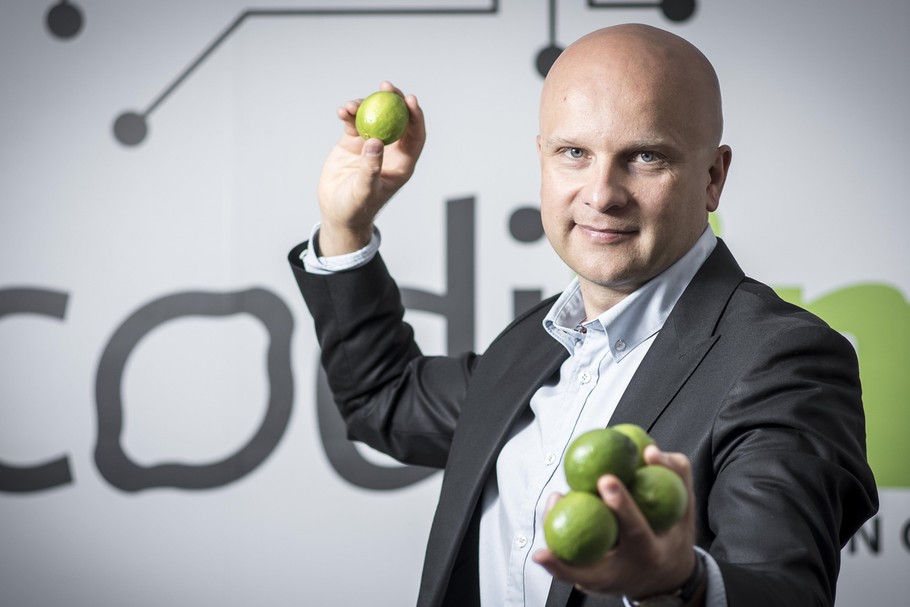
There was a geographical choice here, too. Talented Polish programmers could pursue international careers without every new company having to begin in California. In 2012, Kułakowski supported plans to develop CodiLime in Białystok, the city he had left for university in the late 1990s. His commercial experience abroad and his connections in Poland could belong to the same enterprise.
Give the specialists somewhere to go
Recognition arrived while the company was still young. In May 2014, Kułakowski received an INFO-STAR award for business development achievements. Later that year, he won the New Business category in Poland's EY Entrepreneur of the Year competition. The category matters: the award recognised a particular stage of company building, with all the recruitment and customer work that stage entails.
His technical co-founder Piotr Niedźwiedź publicly credited his commitment to team building and business development. It is a useful contemporary description of the division of labour. Kułakowski was helping create an organisation that could employ specialised computer scientists and find customers for their work. The algorithms required a commercial structure around them.
In 2016 came the Polish Business Roundtable's Jan Wejchert Award for Vision and Innovation. The recognition did not end the practical question that had brought him to the university: how do you give able people a reason to build with you? As the group expanded into machine learning, that question acquired new urgency. Research ambition and paid client work had to share the calendar.
By 2024, Kułakowski described the four businesses as operationally and financially independent.
Independence became a management decision
By 2017, deepsense.ai was giving the group's data science work a clearer identity. It adopted that name in place of deepsense.io and described an offer extending from feasibility studies to deployment and maintenance. Its machine learning team then numbered more than 45 data scientists. The company said it remained self-funded and independent.
That last detail helps explain the relationship between commercial assignments and research. Customers supplied both problems and revenue. Technical work could then support new capabilities, tools and products. Neptune, presented at the time as a machine learning lab for data scientists, was one expression of that approach. A service engagement could sit within a larger programme of company building.
On CodiLime's seventh anniversary in June 2018, Kułakowski announced a further separation. CodiLime and deepsense.ai would operate independently, with dedicated leaders and strategies. Marek Niedźwiedź became CodiLime's CEO; Kułakowski took the CEO position at deepsense.ai. Piotr Niedźwiedź would concentrate on Neptune Labs, while Robert Bogucki joined Kułakowski on deepsense.ai's board.
The decision treated management attention as a limited resource. Networking and AI had developed distinct needs. Giving each business its own leadership allowed those differences to shape its plans. A shared origin could remain valuable without requiring every decision to pass through the same executive desk.
“There is no development without research.”Tomasz Kułakowski, on launching the R&D Hub, 2019
A budget for questions without immediate customers
At deepsense.ai, the 2018 strategy identified predictive modelling, computer vision and natural language processing as central areas. It also included research in reinforcement learning and simulation. Training and workshops formed part of the commercial plan: a potential customer needed enough understanding to decide where AI might be useful.
In June 2019, the company launched a Research and Development Hub with four full-time researchers, technical support and a fixed research budget. That is a revealingly specific commitment. Research had people assigned to it and money set aside for it. Its continuation did not depend entirely on finding an immediate buyer for each experiment.
Among the projects were model-based reinforcement learning for Atari games and work using Unreal Engine 4 to explore autonomous driving in simulation. Games provided a way to investigate techniques before applying them in more demanding environments. The apparent distance between an arcade screen and an industrial problem was part of the research proposition.
Kułakowski also argued for making the work accessible to people outside data science. That concern fits his earlier career: complex work still needs an audience that understands why it matters. The person introducing an airline route and the person explaining machine learning research face different subjects, but both must make a reason to pay attention clear.
The founder changes his job again
His review of 2022 reported a 40% increase in deepsense.ai's international client portfolio and 120% year-on-year revenue growth. He also discussed formalising company policies around cooperation, inclusion, sustainability and AI ethics. Growing revenue and establishing working rules appeared in the same account of progress.
By 2023, he was speaking about large language models at Zebra DevCon in Madrid. The subject had changed with the technology. His interest in connecting technical capabilities to business applications remained recognisable. An audience considering AI needed more than an impressive demonstration; it needed a view of where the work might lead.
In June 2024, he announced that Robert Bogucki would succeed him as CEO. Kułakowski became chairman, describing a continuing role in supporting the team, shaping the company's image and developing global client relationships. It was another redistribution of responsibilities within a partnership that had lasted years.
His career has included selling an airline's expansion, assembling a software partnership and giving a growing AI business its independence. The recurring decision is whom to work with and what room to give them. That first auction website did not contain the whole future. Fortunately, its founders had acquired something more adaptable than a product plan: one another.