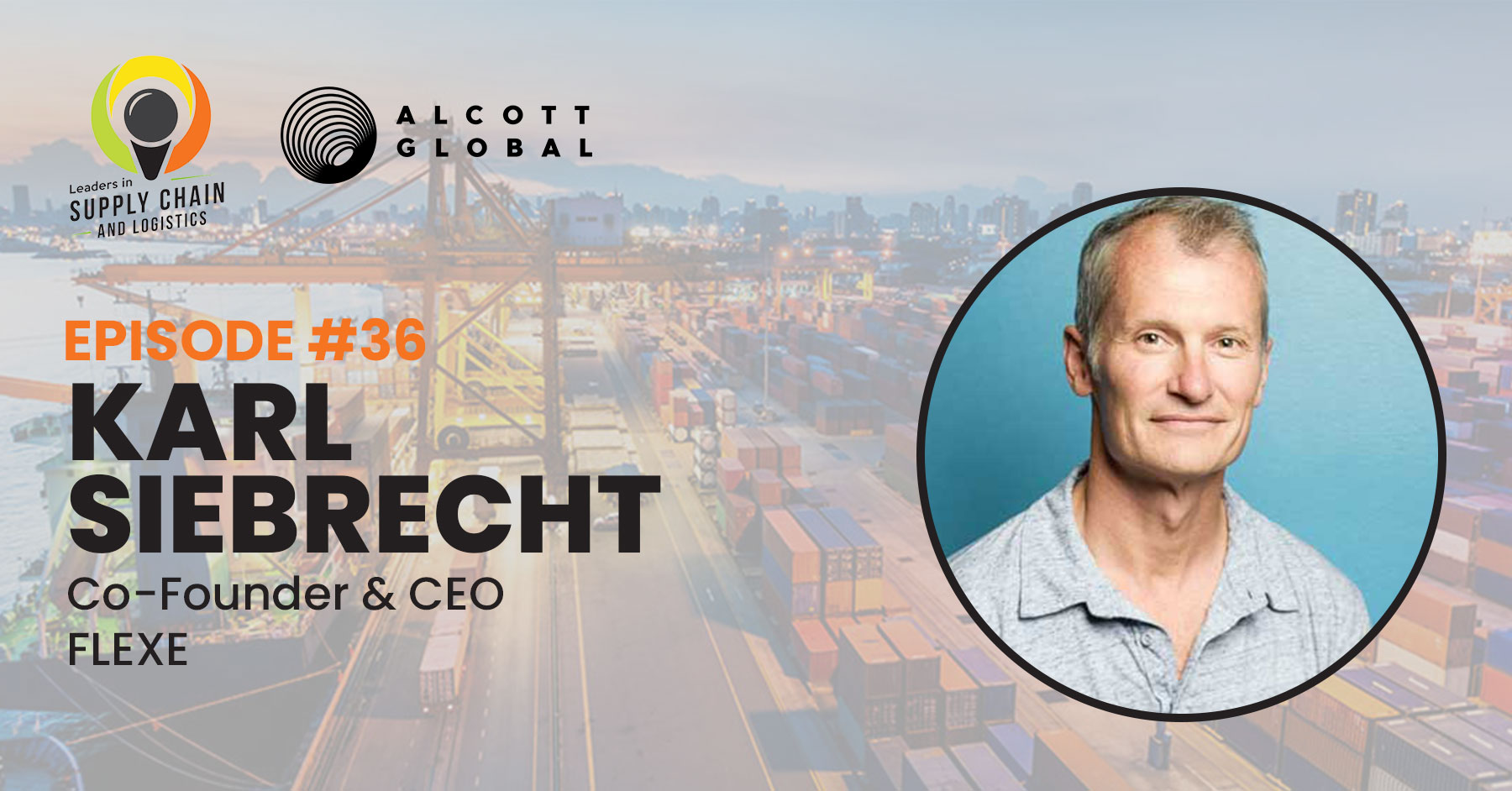
The interesting thing about Karl Siebrecht's warehouse company is that it began without a warehouse, and almost without Karl. At a party in Seattle, entrepreneur Dhruv Agarwal introduced himself through a mutual friend and presented a grievance disguised as a business idea. Agarwal imported home-bar goods from Asia. The products arrived at the Port of Seattle, moved to a warehouse in Kent, Washington, then traveled onward to stores and online customers. To secure that middle step, he had to sign leases measured in years while predicting demand measured in guesses.
Siebrecht has never polished this encounter into a founder myth. The idea, he says plainly, was Agarwal's. What mattered was recognition. He had already watched a legacy industry become a technology platform while running Atlas at aQuantive. Digital advertising had once been a collection of stubborn, manual transactions. Software joined buyers and sellers, made the market legible and allowed capacity to move differently. Warehousing was plainly not advertising, but the rhyme was audible.
He and future co-founders Francis Duong and Edmund Yue made a list of reasons the idea might fail. Liability. Insurance. Contracts. Operational control. They called people, asked inelegant questions and discovered that the problems were difficult rather than fatal. Then they returned to Agarwal with the only test that mattered: if they built it, would he use it? He would. Flexe incorporated in 2013. Six weeks later it had revenue.
01 / Pressure schoolFirst, learn not to panic
By then, Siebrecht had accumulated a career's worth of preparation for a company that would blend software, people and heavy things. The first classroom was the United States Navy. He spent four years as a diving officer, doing work that included salvage and ship repair. The setting offered few illusions about operations. Equipment had to work. The team had to trust one another. A plan was useful precisely because conditions could refuse to obey it.
After earning an economics degree at Duke and an MBA at Dartmouth's Tuck School, he joined Bain in Boston, working in strategic marketing and private-equity transactions. In 1999 he moved west to aQuantive. He rose through analytics, product management, strategy and operations, becoming president of the Atlas advertising-technology unit in 2006. Microsoft bought aQuantive the following year for about $6 billion. Siebrecht stayed as an executive in its online-services division, then became CEO of AdReady in 2009.
The résumé looks like a series of pivots. In another light, it is one continuous fascination: systems that must perform while technology changes the terms beneath them. Ships, investment cases, advertising markets and warehouse networks differ in costume. Each punishes fantasy. Each demands that complicated work be made repeatable without pretending it has become simple.
“I think the balance thing is just part of who I am. I've been described as kind of unflappable.”Karl Siebrecht on composure under pressure
Unflappable is a useful word, though it can suggest someone insufficiently flapped. Siebrecht's version is not indifference. He has explained that stressful situations become manageable when placed against the rest of one's life and the things one is grateful for. Pressure remains real; it simply loses the privilege of becoming the only fact in the room.
02 / A physical cloudThe warehouse learns to flex
Traditional logistics makes sense when the world behaves. A retailer estimates future demand, leases a building, hires labor and moves inventory through a fixed network. The trouble is not that forecasts are useless. The trouble begins when an estimate starts impersonating reality. Peak season rises higher than expected. A new sales channel catches fire. Consumer taste turns. A disruption closes one route and floods another.
Flexe's answer is a network of warehouse operators connected by one technology platform. Enterprise retailers and brands can add capacity for fulfillment, distribution or storage without making every node a permanent bet. The software supplies a consistent view of inventory, workflows and performance across facilities. The people and forklifts still do the physical work. The novelty is in making access to that work programmable.
Siebrecht sometimes describes warehouses as routers, the nodes connecting the arcs of a distribution network. It is a revealing metaphor from a person who admits that too much time in technology makes everything look like technology. Yet he resists the pure-software conceit. One of his contrarian beliefs is that excellent software companies can, and often must, be built with people as well as code. A pallet cannot be persuaded into a database. Someone has to receive it, place it, pick it and send it onward.
That mixture of digital coordination and physical execution helped Flexe reach a valuation above $1 billion when it raised $119 million in 2022. The number supplied the familiar unicorn headline. The more durable fact was the scale of the problem underneath it. Large companies wanted efficiency, certainly, but recent disruptions had reminded them that a supply chain optimized only for repetition can become brittle. Flexibility was no longer spare capacity with a nicer name. It was a way to preserve options.
03 / The useful errorCheck your ego at the door
Siebrecht's sharpest observation concerns the small vanity embedded in every forecast. Organizations lavish attention on getting a number right. They spend less time asking how it might be wrong, by how much, and what they would do then. His preferred correction is almost moral: humility. A plan built on one correct future is not rigorous. It is fragile.
“If you're building a plan based on your forecast being right, you're building the wrong plan.”Karl Siebrecht on designing for uncertainty
This is the quiet center of Flexe. The company does not claim to abolish uncertainty. It sells a better relationship with it. Capacity can be added nearer to demand. Existing warehouses can be used more fully. Goods can travel a shorter final leg. Forecasting continues, but error no longer has to become a referendum on management's intelligence.
There is a sustainability argument in the same design. Flexe does not build or lease the warehouses in its network. It works with operators that already have infrastructure, seeking to use those assets more completely. Placing goods closer to their destinations can also shorten transportation's least efficient stretches. The result is not weightless logistics. It is an attempt to get more work from buildings that already exist.
04 / Culture as infrastructureThe other network he is building
In 2019, Siebrecht won EY's Pacific Northwest Entrepreneur Of The Year award in the business-services category. At the ceremony, he thanked his parents, his wife and the Flexe team. He also turned the individual award into a group noun: it represented what they had accomplished together. Then he ended with the founder's evergreen refrain: they were hiring.
Four years as a diving officer, learning teamwork, industrial operations and logistics.
Strategy work followed by the platform economics of a digitizing advertising market.
CEO experience in Seattle advertising technology after Microsoft's aQuantive acquisition.
A warehouse problem becomes an operating company, with a paying customer in six weeks.
Conversations with logistics operators, researchers and investors about resilience and technology.
Hiring is the cheerful part. Scaling culture is the hard part. Asked what kept him awake as Flexe grew, Siebrecht named the difficulty of maintaining a strong culture and high standards of execution at once. The concern fits his larger pattern. A company, like a logistics network, is a system of connected nodes. Rapid growth creates opportunity and strain in the same motion.
His stated ambition is unusually human for a chief executive in a metrics-rich industry. He wants former employees to look back and say Flexe was the best company they ever worked for. He wants the company to establish a better way to move goods. He wants his children to be good people who contribute meaningfully. Revenue, valuation and network scale matter. They are not the last line of the ledger.
There are lighter clues to the person operating all this machinery. He gets out of bed quickly, as a tactic for convincing himself he has had enough sleep. He exercises every morning. His first concert was Van Halen. He reads about complex systems, behavioral economics, checklists and the unpleasant mechanics of company-building. At home, he has joked, his wife makes the difficult calls while he becomes the more tolerant parent, perhaps because the day's supply of decisions has already been shipped.
Since 2023, he has co-hosted Flexe's Logistics Leadership Podcast, moving from company builder to industry interlocutor. Recent conversations have covered resilience, geopolitics, automation, investment and artificial intelligence. It is another network, this time made of ideas and practitioners. The recurring subject remains movement under pressure: goods, capital, information, judgment.
The warehouse problem that reached him at a party was wonderfully ordinary. Too much space in one place, not enough in another, and a contract entirely unmoved by either fact. Siebrecht's response was not prophecy. It was architecture for fallibility. In a business culture forever announcing that it can see around corners, he has built something around a less theatrical proposition: we cannot. We can, however, leave ourselves room to turn.