In 2020, Tom Seagle had a problem that could be counted in pallets. AmerCareRoyal, a supplier of restaurant disposables, needed to move shipments of 12 to 17. Port bottlenecks were releasing goods in inconvenient dribbles. Customers still expected their deliveries. The orders were awkward for less-than-truckload service, yet too small to fill a truck. Seagle was buying the larger option anyway. The unused floor travelled first class.
- FlockDirect combines compatible shipments on one truck, without terminal transfers.
- The buyer pays for occupied space; Flock handles the pooling and carrier coordination.
- The economics depend on finding freight that agrees on geography, timing and capacity.
Flock Freight offered Seagle another arrangement: share the trailer with someone whose freight was going the same way. The company’s case study reports more than $896,000 in avoided truckload costs and 94% on-time delivery, using internal data from July 2020 through August 2023. These are one customer’s reported results. They explain the attraction better than a sermon about disruption.
01 / A carpool with loading instructions
The freight market has two familiar answers. Reserve a truck and obtain control, including control over a great deal of empty space. Or buy less-than-truckload, usually abbreviated LTL, and let a terminal network consolidate small shipments. That network serves a purpose. It also introduces transfers, handling and opportunities for delay.
FlockDirect, Flock’s shared-truckload service, occupies the gap. Its technology matches compatible shipments, usually two or three, and plans a multi-stop route. Each shipment remains aboard the same truck from pickup to delivery. There are still pickups and deliveries; terminal-free does not mean stop-free. Think of a carpool whose passengers have loading docks and appointment windows.
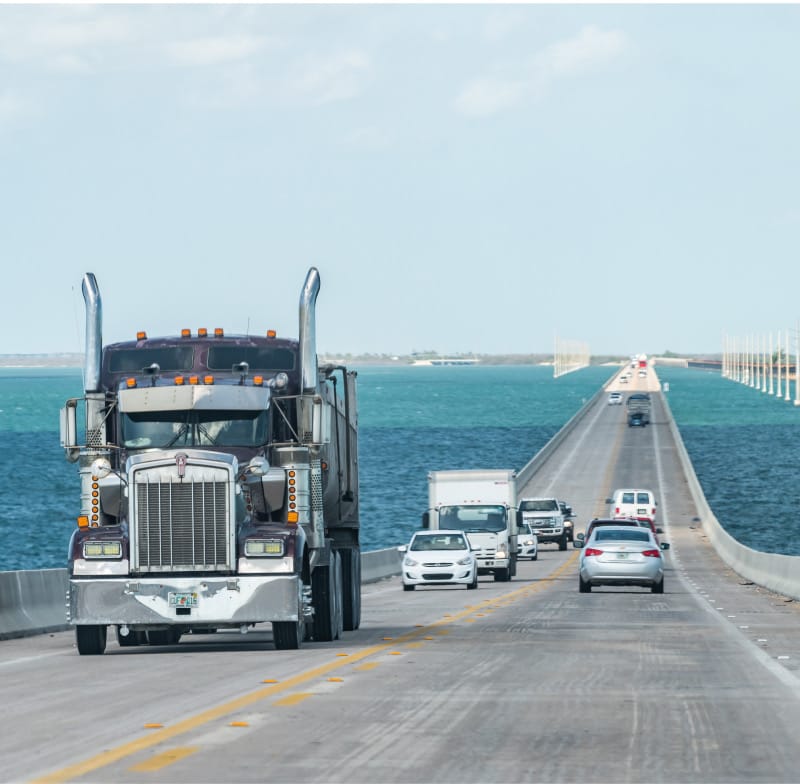
The product serves businesses shipping physical goods, including food and beverage suppliers, retail brands, packaging companies and machinery sellers. Publicly featured customers include Toshiba, Dirty Labs, Orgain and Stone Brewing. Flock says thousands of shippers use its network. This is industrial transportation: pallets travelling between businesses, with the unglamorous paperwork that keeps shelves stocked.
02 / The other shipment is the business
Oren Zaslansky founded Flock in 2015 after earlier logistics ventures. The company’s account describes parents in freight forwarding and his own experience running a truck fleet. His insight came from seeing how rigid shipping categories created waste. A customer’s order could be perfectly sensible while being the wrong size for the transport system available to it.
But putting two orders together is only the visible part. Flock must quote transportation before it knows exactly which other order will fit. In a March 2024 interview, Zaslansky described pricing the chance of finding another customer along the route. The company calls this its Pooling Probability Index. An attractive quote without a compatible second shipment becomes an expensive prediction.
Flock operates as a freight brokerage, selling transportation to shippers and buying hauling from carriers. Its margin depends on the relationship between those charges and costs. Software helps make the relationship work: pooling, pricing and route planning create more usable capacity from a truck already available. A network full of incompatible shipments would be a very elaborate address book.

03 / A new mode needs an old workflow
Shippers can quote, book and track through Flock’s platform. They can also access the service from an existing transportation management system, or TMS. API connections provide rates; EDI exchanges handle transactions such as tenders, invoices and tracking updates. A multiyear e2open partnership announced in 2023 expanded that route to customers. Oracle Transportation Management is another listed integration.
That matters because a logistics manager already has a working day. Adding a new mode becomes easier when it appears beside familiar choices. Flock also offers conventional LTL and full-truckload options. Its competitive position is the terminal-free pooled shipment, rather than the mere existence of a booking screen. Carriers, meanwhile, get load recommendations and opportunities to refill available space.
04 / The bill came due inside Flock, too
Building the system required serious capital. Flock announced a $113.5 million Series C in December 2020 and a $215 million Series D in October 2021. The latter made it a billion-dollar company by valuation. Venture financing paid for expansion and technology development; it did not settle whether each load would earn enough.
FreightWaves reported 54 job cuts in March 2024, following layoffs in April 2023. Management described the affected roles as primarily back office and linked the cuts to automation and profitability. The public record shows an operating-cost reset. A useful shipping idea still has salaries, overhead and a freight cycle to contend with.
“Our mission is to optimize the world’s freight transportation resources.”Flock Freight’s stated mission
In May 2025, O’Neil Strategic Capital led a $60 million Series E. Flock outlined plans for integrations, cargo security and better pooling. Its people pitch includes employee stock options, parental leave and a surf club. The combination is rather Californian: calculate the route, then check the waves.
05 / Start with the space you already buy
Flock’s August 2026 ROI study reported 23% average savings against the estimated market cost of shipping the same freight in partially empty truckloads. It studied ramped customers; it was company research, not an independent trial. The benchmark matters. A saving against underused truckload is not automatically a saving against every LTL quote.
Average savings in Flock’s 2026 study
Compared with estimated underutilized truckload costs; studied customers only.
A practical buyer can copy the method: identify recurring shipments leaving paid-for trailer space unused, then compare quotes and service performance. Flock identifies roughly 10-40 linear feet on recurring lanes as a strong fit. Exclusive-use freight or an already-full trailer has less reason to share. Sparse matching opportunities can also weaken the economics.
The environmental argument follows the same floor plan. More freight per truck and fewer terminal detours can reduce emissions; Flock publishes emissions reporting and identifies as a Certified B Corporation. The persuasive question remains pleasingly ordinary: before paying to move another patch of air, could someone put something useful there?