In 2020, a truck driver at NFI had a peculiar complaint. His electric truck needed recharging, so he had to finish the next load in a diesel. The nuisance was returning to the machine he already knew. A business built around moving things had discovered that changing a habit could be easier than supplying enough electricity to sustain it.
The useful bits
- NFI runs the physical work behind supply chains: trucks, warehouses, port moves and fulfillment.
- Its electric-freight experiment works around repeatable routes and a depot equipped to recharge them.
- The lesson to borrow: plan the power, maintenance and timetable together.
That is a useful entrance into NFI Industries. The Brown family’s logistics company operates in a world where the glamorous object is often the least interesting part of the story. A truck attracts the camera. A warehouse location, a utility connection and a dispatch schedule determine whether the truck earns its keep.
The business hiding behind the buy button
NFI’s job is to take responsibility for the journeys businesses would otherwise coordinate themselves. A retailer can use its warehouses to receive and distribute stock. An importer can arrange a container’s passage from port to inland facility. A manufacturer can outsource a dedicated truck fleet. An online brand can hand over picking, packing, parcel shipping and returns.
Those customers buy an operating service, with contracts and fees shaped around their requirements. The company also develops and leases industrial property. This is a substantial physical business: its September 2026 announcement reports more than $3.8 billion in annual revenue. The scale helps explain why an experiment involving 50 trucks can sit inside a much wider operation.
Shippers have alternatives, including Ryder, Penske Logistics, DHL Supply Chain and GXO for overlapping services. NFI’s particular proposition combines fleets, facilities, property expertise and freight management under family ownership. An individual customer still has to judge the relevant location, service commitments and price. Breadth is useful when it improves the handoffs; a long menu alone delivers nothing.
The depot was the difficult purchase
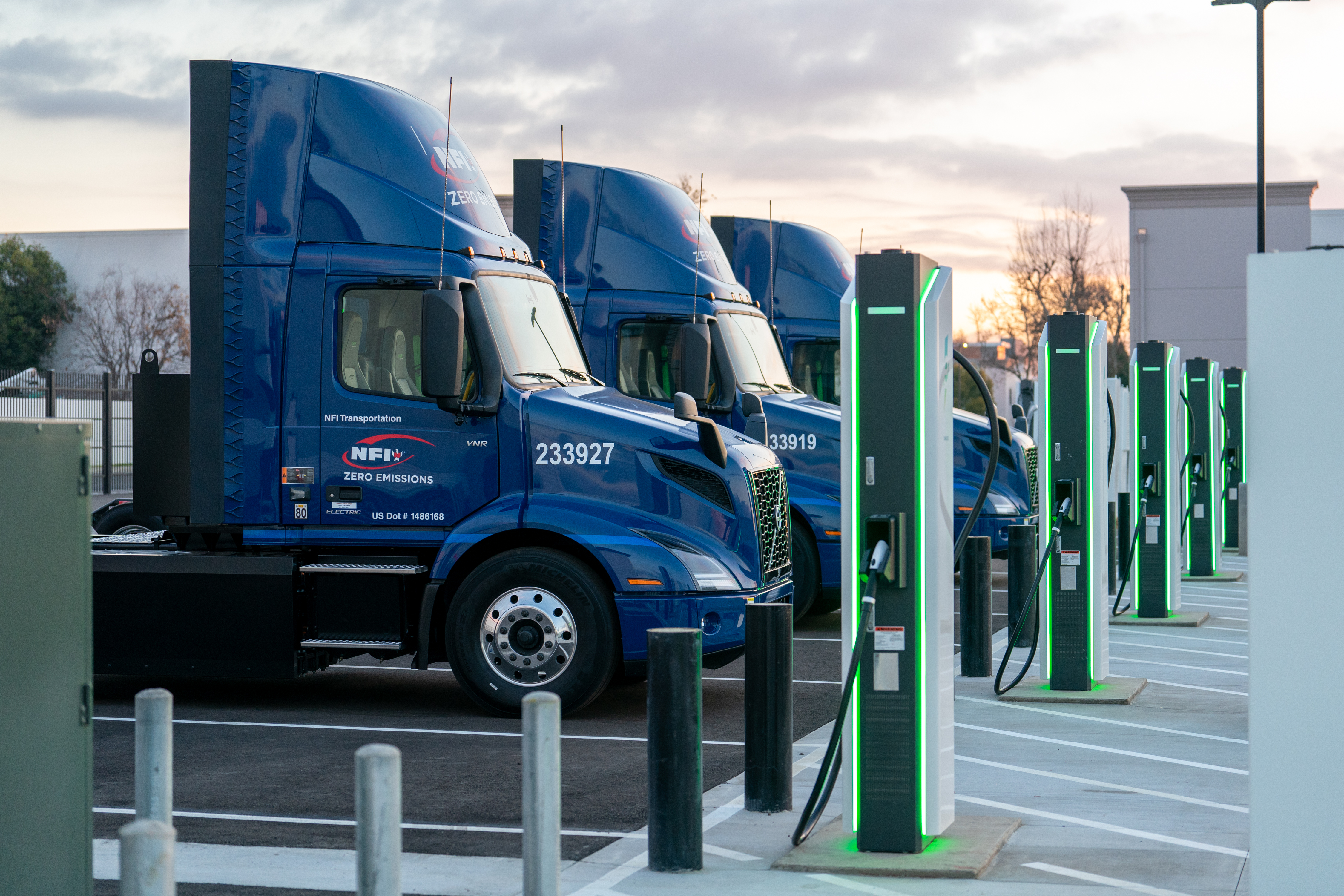
By February 2024, NFI had received 50 heavy-duty battery-electric trucks through California’s Joint Electric Truck Scaling Initiative, or JETSI: 30 Freightliner eCascadias and 20 Volvo VNR Electrics. Its Ontario, California, site brought charging and an electric-truck maintenance shop together. Electrify America and Southern California Edison helped put the power infrastructure in place.
The choice of work mattered. Drayage moves containers between ports and nearby facilities. NFI reported that the trucks typically performed two port pickups a day, averaging 220 miles between recharges. The route from Ontario to Los Angeles or Long Beach has a recognizable beginning and end. That makes the charging problem something dispatchers can organize around.
A route that comes home / reported 2024 operation
The bill extended beyond the vehicles. Transport Topics reported in 2020 that NFI had spent about $1 million on early charging stations, engineering and construction. Later, MSRC contributed $3 million toward the 50 JETSI trucks. These are separate expenditures and contributions from different stages, not a complete depot price. Cleaner freight arrived with public support as well as private investment.
The wider JETSI program covers 100 trucks across NFI and Schneider. California agencies supplied roughly $27 million to that shared project. Assigning that whole sum to NFI would produce a splendid headline and dreadful arithmetic.
A driver changes his mind
The pilots were instructive partly because they were imperfect. FreightWaves reported high-voltage system faults causing downtime in the early Freightliner trucks, with engineers stationed on site. Installing one charger took months. Electricity introduced a new negotiating partner: the utility. Diesel experience did not automatically confer electrical competence.
“It’s like driving a car compared to a diesel.”
Karl Williams, NFI driver, speaking to FreightWaves in 2020
The driver reaction supplied another kind of evidence. Initial hesitation gave way to enthusiasm after time behind the wheel. Smoothness, power and escaping the diesel smell had everyday appeal. Persuasion happened in the cab, where an operator could compare the machines directly.
For another fleet, the transferable lesson is to start with actual duty cycles. Involve the utility and city early; account for maintenance and charging time. A long, unpredictable route without reliable power has different economics from a repeated depot-return run. Incentives, electricity tariffs and vehicle costs also matter. A successful local deployment does not settle every transport problem.
Cumulative battery-electric Class 8 miles, reported by NFI in January 2026. A fleet milestone, not the mileage of the 50 JETSI trucks alone.
The family has an exit requirement
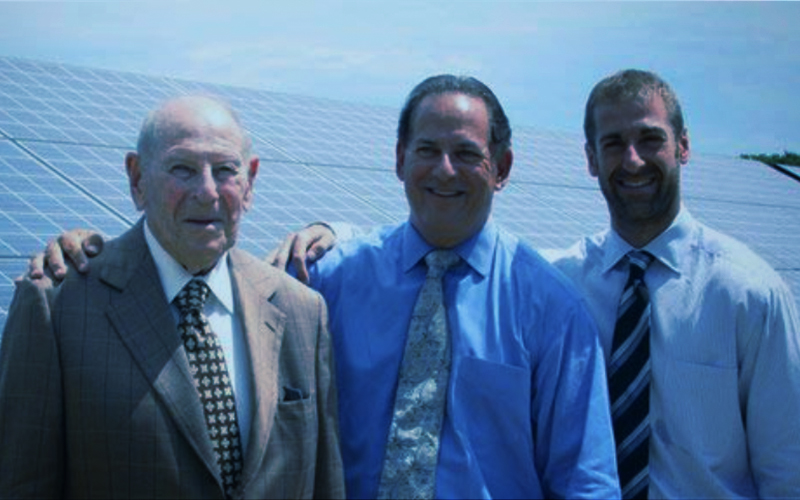
NFI began when Israel Brown established National Hauling in Vineland, New Jersey, in 1932, starting with a gravel-hauling truck. His son Bernie expanded the business; later generations continued into adjacent services. The 2017 California Cartage acquisition added port capabilities, while SDR Distribution expanded its Canadian warehouse footprint in 2023.
There is a pleasing wrinkle in the inheritance story. Fourth-generation family members must first work at another company for at least four years, then complete rotations across NFI’s roles and locations. The surname opens a possibility; it does not replace an apprenticeship. NFI also describes employee support through its disaster-assistance program, NFI Cares.
A control tower with something to do
The next adjacent job is making transport decisions. In September 2026, NFI introduced Vantage, a cloud control tower with shipment alerts, AI-assisted insights and a digital twin for testing network scenarios. NFI says its modeling identified average transportation savings of 5%-10% per customer. That is a company claim, rather than an independently established promise.
Meanwhile, the physical network keeps following customers. A May 2026 Eastvale fulfillment expansion supported a growing apparel account; NFI reported processing more than 30 million eCommerce orders annually. Software and warehouses meet at an ordinary question: where should this order go next? NFI’s appeal lies in having people who can make the decision and an operation that can carry it out.
Follow the freight
Explore NFI’s website, Vantage and its demo request, the Vantage launch announcement, and the 2024 operations recap.
Watch a day in the life of an electric drayage driver or the Ontario depot film. Find more on YouTube.