Karim Beguir gave himself five years. In 2014, he left his finance job in London and returned to Tataouine, in southern Tunisia, to try entrepreneurship. This was an unusual direction of travel for someone whose education and career had carried him through Paris and New York. He had already found a place in the international economy. Now he wanted to build something in the country where he had grown up.
With Zohra Slim, he co-founded InstaDeep in Tunis. The opening inventory has become part of the company's history: two laptops, $2,000 and enthusiasm. Enthusiasm is a wonderfully flexible asset, although suppliers tend to prefer money. By January 2022, the pair were announcing a $100 million funding round. Google, Deutsche Bahn and BioNTech were among the investors. Several years separated the laptops from that announcement, and those years deserve more attention than the before-and-after photograph usually allows.
Beguir's story invites a familiar reading: a mathematician spots an opportunity, takes a risk and builds a valuable company. But the return journey matters. He wanted young people in Africa to participate in making advanced technology. That ambition required an actual business, with customers and research to show for itself. A speech about potential would have been considerably cheaper. It would also have been considerably easier to ignore.
Karim Beguir + Zohra Slim
A childhood with more than one horizon
Born in France, Beguir moved with his family to Tataouine when he was a year old. His childhood also included time in the Hautes-Alpes, where his mother came from. Southern Tunisia and the French mountains offered quite different ideas of a landscape. He describes his upbringing through both places, and both cultures.
Tataouine comes with a conversational advantage: its name helped inspire Tatooine in Star Wars. Beguir brings up the connection in interviews. It makes a useful introduction to a town that many listeners might otherwise struggle to place. The real place, however, supplied more than a film reference. It became the point of return in a career that could comfortably have continued elsewhere.
His schooling took him through Tunisia before he went to Lycée Janson-de-Sailly in Paris for his final school year and preparatory classes. He entered École Polytechnique in 1997. Applied mathematics appealed to him for its consequences in the world. The attraction was to a discipline that could move from a page of symbols into something people actually used.
There was also room for a less mathematical enthusiasm. During his military service, he was posted to an air force fighter base. Having grown up with Top Gun and the flying adventures of Tanguy and Laverdure, he remembered the experience as another dream fulfilled. In the life of a future AI executive, this is a pleasingly analogue interlude: aircraft, people from different backgrounds and a year away from the classroom.
“My message is one of optimism.”
Karim Beguir · G7 address, 2024
The first customer wanted an answer
Further study took him to ENSAE and New York University's Courant Institute, where he completed a double-degree route in 2003. Financial engineering followed: J.P. Morgan in New York, Merrill Lynch in London from 2007, and UBS from 2010 to 2013. The work involved market models and complex risk. It gave him a decade of experience putting mathematics to commercial use.
When InstaDeep began, the founders had to discover which commercial uses people would pay for. One early system applied visual AI to luxury objects, including watches and bags, to help distinguish originals from counterfeits. Beguir and Slim sold it to a London client a year later. There is something fitting about an early AI assignment that asks whether a watch is what it claims to be. Technology businesses face a related inspection every time someone considers signing a contract.
The local sales effort was difficult. Beguir remembers Tunisian businesses treating AI as science fiction and being reluctant to pay. The company looked abroad for customers. Starting at home had given the business a purpose; finding customers elsewhere helped give it a future. Its eventual London headquarters connected it to investors and clients while its teams continued to work across Africa.
In 2019, InstaDeep raised $7 million from AfricInvest and Endeavor Catalyst. For Beguir, the Series A was evidence that the venture had commercial possibilities beyond an interesting experiment. The company had to persuade people with money as well as people with technical curiosity. Both audiences would become important to what came next.
- 2014Founded in Tunis
- 2019$7m financing round
- 2022$100m Series B
- 2023Acquisition completed
A railway is a demanding audience
In October 2019, InstaDeep announced a contract with Deutsche Bahn to research and develop an AI tool for railway planning and dispatching. The work combined operations research with deep reinforcement learning. Those are technical names for a practical ambition: making better decisions inside a system where a choice in one place changes the possibilities elsewhere.
A railway makes the point rather well. Trains share infrastructure, and a plan has to account for competing demands. An apparently sensible decision about one service can create difficulties for another. The attraction of decision-making AI is its ability to explore strategies under constraints. The railway contract concerned a prototyping tool within a longer digitisation programme. That distinction matters: winning research work is an achievement in its own right, without treating a prototype as a completed national system.
InstaDeep also developed a research relationship with DeepMind. A joint paper received a spotlight presentation at NeurIPS in 2019. Publishing research and doing customer work gave the company two ways to be assessed. An algorithm could face scientific scrutiny; a proposed application could face the less ceremonial scrutiny of a customer asking what it would do.
The same practical instinct appears in DeepPCB Pro, introduced with Google Cloud in September 2024. The product uses reinforcement learning to help automate printed circuit board design, including placement and routing. Here the problem is physical and particular: components and connections must fit within engineering constraints. Beguir's company has repeatedly sought out that kind of problem. The appeal lies in the opportunity to turn abstract methods into useful choices.
The deal did not end the work
BioNTech announced an agreement to acquire InstaDeep in January 2023. The announced terms comprised about £362 million in cash and shares for the remaining shares, with up to £200 million more linked to future performance milestones. Those are deal terms, with conditions attached, rather than a statement of money received by either founder.
The acquisition closed on 31 July 2023. InstaDeep became a London-based subsidiary and continued serving customers across industries, including transport, logistics, industry and financial services. Around 290 professionals joined the group through the transaction. Beguir stayed at the helm. For a founder whose original experiment had a five-year allowance, the work had acquired a rather different scale.
Recognition followed alongside the business. He received Endeavor's Linda's Award in December 2023 and a TIME100 Impact Award in 2024. He had joined the Endeavor network in 2018 and its Tunisia board in 2023. These connections place him among other entrepreneurs as well as researchers, an appropriate mixture for someone who spends so much time arguing that technical ability needs a commercial outlet.
Back at NYU in 2024, he shared a stage with Yann LeCun for a discussion about AI's future. Their conversation included universities, industry partnerships and the resources needed for fundamental research. Beguir had once gone to Courant to study. Returning as a company founder allowed him to approach the question from the other side: how a business might help make serious research possible.
Who gets a seat at the computer?
The infrastructure question has become increasingly concrete. In October 2024, InstaDeep announced Kyber, its computing cluster hosted in Saint-Denis, outside Paris. Equipped with NVIDIA H100 GPUs, it increased the company's computing capacity tenfold, according to the launch announcement. The company manages the cluster itself alongside its cloud partnerships.
Kyber puts hardware behind Beguir's public arguments about participation. Research requires access to machines as well as ideas. A talented person can learn a method and still lack the computing time to test it at the desired scale. Owning infrastructure gives InstaDeep greater control over that part of its work. It also helps explain why his discussion of African AI increasingly includes energy and data centres.
Training remains another part of the argument. At Deep Learning Indaba in 2024, Beguir spoke on building AI's future in Africa. InstaDeep also introduced a six-month Young African AI Research Fellowship in Kigali, developed with AscendP360 and Deep Learning Indaba and supported by Jeff Dean. Brenda Anague, a doctoral student at the African Institute for Mathematical Sciences, received the first fellowship.
That is a specific route into research: time, guidance and a place to work. It gives practical shape to Beguir's stated mission of making AI accessible. His mentoring with Google for Startups and involvement with Deep Learning Indaba belong to the same effort. The question of who builds AI becomes much easier to discuss when there are actual people, programmes and workplaces attached to it.
Skills and machines need a route into practical work.
An optimist with an infrastructure bill
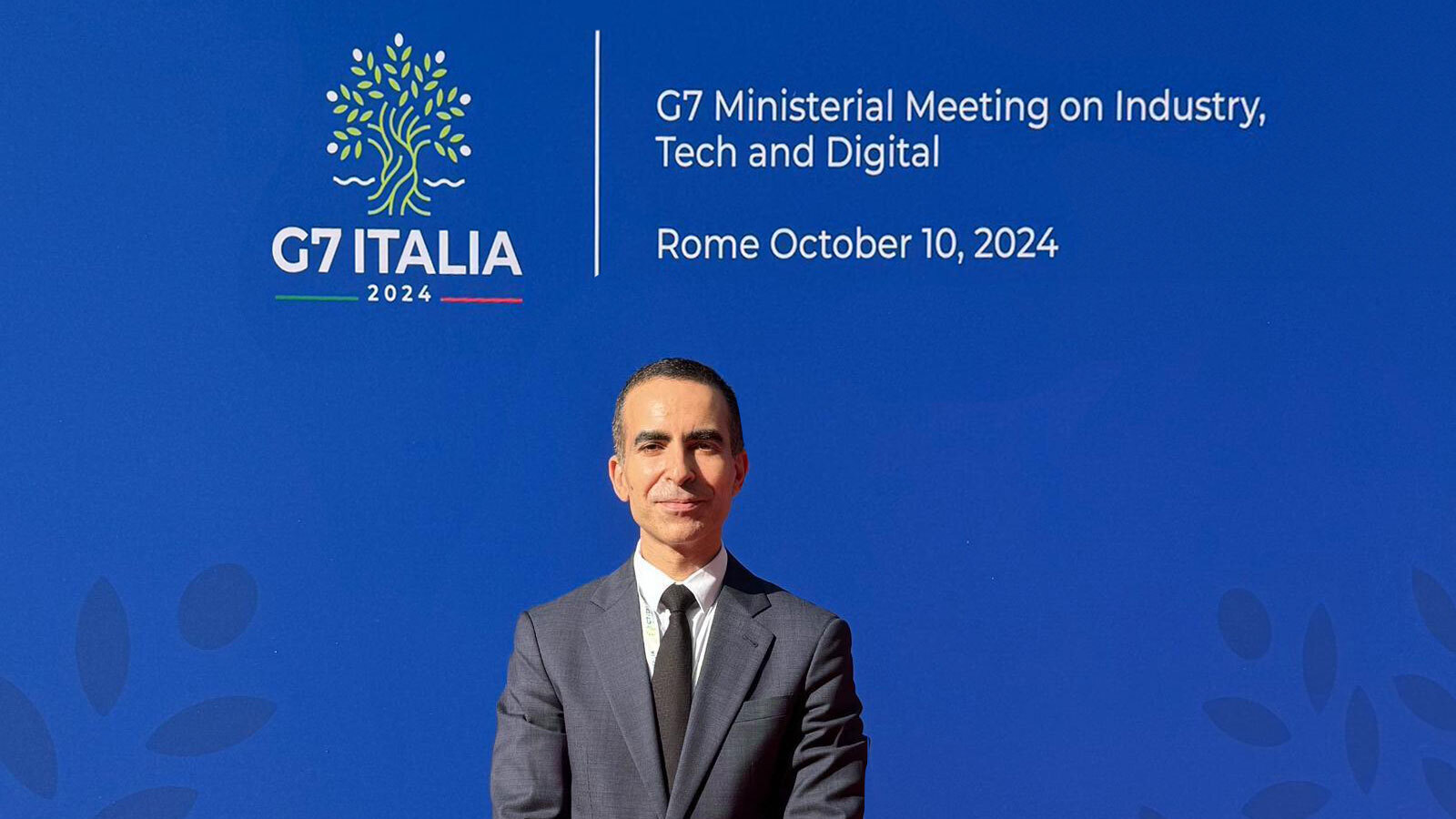
In his October 2024 G7 address in Italy, Beguir advocated cooperation between African countries and developed economies. “My message is one of optimism,” he said. He proposed solar-powered data centres in North Africa serving markets on both sides of the Mediterranean. Geography, which can limit access to a technology industry, might also offer a commercial advantage.
His 2025 book, Le Saut décisif: Construire l'avenir de l'Afrique à l'ère de l'IA, develops an argument around three technologies: artificial intelligence, renewable energy and digital currency. It is a proposal for what African economies could build, grounded in his experience as a founder. Its predictions belong to Beguir; the existence of InstaDeep supplies an example, rather than a guarantee that the next venture will follow the same path.
By May 2026, speaking at the AI Infrastructure Forum in Tunis, he was emphasising urgency. He argued that Tunisia had a limited window to turn solar resources into computing capacity and AI services. The ambition had expanded from assembling a company to encouraging an industry around it. Electricity, machines, investment and trained researchers all have to arrive in a workable arrangement.
There are quieter interests behind the public programme. Beguir reads history to unwind. In a 2024 interview, he named The Bureau as a favourite television series and mloukhia as the food he missed away from home. These are small details, but they give the international executive a recognisable daily life. The career has crossed borders repeatedly. His attachment to home has travelled with it.
The decision in 2014 remains the revealing one. Beguir already knew how to leave Tunisia and succeed elsewhere. With Slim, he chose to test what could be built there. More than a decade later, his proposals have become larger and his audience more international. The underlying ambition is still legible: give people the means to build something where they are.