The phone was getting hot. Jay Dawani was trying to make shopping for clothes more immersive, using AI to improve the experience of buying something you could not try on. The idea had possibilities. The phones had limits. They overheated, the software lagged, and the experience he needed could not fit comfortably inside the hardware people owned.
He wound the startup down. It was 2018, and the lesson was unusually physical for a business built on software: an idea can be perfectly intelligible and still ask too much of the machine. A customer does not owe you a better phone.
Years later, Dawani would help lead a company designing new chips, then give up the custom silicon to concentrate on software. From a distance, that looks like a founder changing his mind. Up close, it looks like someone repeatedly opening the machine to find the part that is holding everything else back.
Karachi, a modem and a shelf of books
Dawani grew up in Karachi in a multigenerational household, with conversation around him and dial-up internet until he was about fourteen. His own account of school is less affectionate. Memorization occupied too much of it. He preferred exploring an idea until it led somewhere unexpected.
Books, comics, films and strategy games supplied other kinds of education. Games made systems visible: a decision had consequences, resources ran out, an apparently sensible move could produce an awkward result several turns later. There was room to experiment without waiting for permission from the syllabus.
He began programming at twelve, building games of his own. At fifteen, a friend of his father encouraged his interest in AI with books. The reading included John von Neumann, Marvin Minsky, and Stuart Russell and Peter Norvig. These were substantial companions for a teenager’s curiosity.
When university approached, Dawani wanted to study AI. Unable to find the program he wanted, he chose applied mathematics at Western University. The choice gave him a way into the underlying machinery. His interest accelerated as neural networks attracted new attention. He wanted to understand them well enough to build things.
In 2020, Packt published his Hands-On Mathematics for Deep Learning, a 364-page guide to the mathematics beneath neural networks. The book moves from linear algebra and calculus toward the machinery of deep learning. Writing a guide is a different task from designing infrastructure, but it addresses a familiar obstacle: someone wants to build, and the foundations need to become understandable first.
The pool, the boardroom and the guitar
There had already been another demanding system in his life: competitive swimming. He started at seven. A second-place finish around thirteen stayed with him because he found it so disappointing. He traces part of his discipline to the discovery that enjoying a win and accepting a loss were different skills.
His coach, Sabir, supplied the daily version of that education. Dawani remembers the insistence on another lap, another attempt, the repetition that makes an ability dependable. His mathematics tutor, whom he called Biddu, encouraged abstraction and questioning. Between them were two habits useful to an engineer: keep doing the work, and keep asking why the work is arranged that way.
After the shopping startup closed, an investor connection led him into blockchain gaming. At twenty-four, he became interim chief technology officer at a publicly traded company, BlocPlay. The ensuing six months involved restructuring, product decisions and the scrutiny that comes with public markets. A leadership title had arrived with quite a lot of assembly required.
There are less corporate details, too. He played in a band in high school. Recording a podcast years later, he joked about resisting the temptation to sing. Asked what joined his varied interests, he answered plainly.
“I am very, very curious, restless, and I like hard problems.”
Jay Dawani
The robot that sent him downstairs
His work ranged through autonomous vehicles, materials discovery, simulations and robots. At Geometric Energy Corporation, he led AI work; his background also includes advising NASA Frontier Development Lab. Work connected with Mars navigation and planetary mapping placed some of the same questions in a setting where a machine’s ability to interpret its surroundings matters considerably.
The robotics problem that kept returning was broader autonomy. A useful robot has to sense what is happening, decide what to do and act before the world changes again. In 2022, Dawani described Lemurian’s early processor ambitions around that loop. Available computing power had to fit the robot’s limits on energy, space and delay.
Another memory supplied the economic constraint. In 2018, his team had tried expanding an autonomy model from 350 million parameters toward two billion on a 256-GPU cluster. He says they abandoned the effort when the cost of going further became unjustifiable. The question of intelligence had acquired a purchasing department.
The cluster Dawani recalls using for an early autonomy project. Scaling costs eventually stopped the effort.
In collaborative robotics, simulation posed a different trap. Agents could coordinate convincingly in a virtual environment, then struggle with physical machines. More detailed simulation could make matters worse by teaching the agents to depend on quirks that reality did not share. Progress required reconsidering the environment in which learning happened.
These experiences help explain why a founder interested in robots ended up working several layers beneath them. The application was only as useful as the infrastructure supporting it. A clever policy with nowhere practical to run remained an expensive demonstration.
Putting the chip back in the drawer
Lemurian’s early public proposition was hardware for autonomous machines. By 2024, Dawani was explaining its move toward data-center computing. The market had changed, and the demand for larger AI systems made the economics harder to ignore. He was now discussing the machinery needed to train and serve models at a different scale.
The mathematical element was distinctive. Lemurian explored a number format called PAL, short for parallel adaptive logarithms, alongside a spatial processing unit. How numbers are represented affects the work a processor has to perform. For a founder trained in applied mathematics, the representation itself was part of the design space.
Software was already central to this hardware plan. Dawani argued that a processor’s value depended on whether developers could use it. A technically interesting chip could impose enough programming work to make adoption unattractive. In that case, the inconvenience arrived before the performance benefit.
The company eventually moved away from building its own silicon. The destination became compiler and runtime software for heterogeneous computing: systems containing different kinds of processors. Dawani describes two strategic pivots, each requiring the team to leave behind work in which it had invested. The continuity was the desire to make AI practical.
Three answers to one stubborn question
- 01RoboticsMake autonomy practical within a machine’s limits.
- 02Chip designRethink the compute available to AI.
- 03Compiler + runtimeMake different processors work as a system.
A schematic of Lemurian’s changes in focus, not a performance comparison.
An idea should survive a change of hardware
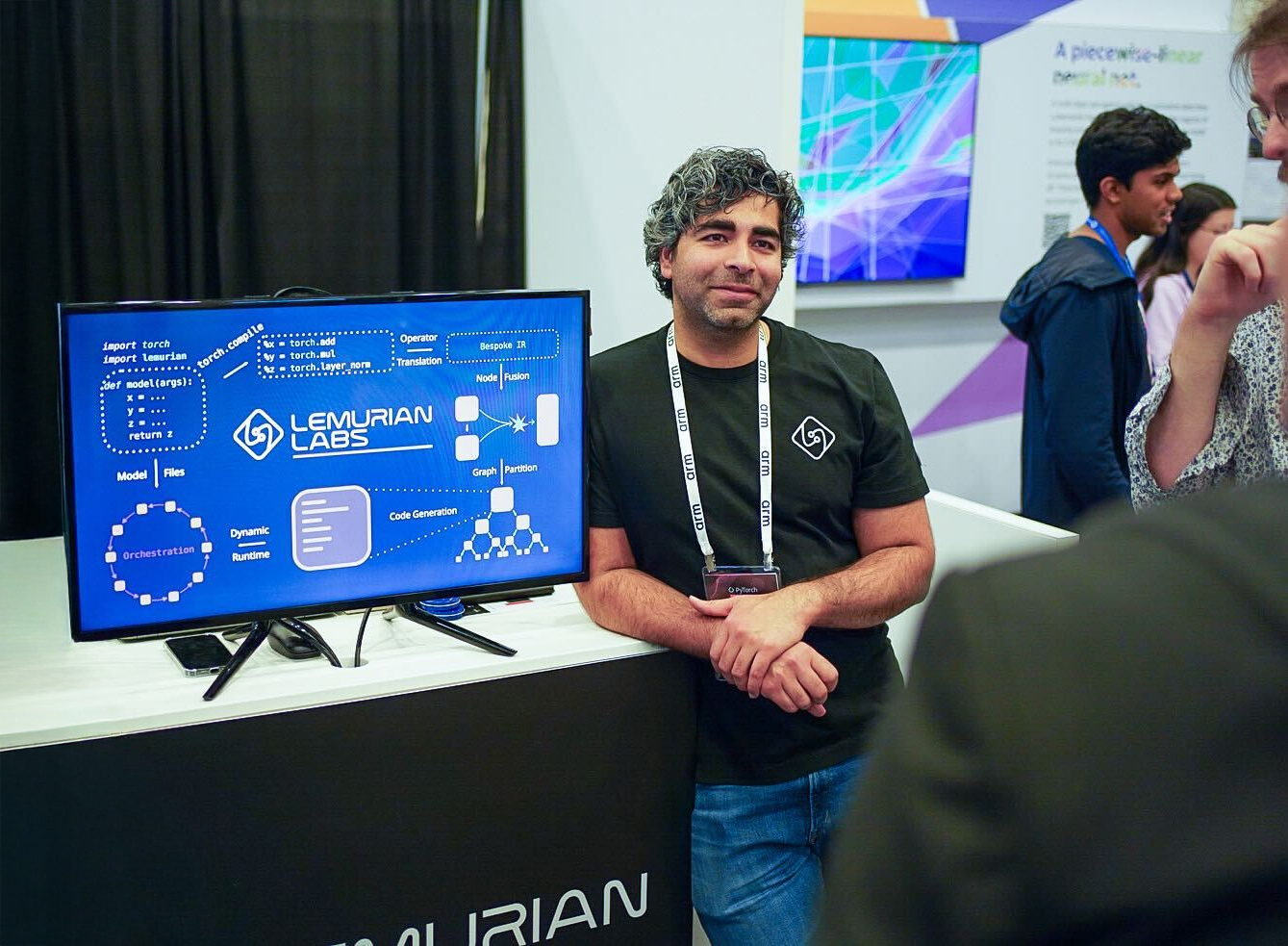
A compiler translates a program into work a machine can execute. A runtime helps manage that work as it happens. Lemurian’s current platform, Tachyon, is intended to bring those jobs together across hardware, taking AI models expressed in PyTorch toward efficient execution without requiring developers to rewrite everything for each device.
Dawani’s objection to the usual approach concerns kernels, the hardware-specific units of computation that developers tune for performance. Optimizing a local operation can be useful. But the whole workload also has to move data through memory and between processors. A beautifully optimized calculation can still spend time waiting for its inputs.
He wants the software to reason about the larger system: where work belongs, how it is scheduled and what it costs to communicate. The company’s pitch is that this wider view can make performance and portability easier to obtain together. Those are the goals against which Tachyon will have to be judged.
That concern extends beyond engineering elegance. If trying a different chip requires months of specialist work, switching suppliers becomes expensive. If a new model is awkward to express in the available tools, the cost of testing it rises. Infrastructure helps determine which ideas get a fair hearing.
Dawani is willing to question his own answer, too. Asked about competing approaches, he has acknowledged that a better one could emerge and that he would try it if convinced. It is a useful qualification from someone asking developers to reconsider habits that already work well enough to be difficult to abandon.
The next machine is still being made
In December 2025, Lemurian announced a $28 million Series A, co-led by Pebblebed Ventures and Hexagon. The announced amount included capital previously raised through convertible securities. The company said the money would support engineering, product development and partnerships.
In March 2026, Kim Polese joined the board and MIT professor Saman Amarasinghe became a technical advisor. Polese had been Java’s founding product manager. Amarasinghe’s work includes compilers and programming systems. Their backgrounds fit a company whose challenge involves both building infrastructure and persuading people to adopt it.
The next public milestone remains ahead: Lemurian lists Tachyon beta testing for summer 2027. Dawani’s ambitions reach toward autonomous agents that learn through interaction, with computing infrastructure flexible enough to support them. The developer’s immediate question will be more practical: can this tool make the next experiment easier to run?
For someone drawn to hard problems, there is plenty left to occupy him. The shopping app needed a phone that could keep up. The robots needed affordable computation. The chip needed usable software. Each answer opened another question. Dawani is still working his way through the machine.