Bobby Reddy Jr. had the technical training, a research collaborator and an idea he thought people would want. What he eventually acquired was a more inconvenient asset: the willingness to admit that the market disagreed. For an engineer who wanted to become an entrepreneur, this was an education with rather different grading criteria. A device could be interesting, difficult to build and scientifically respectable, and still fail the test that mattered to a business.
He and Rashid Bashir began combining their entrepreneurial interests in 2012. Their early device work led to a change in direction when they recognized that the market was missing. Reddy has described that decision plainly: “It was a cool technology, but the market wasn’t there, so we chose to pivot.” There is no elaborate rescue of the original idea in that account. He allows it to have been clever and commercially unpersuasive at the same time.
The distinction gives his story its shape. Today, he is the co-founder, chief executive and a board member of Chicago-based Prenosis. Those titles describe where he arrived. The abandoned assumption explains something about how he got there. The useful part of the origin story is the moment when being right about a piece of engineering stopped being sufficient.
An inventor can spend years making a thing work. A founder has to ask whether anyone has a reason to use it. When those questions produce different answers, the spreadsheet rarely offers much sympathy. Reddy's decision to change direction gave the company another question to pursue, and gave its founder a job that extended well beyond the laboratory.
“It was a cool technology, but the market wasn’t there, so we chose to pivot.”
Bobby Reddy Jr.
Before the pitch, the circuit
His academic route ran through the University of California, Irvine, where he earned bachelor's degrees in computer engineering and electrical engineering, followed by a master's in electrical engineering. At the University of Illinois Urbana-Champaign, he completed his electrical engineering doctorate in 2012. It is a substantial concentration of technical study before the chief executive's calendar begins filling with capital, recruitment and partnerships.
The publication record supplies a less polished, more revealing introduction than a business title. In January 2012, he was among the authors of an Analyst paper on electrical detection using field-effect devices. The collaboration connected researchers at Illinois with Intel Labs and Purdue. Its subject was sensing, its language precise, its author list a reminder that technical work has usually involved quite a few people before a founder's name reaches a headline.
An early ElectroCyt biography credited him with more than 25 journal publications as an author or co-author. It also described his work overseeing partnerships involving researchers, graduate students and industry professionals. The organizations included Taiwan Semiconductor Manufacturing Company, Intel and Purdue. These were already exercises in coordination: people with different specialties working on a shared technical problem, with responsibilities distributed across institutions.
Read that background alongside the later executive biography and a continuity appears. The scale and obligations changed, but collaboration was already part of the work. Research required him to connect disciplines and organizations. Running a company would make that coordination a continuing responsibility, with a payroll attached. A promising result could begin a conversation; keeping the conversation useful became part of the profession.
Electrical engineering
Master’s in electrical engineering
A company takes longer than a title
Prenosis was founded in 2014. Its early history also appears under the ElectroCyt name, preserved in a University of Illinois engineering report. That report records $5.5 million in funding closed during 2016 and places the company in the campus EnterpriseWorks incubator. The university's Research Park lists an EnterpriseWorks tenure of 2017 to 2018. Before the Chicago awards photographs, there was a university company finding its footing.
An incubator address is a small detail, but it prevents the story from floating free of place. The business emerged from an actual research group and passed through an actual environment built to help young companies. Reddy's collaborator, Bashir, was both an academic partner and a co-founder. The connection between their university work and their business was practical, carried through people, facilities and the effort of translating research into something an organization could sustain.
Reddy's present responsibilities include setting the company's direction, building its team, arranging strategic partnerships and raising capital. Each is listed in his company biography. Taken together, they describe an occupation that has expanded considerably from designing an experiment. A chief executive needs specialists whose expertise exceeds his own, and needs enough shared purpose for their different kinds of work to add up.
The change of title can be instantaneous on a business card. The change of competence takes longer. In Reddy's case, the public record lets the stages remain visible: doctoral research, an early venture, financing, an incubator, a Chicago business and a management team. There is something reassuringly ordinary about that sequence. Even a company working with artificial intelligence still has to acquire the decidedly human machinery of an organization.
Who gets into the photograph
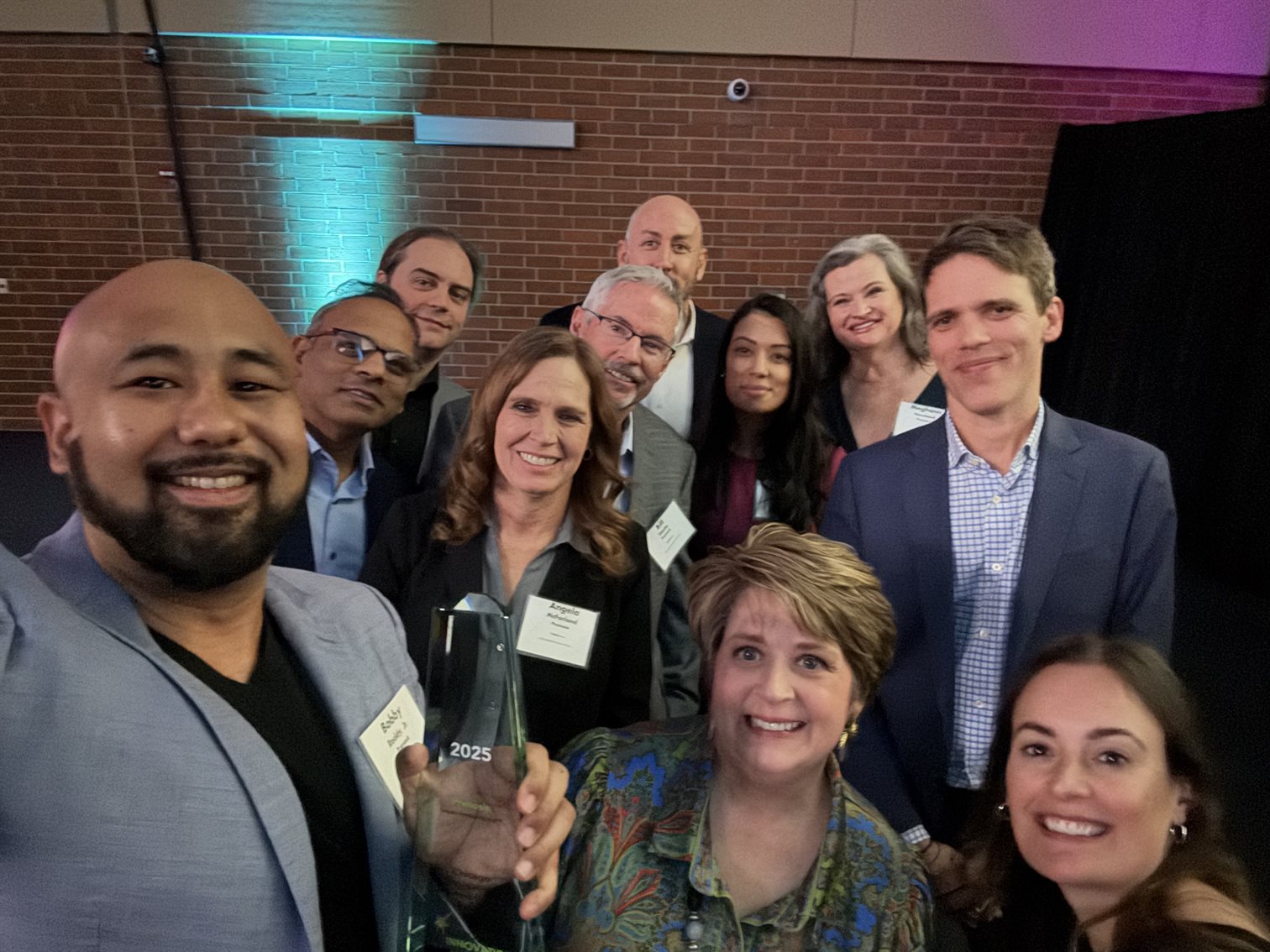
At the 2025 Chicago Innovation Awards, Reddy held the trophy and put himself at the edge of a group selfie. The photograph includes the people around him, with faces fitted into the frame at different heights and distances. It has the appealing geometry of a celebration arranged by whoever could reach far enough with the camera. The award is visible. So is the company around it.
Prenosis was named a winner at the November 13 ceremony at the UIC Forum. Across that year's competition, 315 organizations had been nominated. That number describes the whole field, rather than a tally of companies Reddy personally defeated. It places the recognition within a broad Chicago event bringing together different industries and different approaches to building a business.
A year earlier, Crain's Chicago Business included him in its 2024 40 Under 40 class. An individual accolade and a company award do different work in a biography. One attaches recognition to a person. The other gives the organization a public moment. Here, the group photograph usefully brings the two together. The founder holds the object, while the rest of the frame refuses to disappear.
It would be easy to make this a story about a lone engineer's persistence. The evidence keeps adding collaborators. Bashir is there at the beginning. The earlier research crossed institutional boundaries. The current organization has financial, technical and engineering leadership. The photograph makes the point without requiring an organizational chart. There are more people in this story than the name at the top of the page.
Twenty million, twice
On January 29, 2026, Prenosis announced a $20 million Series A financing round and a separate $20 million federal contract. The equal amounts make a memorable pair. They also require careful reading. An investment round and a contract have different purposes and obligations. Combining them into a single venture round would produce a tidier headline and a less accurate account.
The announcement connected the funding with commercial delivery, algorithm development, validation and further development work. For Reddy, this placed the business in another phase of execution. Capital enlarges the list of things a company can attempt. It also creates expectations about what those attempts should produce. A financing announcement is a date on a timeline; the work it supports occupies the less photogenic months afterward.
His approach to investors has included looking for practical involvement. In a testimonial published by PACE, he singled out the firm's experience and willingness to contribute beyond its investment. That is a revealing preference for someone whose company grew out of academic engineering. Money can fund a team. Experienced partners can help a founder think through decisions that were never part of a doctoral examination.
The scale of the 2026 announcement belongs beside the early financing and incubator years. Seen together, they show a business acquiring resources over time. There is no need to pretend that every stage was inevitable. The original market assessment had already forced a change. The later financing gives that earlier willingness to reconsider a concrete consequence: a company still present to take on its next set of obligations.
California sunshine, Chicago appreciation
Reddy grew up in Southern California. By his September 2025 conversation on AI in Chicago, he said he had spent more than 20 years in the Midwest. He praised Chicago's grounded working culture and spoke with particular affection about summer. His explanation was pleasantly economical: constant good weather in California had made it easy to take good weather for granted. Chicago supplies the contrast.
“I love the summers.” It is a modest sentence to sit beside a financing announcement, which is precisely its appeal. A person can think in long development cycles and still measure part of a year by the arrival of a season. The detail gives the executive biography a little air. The city is somewhere he enjoys living, as well as somewhere the company operates.
There is a temptation to enlist every preference as evidence of a founder's philosophy. A fondness for warm weather need not become a theory of management. Still, his appreciation of people doing their work without much flash fits comfortably beside the less glamorous parts of his own chronology. Research, organizational learning and the work after a funding announcement are all activities that continue when the audience has gone home.
“I love the summers.”
Bobby Reddy Jr. · AI in Chicago, 2025
The ambition that survived the revision
The lasting thread is his wish to build a company capable of solving a substantial real problem. The early idea changed. The desire to make something useful acquired a clearer direction. That leaves room for ambition without requiring a founder to defend every assumption he began with. In Reddy's case, revising the premise helped the business continue.
His story offers a demanding version of the engineer's move into leadership. Technical knowledge gave him a starting point. Collaborators, financing and a growing organization widened the work. The person who once concentrated on a device now has to keep different kinds of expertise moving toward a common purpose. The interesting achievement is the accumulated capacity to do that work, year after year, with other people.
Return to the trophy photograph and there is a useful final image: Reddy close to the camera, the award in hand, everyone else making room. It is a recognizable scene after an unusually long preparation. A company has reached an evening worth remembering. Tomorrow, its founder has people to work with, decisions to make and an idea of success that has already benefited from being revised.
More from Reddy’s world
Explore his company, conversations and engineering work.