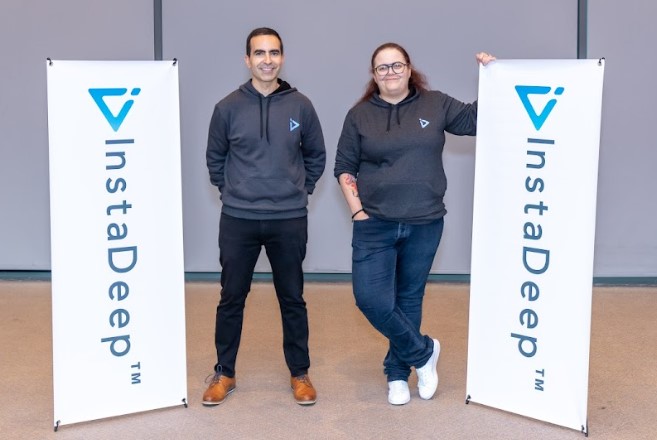
The first version of InstaDeep did not rearrange German trains or design therapeutic proteins. It made websites. That is an awkward detail in a startup story polished by a nine-figure acquisition, and therefore the useful one. Karim Beguir, an applied mathematician who had worked in finance, and Zohra Slim, a self-taught software builder, started the company in Tunis in 2014 with two laptops, roughly $2,000 and, by Beguir's account, no precise business plan. Local software work paid the bills while they searched for a harder problem.
Their early experiment was a computer-vision system that checked the authenticity of luxury objects. Tunisian companies were puzzled by the technology and reluctant to pay much for it. A buyer in London was not. The founders' conclusion was less romantic than a pivot diagram: the skill existed in Tunisia, but the nearest market for it did not. InstaDeep moved its legal headquarters to London, kept building in Africa and started selling outward.
The product is a better decision, not a clever answer
Much of commercial AI predicts a label or generates a plausible response. InstaDeep has concentrated on systems where an action must be chosen from a ludicrous number of possibilities while respecting rules. Which train moves first after a disruption? Where should hundreds of electronic components sit, and how should copper traces connect them? How do irregular boxes fit inside a container? Which protein sequence might bind more effectively?
These are optimization problems with consequences. A railway answer must coexist with safety rules, crews, maintenance closures and other operators. A circuit-board route must pass manufacturing checks. A protein design must survive biological and physical scrutiny. InstaDeep mixes reinforcement learning, operations research, high-speed simulation and large-scale compute, then wraps the result in software or a custom enterprise system. That combination is its market position: more applied than an academic laboratory, more research-heavy than a conventional consultancy, and narrower than a general-purpose AI platform.
Electronics
DeepPCBAutomates placement and routing, the fiddly geometry between an engineer's schematic and a manufacturable circuit board.
Biology
DeepChainBrings genomic, protein and antibody models into design workflows, with an AI assistant intended for laboratory tasks.
Logistics
DeepPackBuilds fast loading plans for containers, pallets and air-cargo units while accommodating real operational constraints.
Infrastructure
AIchorDistributes machine-learning workloads across clusters, the plumbing beneath increasingly compute-hungry research.
The railway was a credibility machine
In 2019, Deutsche Bahn chose InstaDeep through a competitive tender to prototype an AI capacity and traffic-management system. A single train is easy to route. A dense national network, with random breakdowns and trains blocking one another at junctions, becomes a multi-agent puzzle. InstaDeep's work expanded from research toward timetable planning, maintenance scheduling and re-dispatching. It also produced baselines with Deutsche Bahn for the 2020 NeurIPS Flatland challenge, exposing the problem to outside researchers rather than hiding it in a sales presentation.
That pattern - a difficult customer problem, publishable technical work, then a longer commercial relationship - repeated. Google and Google DeepMind became research collaborators. NVIDIA supplied an ecosystem and compute. Some customers later joined the $100 million Series B. The distinction matters: InstaDeep's partners were not decorative logos. BioNTech, Deutsche Bahn and Google invested after seeing the work.
The DeepPCB result illustrates what customers are buying. InstaDeep built a fast simulator for printed-circuit-board routing, then found that common reinforcement-learning libraries could not train quickly enough. Connecting that simulator to a TPU-oriented architecture increased throughput between 15 and 235 times compared with the legacy distributed setup and cut training costs by almost 90 percent. The model mattered. So did the unglamorous work of making the model affordable to improve.
BioNTech tested before it bought
The defining relationship began in 2019 as one project lasting a set number of months. Beguir later described it plainly: InstaDeep was being tested. Successful work led to more assignments. In 2020, the companies announced a joint AI Innovation Lab for drug design, protein engineering, manufacturing and supply chains. They completed dozens of projects, and BioNTech joined the 2022 funding round.
“We were kind of being tested. The project was successful, so we expanded to do more projects.”Karim Beguir on the BioNTech relationship
Their most visible joint proof was an early-warning system that scored new SARS-CoV-2 variants for immune escape and transmissibility. The companies said it identified more than 90 percent of variants later designated by the World Health Organization, an average of two months early. Omicron was flagged the day its sequence became available, among more than 70,000 variants discovered in October and November 2021. This was not a consumer diagnostic. It was a triage machine for a flood of genomic data.
BioNTech announced the purchase in January 2023 and completed it in July. The closing release valued total consideration for the remaining shares at approximately €500 million in cash, shares and performance-linked payments. The earlier announcement broke that into roughly £362 million upfront and up to £200 million in milestones. InstaDeep stayed a London-based subsidiary and kept outside clients in technology, transport, industry and finance. The acquirer wanted more than DeepChain: it wanted an internal AI capability stretching from discovery through manufacturing.
After the deal, biology moved to the center
InstaDeep still sells the industrial breadth. DeepPCB Pro launched with Google Cloud in 2024 using a free trial and pay-as-you-go credits. A 2026 agreement with pump maker Wilo starts with a pilot and aims at a scalable platform for smart water infrastructure. Yet the center of gravity is unmistakably BioAI.
DeepChain now acts as a delivery layer for genomic and generative protein models. The Nucleotide Transformer family learned representations from thousands of human and other-species genomes; by October 2025, InstaDeep said the models had passed one million downloads and 500 citations. ChatNT adds natural-language interaction across DNA, RNA and protein tasks. InstaNovo reads mass-spectrometry peaks to infer peptide sequences without a reference database. NTv3, described in 2026, can consider genomic contexts as long as one million bases while combining annotation, function prediction and controlled generation.
There is also physical infrastructure. Kyber, an H100-based near-exascale cluster opened outside Paris in 2024, gives the company dedicated compute for training and simulation. At BioNTech's 2025 AI Day, InstaDeep said DeepChain could screen up to 10,000 protein designs a day. Its AI-guided T-cell receptor pipeline reported binding-affinity improvements averaging as much as 50,000-fold after three optimization rounds. Those are company-reported research results, not medicines on pharmacy shelves. Biology preserves the final veto.
The part another founder can actually copy
InstaDeep's starting budget is memorable but misleading if treated as a recipe. Serious AI eventually required outside capital, international incorporation, scarce specialists and huge compute. What can be copied is the order of operations. Early service revenue bought time. Original research made an unknown Tunisian team legible to technical buyers. Bounded projects lowered the risk for large customers. Successful customers became reference accounts, collaborators and investors. Products captured repeated patterns from the custom work.
A practical sequence
- Sell a narrow service before the grand platform is ready.
- Publish enough technical work for experts to judge the substance.
- Choose problems where a better decision has measurable economic value.
- Let one successful project earn the next, larger commitment.
- Turn repeated infrastructure and workflows into products.
Its culture reinforced that loop. InstaDeep recruited from underexamined talent pools, helped convene African machine-learning communities, ran hackathons and released JAX libraries and biological models on GitHub and Hugging Face. Offices in Tunis, Lagos, Kigali and Cape Town are both a values statement and a talent strategy. London supplied customer and capital access that Tunisian regulations could not easily support at Series B scale.
Conditions attached
This approach fits expensive, repeated decisions with good simulators, reliable data, measurable rewards and room for human oversight. It fits poorly when the objective is political or disputed, the environment changes faster than training, rare failures are catastrophic, data cannot represent reality, or a customer cannot integrate recommendations into daily operations. In biology, promising computational scores still require laboratory and clinical validation.
The company is not easy to compare with one rival. An enterprise might choose its own data-science team, an operations-research vendor, a general platform such as Palantir or C3 AI, an electronic-design specialist, or a biology-focused group such as Isomorphic Labs or BenevolentAI. InstaDeep's wager is that its common machinery - simulation, reinforcement learning, foundation models, compute and deployment - travels across domains. The risk is the same as the appeal: breadth can produce unusual transfers of knowledge, or it can stretch attention thin.
For now, the post-acquisition company looks less like the generic enterprise-AI vendor of 2019 and more like BioNTech's full-stack laboratory for computational biology, with selected excursions into physical systems. That is a long way from selling websites in Tunis. It is also recognizably the same method: find a decision whose search space has become too large for people, construct a world in which software can practice, and earn the right to solve a more consequential version next.