Before Aman Bhutani became GoDaddy’s chief executive, he taught software engineers to dance to Lady Gaga. At Expedia, the routine to “Edge of Glory” travelled across offices and eventually drew in his boss, Dara Khosrowshahi. Bhutani showed off a compilation of the performances. The technology executive had found a way to make a global organisation look, briefly, like a group of people enjoying themselves.
There were other signs of allegiance: yellow running shoes with blue stripes, an Expedia lapel pin. Corporate culture usually arrives in a slide deck. His had footwear and choreography. Alongside the fun sat a serious question: how do you get people in different places, with different specialities, to move together?
That question follows Bhutani through his career. It connects the engineer to the business president, the student from Delhi to the executive in Bellevue, and the operator of a domain registration company to a bet on artificial intelligence. His answers often begin somewhere smaller than a strategy presentation: a family lesson, an uncomfortable meeting, a craft practised again tomorrow.
The first pay cheque went to his father
Bhutani grew up in Delhi. His father had been a refugee and learned to rebuild through doing. In the household, a first pay cheque came with an instruction: hand it to your father, who would put it in the bank. The prospect of celebrating with a purchase had to wait. Work carried obligations beyond the immediate pleasure of being paid.
His parents also supplied a memorable piece of transport advice. How do you ride a tiger? On its neck. Sit at the tail and every turn sends you in the wrong direction. Bhutani later applied the image to managing change. “Change is a tiger,” he said. A business leader’s position on the animal matters.
The family stories have proved portable. Another involves the mango tree, whose branches bend as they bear fruit, putting what they carry within reach. In Bhutani’s account of leadership, ability comes with a responsibility to make other people’s gifts accessible. The picture is agreeably domestic for a philosophy intended to survive the public company boardroom.
He has also described a test for taking an opportunity: S.O.U.L. There must be something you want, an opportunity that creates value for others, a unique contribution you can make, and learning. The final condition is useful insurance against becoming too pleased with the first three. A job can reward you handsomely and still leave you standing still.
An economics degree, then the engineering room
His academic route crossed disciplines before his career did. He earned a bachelor’s degree in economics at Delhi University and an MBA at Lancaster University in 1999. Economics, engineering and management would all appear in the work that followed. His résumé resists the tidy story in which a person selects a lane at university and stays there.
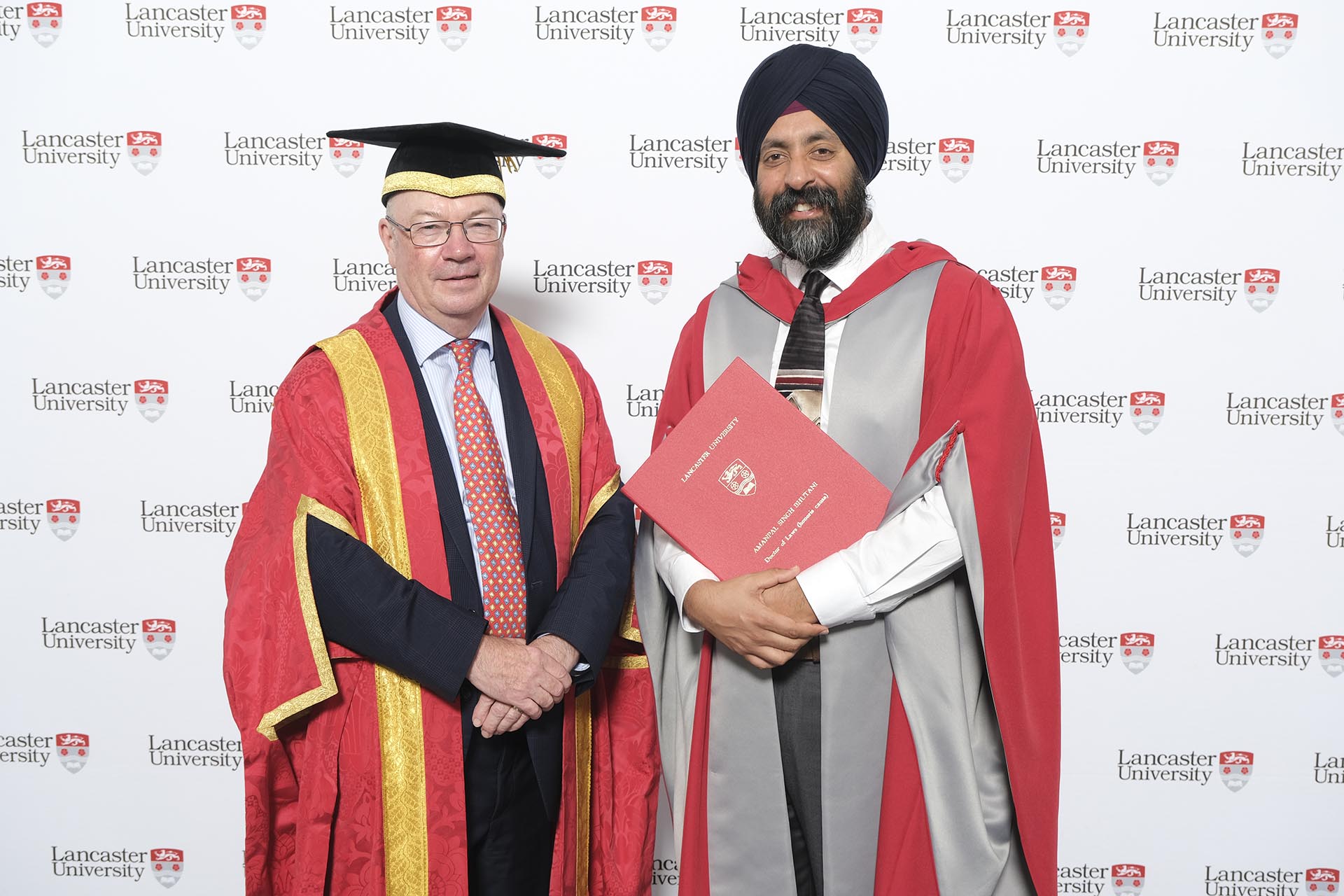
In July 2024 he returned to Lancaster for an honorary degree, 25 years after completing the MBA. Beside Pro-Chancellor Alistair Burt, he posed in academic robes with a red degree folder. “A lot of the ideas I have were formed in my mind at Lancaster,” he said. The return visit put a visible marker on an education whose effects had travelled well beyond campus.
Before the familiar company names, there was consultancy work and a startup where he was founder and technical lead. Banking followed: Washington Mutual, then JPMorgan Chase. These were roles in the machinery of online business, where an elegant idea still has to work for the person on the other side of the screen.
The meeting where expertise got in the way
At Expedia, which he joined in 2010, Bhutani led engineering before becoming president of Brand Expedia Group in 2015. That move enlarged the territory. Product and software were familiar ground. Advertising required him to learn in public, among colleagues who knew much more about it.
He has recalled staying quiet during discussions of marketing. Khosrowshahi asked why. Bhutani’s explanation was reasonable: he lacked practical experience. His boss pointed out the trap. Remaining silent would preserve that lack of experience indefinitely. He would have to contribute, get things wrong and accept correction.
By October 2026, when he recounted the exchange again, Bhutani had spent seven years running GoDaddy. The lesson had lasted longer than the meeting. It captures a difficulty that promotions can conceal: a larger title does not confer knowledge of the larger job. You acquire that knowledge while people are watching.
There is a companion skill in his account: knowing when to listen. A board member once praised his balance of thinking, speaking and hearing others. The two lessons belong together. Speak where you need to learn; leave enough room for somebody else to teach you. A meeting can become quite expensive when everybody concentrates on demonstrating their attendance.
The craft has no graduation day
Bhutani’s model of improvement draws on shokunin, the Japanese ideal of dedication to a craft. Watching Jiro Dreams of Sushi helped him give the idea a name. The comparison he chooses each day is with his previous self. The chief executive’s title supplies a job description; it does not declare the work finished.
He makes the model practical through a sequence: transparency, awareness and discipline. Reveal what is happening, understand it, act on it, then repeat. Humility, hunger and responsibility complete the set of principles he describes. The attraction of this approach is its refusal to let awareness count as an accomplishment by itself. Seeing a problem still leaves the problem.
“How long will it take to test?”
Bhutani on decision-making at Expedia, 2015
At Expedia, that habit appeared in an emphasis on testing changes before settling arguments through organisational rank. A debate about a product can continue until the person with the largest office grows tired. An experiment creates another route to a decision. It also asks a mildly inconvenient question of the confident executive: what evidence would make you change your mind?
The principle gets harder when the decision hurts. In a 2026 conversation, Bhutani recalled the reduction of roughly seven percent of GoDaddy’s workforce in 2023. He said he wrote the message himself, then spent 90 minutes answering employees’ questions. His account included a challenge about why he had not cut his own salary.
Those figures cannot measure how employees felt about losing colleagues or jobs. They do show what his stated preference for transparency required of him in that moment: remaining available for questions he could not expect to enjoy. A leadership philosophy earns its keep on the days when nobody feels like putting on the company shoes.
A big company serving very small ones
Bhutani became GoDaddy’s CEO on September 4, 2019. The company recruited an executive who had worked across engineering, products and commercial operations. At Expedia, his work had included a shared technology platform supporting multiple brands. GoDaddy presented another version of the coordination problem, with an unusually broad population of small customers.
A domain purchase is a modest transaction attached to a potentially large ambition. Someone is naming a shop, offering a service or putting years of practice in front of paying customers. The owner may know the trade thoroughly and have little interest in learning the mechanics of websites, email campaigns and online checkout.
Bhutani’s argument for an independent website rests on ownership, control and legitimacy. Social platforms can help customers discover a business; the business also benefits from a place of its own. That is an intelligible commercial position for a domain registrar. It is also a useful way to understand his audience: people who want technology to help their work find a public.
His New York Times Company board role, which began in 2018, offers a different seat in another digital business. He serves on its audit and finance committees. The connection adds breadth to a career already spanning banking, travel and small business services. Across those organisations, the questions of technology and business performance keep returning in different clothes.
The next routine is called Airo
GoDaddy Airo brings that small business argument into artificial intelligence. Describe an idea and the service can help produce a business name, a logo, a website and marketing material. The promised saving is time between deciding to begin and having something customers can use. For Bhutani, this is a way to apply software to the intimidating collection of tasks that surrounds a new venture.
He announced GoDaddy’s return to Super Bowl advertising after eight years away to promote Airo. The February 2025 campaign featured Walton Goggins and his Goggle Glasses business. Spectacles supplied the spectacle, but the advertised work was practical: establishing a website, arranging communications and getting an online business moving.
Customers worldwide, as reported in GoDaddy’s first-quarter 2026 prepared remarks. Behind the total are individual businesses with individual reasons to begin.
By October 2026 the infrastructure was expanding too. GoDaddy added hosting, professional email and commerce interfaces to its Developer Platform, allowing developers and AI agents to connect more of the steps between working software and an operating business. A separate demonstration with Infoblox, Google and Cloudflare explored how agents could identify themselves and complete transactions across platforms.
These developments give his long-standing interest in coordination a new cast of participants. Software agents introduce questions about identity and permission as well as speed. The demonstration showed a possible architecture; its wider usefulness will depend on what businesses can reliably do with it. Bhutani’s preference for evidence has plenty of work ahead.
The dancing engineers remain a useful place to leave him. The routine was light-hearted, but getting people to participate required a leader willing to join in. Much of his subsequent career has involved that same willingness to be seen learning: entering the marketing discussion, returning to the classroom, answering the uncomfortable question. The next improvement may be small. He has built a working philosophy around showing up for it.