An insurance policy can tell an agent what a business bought. The harder question is what the business should have bought. FatBrain’s insurance pitch lives in that gap: give an agent enough relevant knowledge to spot the missing coverage while there is still time to discuss it.
The useful bits / 30 seconds
- Peer intelligence: compare a business with relevant businesses around it.
- Insurance: bring underwriting references into the sales conversation.
- Distribution: work through software agents already use.
- History: read the expansion story alongside the accounting and deal disputes.
A very old book, a very current problem
In July 2023, FatBrain announced IntellAgent Advisor for independent property-casualty agents. Its knowledge partner was Rough Notes, an insurance publisher dating to 1878. The proposition joined established underwriting references with FatBrain’s private data model technology, called FatGPT. An old reference shelf was getting a different front door.
The announced workflow began with a prospective client’s name and address, or a photograph of an existing policy. Advisor would relate that business to one of 700 business classes and surface coverage considerations. That is a specific job for AI: helping an agent prepare a better conversation about a particular risk.
The announced Advisor workflow / 2023
Borrow the neighborhood’s homework
FatBrain’s broader idea is that a business’s own records reveal only part of its situation. Peer behavior and market signals might reveal the rest. The company compares this with Waze: the useful information comes partly from everyone else on the road. For a business, the challenge is deciding who belongs on the same road.
Co-founders Peter B. Ritz and Rajarshi Das described a business AI approach that packages analytical capabilities into services. Their writing emphasized recommendations and business outcomes without requiring customers to assemble large specialist teams. The company’s offering spans software, market data and expert help, sold through subscriptions and designed to connect with existing applications.

That places FatBrain between enterprise analytics, integration services and industry software. Its distinction is the proposed combination of comparisons, specialized knowledge and delivery. A buyer should judge that combination against the decision it improves, including the manual research or existing software it would replace.
The shortcut was distribution
In August 2023, FatBrain announced an agreement with Appulate to distribute Advisor. The release described Appulate’s network as nearly 300,000 users at 35,000 agencies, connected to 150 carriers. These were channel figures. They described the doorway available to FatBrain, rather than how many customers had walked through it.
The commercial logic is easy to appreciate. Agents already working inside insurance software are a more specific audience than everybody who might someday want AI. Bringing a product to that workflow reduces the need to persuade an entirely new audience to change its habits. Distribution becomes part of the product design.
A channel tells you where a product can go. Adoption tells you whether anyone wants it.Reading the Appulate announcement
The July launch offered three complimentary subscription months. That gives the reader a concrete introductory offer, but it does not establish the ongoing bill. A sensible pilot would compare time spent preparing advice and the quality of coverage discussions before committing to a larger rollout.
A currency problem with a receipt
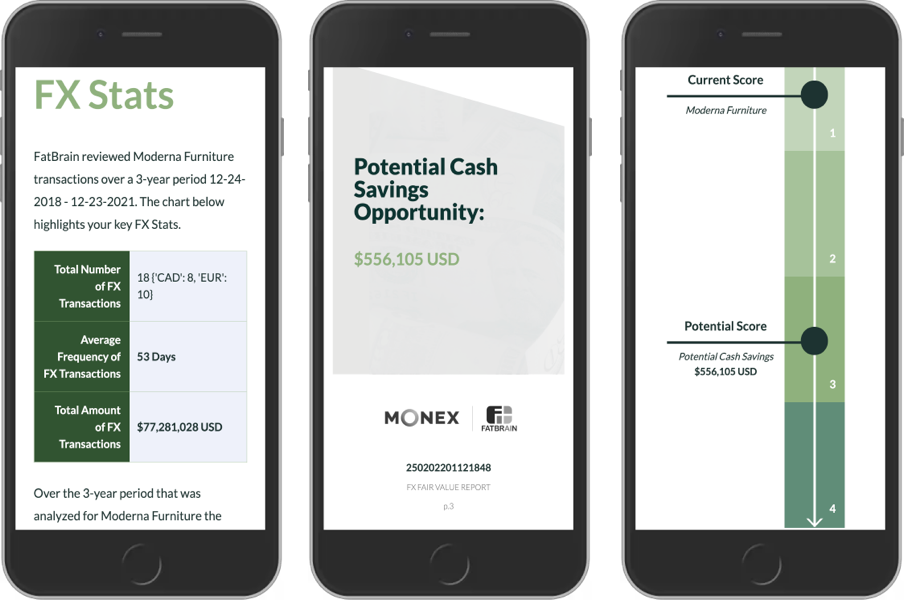
Foreign exchange offers another way to understand the company. FatBrain’s FX page describes a Monex partnership and a Fair Value Report that reviews historical transactions for potential savings. It combines analysis with adviser coaching and offers API access for businesses wanting to incorporate the service into their own offering.
The prospective users include importers, freight forwarders and businesses making international payments. Here the starting material is refreshingly ordinary: transactions that already happened. The proposed benefit is a clearer view of costs and purchase timing. Potential savings remain potential savings until a business checks them against executable terms and its actual obligations.
Growth acquired a back office
FatBrain expanded its delivery capacity through acquisitions. In June 2022 it announced the purchase of Kazakhstan’s Prime Source, then described as having 450 engineers and more than 2,000 customers. Its capabilities included integration, automation and risk analytics. In September, FatBrain acquired Intellagents and its insurance integration marketplace.
Expansion had a bill. FatBrain’s October 2023 announcement reported unaudited fiscal-year revenue of $45.4 million, operating expenses of $24.4 million and a $13.7 million net loss. Research and development accounted for $13.1 million of operating expenses. Those are historical company-reported figures, rather than a description of today’s economics.
Research and development expense
The reporting machinery was under pressure, too. An October disclosure identified international accounting requirements as a hurdle to year-end filings and described plans for automation and additional staff. Ritz acknowledged “international accounting hurdles and late filings.” This is an early documented strain in the expansion story: consolidating businesses also means consolidating their accounts.
A separate September 2023 announcement repositioned FatBrain as an AI venture operating company. Management attributed the decision to an internal strategic review and the opportunity to combine investing with operating expertise. The ambition had widened beyond selling a set of software subscriptions.
The deal needs a second date
In March 2024, Genius Group announced a transaction involving FatBrain. A clarification described the purchase of selected assets and liabilities through a subsidiary, explicitly saying no merger into Genius had occurred. By December, Genius’s board had voted to seek rescission through arbitration. The early celebratory headline had acquired a much less celebratory sequel.
On April 20, 2026, Genius announced a final ICC award against LZG International, entitling it to the return of approximately 7.4 million shares and $7.97 million. Genius said it intended to enforce its rights. An announced entitlement should not be confused with money already collected.
There is still a useful product lesson here: start with a costly decision, find relevant knowledge, and put it where someone can act. Peer comparisons need comparable peers, timely information and professional judgment. Without those conditions, the neighborhood’s homework may simply be the wrong assignment.