Karan Chaudhry once gave a three-word answer to a question about his biggest business mistake: “Hiring too fast.” It is an unusually economical entry in the literature of startup regret. There was no elaborate explanation about market timing before the admission. His first startup had recruited in anticipation of growth. Spending rose, the runway shortened, and some early hires proved a poor fit. The future had been invited onto the payroll before it had agreed to turn up.
Today, Chaudhry is the co-founder and CEO of Sprouts.ai, which builds customer intelligence and revenue agents for enterprise sales teams. It is work surrounded by the promise of acceleration. His earlier admission supplies a useful counterweight. He has experienced how a business can move quickly while making its own job harder. Across his career, the interesting question is often what deserves attention before anybody presses the accelerator.
A customer comment becomes a company
Before enterprise sales agents, there was DropThought. Chaudhry co-founded the business and served as its CEO. The product used machine learning and text analytics to turn immediate feedback into something a company could use. Customers and employees leave a great deal of information in ordinary language. DropThought worked on finding meaning inside those comments, giving businesses a way to hear more than a score.
The company’s early orbit included Stanford marketing professor Baba Shiv and investor and Stanford teacher Robert Siegel. Its enterprise customer names included Adobe, Cisco and Juniper. Those connections placed Chaudhry in a setting where academic ideas about people met the requirements of large organizations. A comment could be understood by an individual. Making thousands of comments useful to a company required a system.
There was also the less tidy business of being a founder. Born in India, Chaudhry had earned MBA and MS degrees at Stanford. In 2015, while building DropThought, he described the uncertainty of running a startup on an H-1B visa. He said he had raised roughly $5 million to $6 million, yet still faced questions about whether he could remain the person running the company. Capital and permission were separate obstacles.
He also spoke about the shortage of established Asian executives as role models and the difficulty that created for people trying to move up. It adds a human complication to the usual founder biography. Starting a company could offer a way to take responsibility for an idea, while introducing another set of dependencies. Even the person who created the job had matters beyond his control.
Who is the customer?
What are they telling you?
What should happen next?
The bill for moving too quickly
Chaudhry’s operating advice has often been shaped by these practical limits. He favored releasing a minimum viable product and adjusting it through user feedback. His warning was that founders could perfect an idea for so long that they discovered the customer’s disagreement very late. Small releases made learning possible while giving a team visible progress. The customer got a vote before the entire product had been built.
Software development supplied another education. While bootstrapping a startup, he tried contracting out parts of the codebase to help meet release deadlines. The apparent shortcut accumulated its own work. Negotiating the agreement took three to four weeks. Larger clients could take priority at the supplier, while suggestions for additional features pulled attention away from the minimum product his team was trying to finish.
He described uneven development quality, the difficulty of replacing people, and the work of integrating outside code. Even a colleague with experience managing external projects found the arrangement difficult. His account is useful because it follows the cost beyond an invoice. A founder also spends attention, coordination and time correcting assumptions that the cheaper proposal never priced.
There is a recognizable business temptation in both stories: hiring people for expected demand, or adding developers to speed a release. Each decision promises capacity. Each also creates obligations. Chaudhry’s experience makes the trade-off concrete. A team has to manage the people and connections it adds, and the burden arrives immediately, whether the hoped-for advantage arrives on schedule or takes its time.
“Be scrappy and don’t let go of that mindset even as you grow.”
Karan Chaudhry
The next video, the next audience
His next entrepreneurial chapter moved from feedback to discovery. Comnplus developed machine-learning personalization and recommendations for online digital content. Chaudhry was its co-founder, chief product officer and global head. The underlying task involved choosing what a viewer might want to see next. An enormous catalog can be a rather lonely place if the interesting thing remains somewhere beyond the screen.
Comnplus was acquired by TVFPlay within six months. DropThought, too, was acquired. These are the compact milestones that make a biography look orderly. The work connecting them is more revealing: understanding responses, interpreting behavior, and helping a business decide what to put in front of somebody. A customer comment and a viewing choice are different kinds of evidence about a person.
By August 2019, Chaudhry was discussing The Viral Fever’s plans as its president and COO. Regional programming was a priority as India’s expanding internet audience brought more people from smaller cities online. He described an audience whose needs could not be served simply by repeating an offering designed for the earliest internet users. The market had grown, and its composition mattered.
He was also explicit about the sequence of the business model. TVF wanted more scale before considering a freemium offering in India. Advertising included brands integrated into shows and videos, alongside more familiar advertising formats. Distribution relationships extended across several streaming and digital platforms. Behind the entertainment was a set of decisions about audience, reach and how the work would be paid for.
His career also included an EVP role at Disney+ Hotstar. Earlier, he had worked in sales and marketing at PepsiCo India and corporate development at Applied Materials. The range is considerable: consumer products, industrial technology, feedback software and entertainment. Across those settings, he has repeatedly worked where a product must find its market and a business must learn how to reach people.
- 01 / DropThoughtWhat people sayInstant feedback and text analytics
- 02 / ComnplusWhat people watchContent personalization and recommendations
- 03 / Sprouts.aiHow buyers are understoodAccount intelligence and revenue agents
A culture with room for bowling
For all the discussion of markets, some of Chaudhry’s most specific observations concern the people inside a company. At Comnplus, he described asking prospective hires about their passions and why those interests mattered. The conversation helped him understand motivation. It also allowed an interview to become a less formal exchange, with room for the candidate to explain what actually animated them.
His examples of culture were similarly tangible. Colleagues acknowledged one another’s work during daily standups. People raising problems were encouraged to bring possible solutions, and some of those suggestions became the chosen approach. New employees received a buddy for their first thirty days. Anonymous feedback gave staff another route to suggest changes, with action on a few recommendations helping people take ownership.
Then there was the disagreement over outings. Some people wanted a movie night; others preferred bowling. His answer was to combine the two or schedule separate events close together. A minor detail, perhaps, but an unusually useful one. A company can write many words about valuing its team. An evening out still requires someone to notice that the team has preferences of its own.
Learning to ask the sales question
Chaudhry has also spent time on the questioning side of a microphone. In a conversation published in August 2024, he interviewed sales coach and SalesQualia founder Scott Sambucci about moving from founder-led sales to a repeatable process. They covered early revenue, understanding an ideal customer, and building a sales team. The discussion concerned the transition from personal effort to something other people could carry forward.
His public conversations have included other operators working on customer success, marketing and growth. Alongside his StartX mentoring, those exchanges show a founder willing to examine the operating details with people who work on them. Selling software brings a recurring challenge: the product can be ready while the process for finding, convincing and serving its customer is still under construction.
At Sprouts.ai, his public argument centers on the quality of the information underneath that process. He has called for shared definitions across teams and systems, cleaner identities, and a more coherent picture of buyers. It is an argument about what automation receives as input. A system can act on a record very efficiently while the person described in that record has long since changed jobs.
Fourteen million dollars, and the same old question
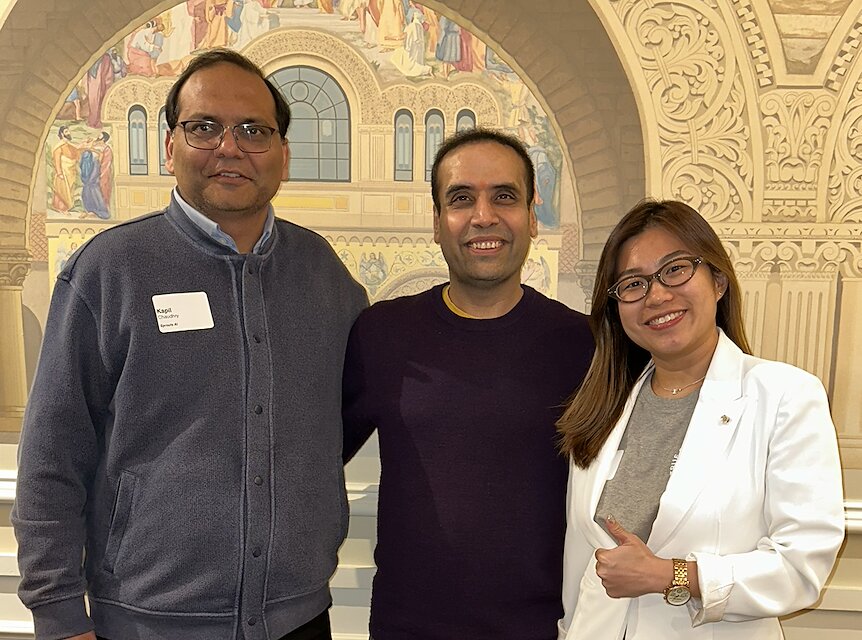
Chaudhry founded Sprouts.ai with Kapil Chaudhry and Avinash Nagla in 2023. In May 2026, the company announced a $9 million pre-Series A round co-led by True Global Ventures and Accel, taking its disclosed funding to $14 million. Its product brings account intelligence and automated sales workflows into environments including Salesforce and Microsoft Dynamics. The ambition is to work inside systems enterprise teams already use.
$14M disclosed total · Pre-Series A
“The B2B revenue stack is broken,” Chaudhry said when the financing was announced. His stated ambition was to bring revenue agents into enterprises using major customer-management platforms and language-model interfaces. For a founder who has worked on feedback and recommendations, the move into buyer intelligence has a familiar concern beneath its newer vocabulary: a company needs a usable understanding of the people it hopes to reach.
One of his older habits offers a small way to think about the work ahead. He described beginning the business day by making a prioritized list and doing the large tasks first, before urgent demands took over. A list cannot settle every question in a growing company. It can insist that some things deserve attention before the interruptions start. Chaudhry’s career keeps returning to the customer. The next question is what to do with what he hears.
Keep the conversation going
More from Karan Chaudhry, and conversations from across his career.