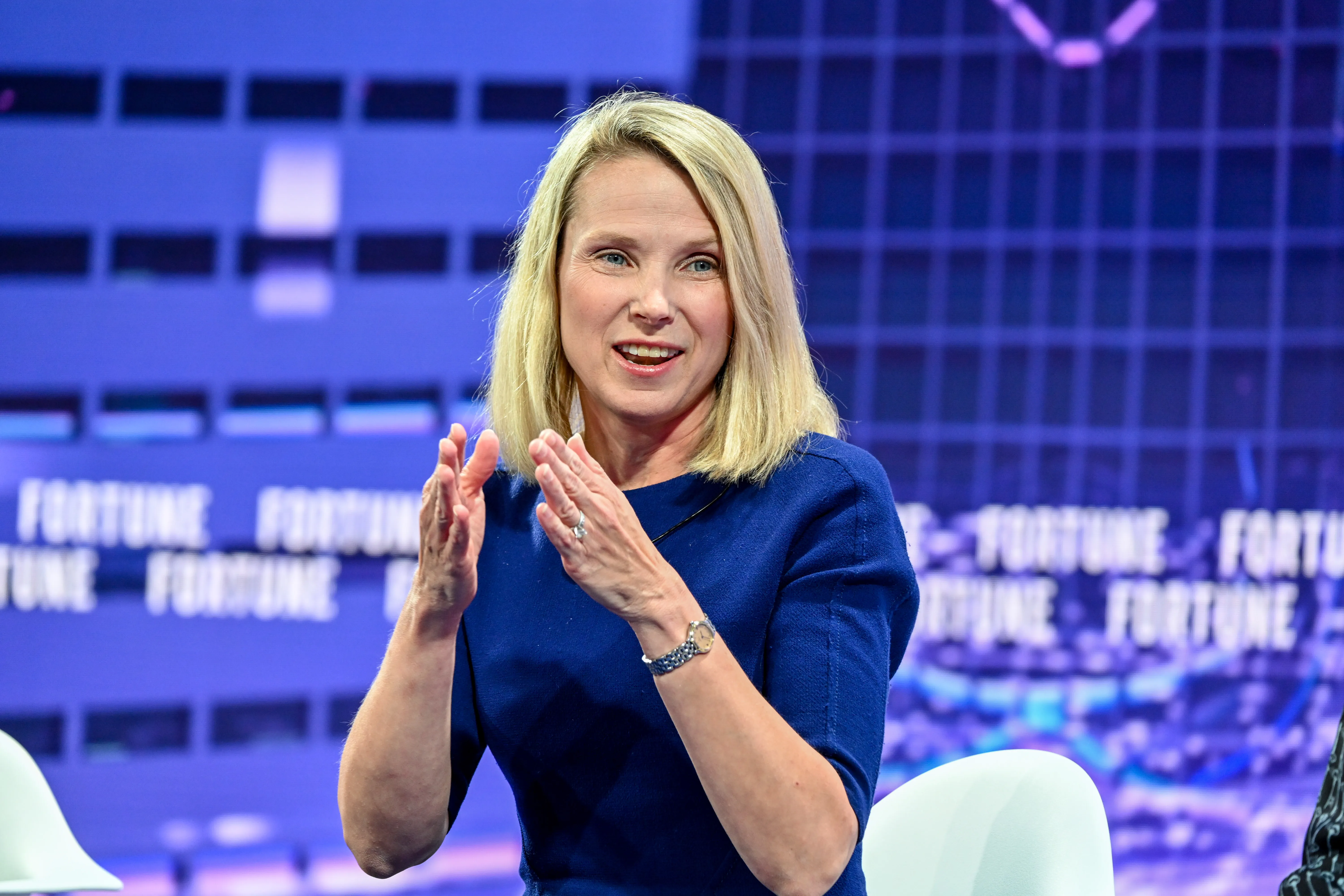
The Scientist Who Bakes
Most people don't commission Dale Chihuly to install 400 pieces of glass sea creatures on their ceiling. Then again, most people didn't walk into Google as employee number 20, the first woman engineer, when the company was running out of a garage and figuring out how to index the internet.
Marissa Mayer has always had a thing for the specific. Not big ideas. Specific things. The precise shade of blue on a search button. The exact curvature of a logo. The particular way cupcakes respond to new ingredients when you approach baking like a controlled experiment.
"I've always loved baking," she once said. "I think it's because I'm very scientific." She tinkers with recipes the way she tinkers with code. Change one variable. Observe. Iterate. Repeat.
This is how you get from Wausau, Wisconsin - where she was "painfully shy" and crammed her days with ballet, ice-skating, piano, swimming, debates, and Brownies - to Stanford, where she showed up planning to become a pediatric neurosurgeon and left with degrees in symbolic systems and artificial intelligence. The major didn't even make sense to most people. Philosophy plus cognitive psychology plus linguistics plus computer science. Who does that?
Someone who's wired to see patterns between things that don't obviously connect. Someone who, 25 years before the AI boom made everyone suddenly care about symbolic reasoning and neural networks, was already thinking about how machines understand meaning.
"I always did something I was a little not ready to do. When there's that moment of 'Wow, I'm not really sure I can do this,' and you push through those moments, that's when you have a breakthrough."
The breakthrough moment at Google came early. She wasn't just writing code. She was deciding what the internet would look like. Google Search, the thing billions of people use without thinking, started as hundreds of thousands of queries a day when she arrived. Under her product management, it scaled to over a billion. Daily.
Then Gmail. Then Google Maps. Then Google Earth. Then Street View. Then Chrome. Thirteen years of building the foundational tools that now feel inevitable, like they always existed. They didn't. Someone made them. Often, that someone was Marissa Mayer's team.
She taught computer programming at Stanford while doing this. Mentored kids at East Palo Alto Charter School. Collected art - Warhol, Lichtenstein, the kind of pieces that end up in museums. Became a devotee of Oscar de la Renta. Built a life that looked nothing like the stereotype of a Silicon Valley engineer, which was probably the point.
"I'm not a woman at Google," she said. "I'm a geek at Google. And being a geek is just great."
Then came Yahoo. In 2012, when the company was circling the drain and everyone agreed it was too late, too broken, too far behind Google and Facebook, Marissa Mayer took the CEO job. Pregnant. At 37. The youngest woman to ever make Fortune's list of the 50 Most Powerful Women in Business.
The Yahoo years don't fit a clean narrative. She hired 5,000 people. Grew the user base to a billion people worldwide, 600 million on mobile. Built a multi-billion dollar advertising business in mobile, video, native, and social. The company still sold to Verizon in 2017. Some called it a failure. Others pointed out she inherited a company most people thought was already dead.
What's undeniable: she gave birth to her son Macallister months after becoming CEO, then had identical twin daughters Marielle and Sylvana three years later, all while running a Fortune 500 company through one of tech's messiest turnarounds. The woman does not do things the easy way.
"You can't have everything you want, but you can have the things that really matter to you."
- Marissa Mayer on priorities
After Yahoo, most people with a $1.3 billion net worth would retire. Buy an island. Collect more Chihuly installations. Marissa Mayer co-founded Lumi Labs (later renamed Sunshine) in 2018. The pitch: consumer AI applications. Contact management. Photo sharing. The kind of everyday-task software that sounds boring until you realize how much of your life you waste on it.
Sunshine didn't work. Seven years, $20 million raised, and by September 2025, she shut it down. Most founders would lick their wounds. Take a break. Reassess.
Mayer had already started building Dazzle.
By December 2025, Dazzle AI raised $8 million at a $35 million valuation from Forerunner, Kleiner Perkins, Greycroft, Offline Ventures, Slow Ventures, and Bling Capital. The mission: bridge the gap between what people want and what AI can actually do. Next-generation personal assistants. The kind that make everyday tasks feel magical instead of frustrating.
She's doing it again. The thing she's a little not ready to do. The thing that might not work. The thing that, if it does work, will change how millions - maybe billions - of people interact with technology.
This is the pattern. Pre-med to symbolic systems. Google employee to product manager. Product manager to Yahoo CEO. Yahoo CEO to startup founder. Startup founder to startup founder again. Each time, stepping into uncertainty. Each time, pushing through the discomfort.
She sits on the Walmart board now. Serves as a trustee for the Lucile Packard Children's Hospital, the San Francisco Museum of Modern Art, the San Francisco Ballet. Remains connected to Stanford. Has three kids. Manages a billion-dollar fortune. And still finds time to experiment with cupcake recipes.
Because here's the thing about Marissa Mayer: she never stopped being the shy kid from Wisconsin who filled her days with activities. She just scaled it. Ballet became board meetings. Piano became product launches. The Brownies became building companies that serve billions.
The geek who wouldn't be defined by gender. The scientist who treats baking like an experiment. The executive who commissions art installations and collects Warhols. The billionaire who keeps starting over.
Dazzle is expected to emerge from stealth in early 2026. Whatever it is, it'll be specific. Meticulously designed. Probably not what anyone expects. And if the past 27 years are any indication, it'll be something Marissa Mayer wasn't quite ready to do.
Which means it might just work.
In Her Own Words
"I'm just geeky and shy, and I like to code."
- On her identity
"If you can find something that you're really passionate about, whether you're a man or a woman comes a lot less into play. Passion is a gender-neutralizing force."
- On passion and identity