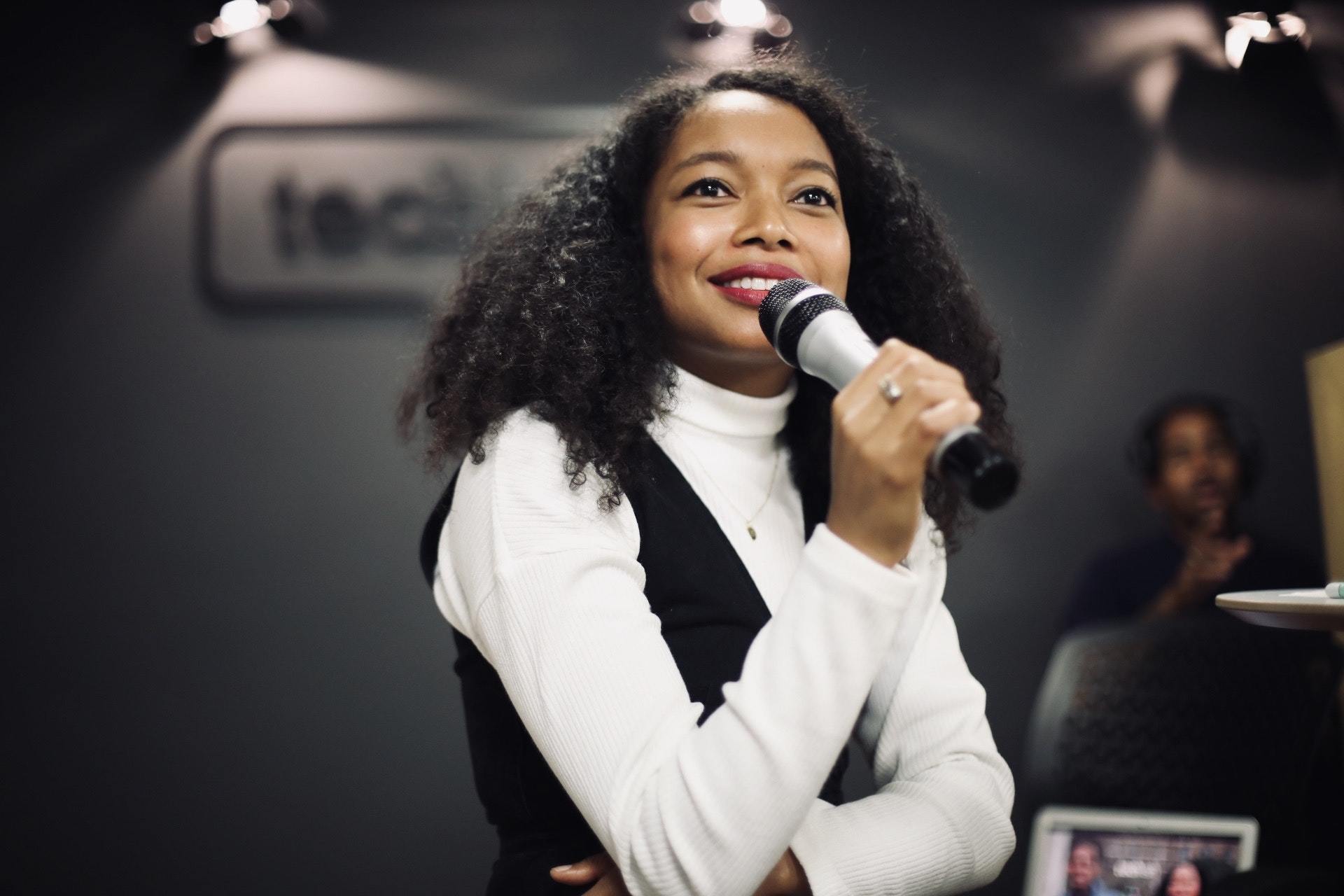
Her first professional invoice was for acting in a BBC Radio 4 play. She was still in school. The second - the one that really changed things - came when she discovered that male colleagues with the same grades, sometimes lower, were earning two to three times her salary. She didn't cry. She didn't quit. She wrote a book, founded a company, and spent the next decade making that particular kind of discovery less common for everyone else.
That's Abadesi Osunsade: the kind of person who turns grievances into infrastructure.
Born in Washington D.C. to a Nigerian father (Oxford PhD, IMF economist) and a Filipina mother who met him in the Philippines in the 1970s, Abadesi grew up across East Africa as a diplomat's child. By the time she arrived at Roedean, the all-girls boarding school in Brighton where she'd later become a school governor, she had already lived on three continents. She describes herself as a child as "precocious, bright and talkative" - teaching herself from lengthy books just to prove to older siblings she was ready for school. The hustle was always there. The word just hadn't attached itself yet.
LSE followed: BSc Economics and Government, class of 2009, graduating straight into the wreckage of the financial crisis. Her observation from that time is sharp enough to frame: "When I got to LSE I realized how many stupid people are really good at exams." She filed this away and applied the actual lesson - research everything, prepare like an exam, then walk in the room like you've already won - to her job hunt instead.
"The sooner you start the quicker you learn. I'm still not ready. But I'm in the game."- Abadesi Osunsade on launching Hustle Crew
Groupon London hired her as employee number eleven or twelve - the precise number matters less than the fact that she was in before the chaos, before the $16 billion IPO that would briefly make it the fastest-growing company in history. She scaled her department five-fold in eight months. Then came Amazon - slower, more bureaucratic, less her - and then HotelTonight, where she learned to pitch mobile tech to hotel managers who'd never touched an app. Each stop added a tool to the kit. None of them was the destination.
August 2016: she co-founded Hustle Crew with Natalie Nzeyimana, her old friend from Roedean. The origin story is honest rather than romantic. She was frustrated by the homogeneity of tech. She had written a book, Dream Big. Hustle Hard: The Millennial Woman's Guide to Success in Tech, tested its ideas in workshops, and the response told her something: people needed this. What started as $40/month coaching for individuals shifted, without fanfare, into enterprise DEI training for Google, Pinterest, BBC, the Mayor of London, Airbnb, NHS England, and Meta. No outside funding. No code written. Squarespace, GoPaywall, Stripe, MailChimp, Buffer. A global brand built on the back of no-code tools and relentless clarity of purpose.
Simultaneously - and this is the thing that people tend to miss - she was doing everything else. Head of Maker Outreach at Product Hunt (2017-2020). Scout at BACKED VC. Scout at Ada Ventures, the £50M fund backing underrepresented founders. Co-founder of Elpha, the professional community for women in tech that walked straight into Y Combinator's S19 batch. Co-founder of Extend Ventures, a non-profit producing data on funding disparities for diverse founders in the UK. Trustee of Art Fund and GoodGym. Global VP of Community and Belonging at Brandwatch, where she increased Black hires by 800% year-on-year and LatinX and Middle Eastern hires by 700%. All of this, mostly at the same time.
"A man can negotiate for a pay rise and meet favourable results. A woman can do the exact same thing and be described as aggressive."- Abadesi Osunsade
The Techish podcast is its own category entirely. Co-hosted with Michael Berhane (founder of POCIT - People of Color in Tech), it cracked Apple's Top 20 Technology shows and occupies a particular frequency: internet culture, capitalism, millennial life, industry news, and pop culture, delivered with the energy of two people who have both been the only one in the room and found something useful to say about it. The first live London show, November 2019, sold out with a hundred people. The podcast now lives on Apple, Spotify, iHeart, and YouTube.
What makes Abadesi unusual is not the list of things she's done - impressive lists are everywhere in tech and largely indistinguishable from each other. It's the thread running through them. Every role, every venture, every scouting deal points back to the same structural problem: underrepresented people in tech don't have access to the informal networks, unseen mentors, and back-channel information that their more privileged peers navigate as a matter of course. She saw this clearly at twenty-something, earning a fraction of what her male colleagues made, and decided the answer wasn't to assimilate quietly. The answer was to make the invisible visible, then change it.
She's now Ecosystem Lead at Geovation, Ordnance Survey's initiative connecting UK location data startups with founders, corporates, government, and investors. The role fits: she has spent a decade mapping the invisible terrain of the UK tech ecosystem, and this is just another version of that work, with satellites involved.
In 2025, she keynoted the Women in Cybersecurity event at Infosecurity Europe, sharing a stage with Professor Brian Cox and Rory Stewart. Her message, delivered with her characteristic directness: "I know from experience how hard it can be to claim your place in a male-dominated industry. But it's not about fitting in, you have to stand out."
Accolades have accumulated the way they do when the work is consistent: Forbes 30 Under 30 Europe (Technology, 2019), FT Top 100 Influential Leaders in Tech (2018), Forbes 25 Black Business Leaders to Follow (2020), Computer Weekly Top 50 Women in Tech, Management Today Inspiring Women in Business (2021), UKtech50 Most Influential in UK Technology (2023). She collects them the way she collected Lisa Frank stationery as a child - with genuine enthusiasm, but they're not the point.
She has described burnout cycles as a recurring pattern in her career, and a 2025 podcast appearance on The Slow Down found her in the unfamiliar territory of learning to listen to her body, say no, and locate an opinion that wasn't someone else's. The woman who built a company and a movement on the principle that you should start before you're ready is now, perhaps, learning what rest looks like for someone who doesn't naturally sit still.
Her dream dinner table: Sharmadean Reid, Malala Yousafzai, Joy Adowaa Buolamwini. The conversation she'd want there isn't hard to imagine - the intersection of beauty, politics, and algorithmic justice, served with enough directness to strip paint.
She is, in the end, one of those people who changed the conversation by insisting that the conversation wasn't the goal. The goal was the industry itself - who gets to work in it, who gets to lead it, who gets funded, who gets hired. Eight years in, she said she was proud to still be in tech, still working, still pushing. That's not a small thing. It's actually the whole thing.