In April 2016, Justin Villiers and two colleagues asked the University of Ottawa for $1,500 to start a rocketry project. Their proposed destination was 20,000 feet. The ambition came with a less theatrical requirement: the rocket and its payload had to return. Altitude, deployment and recovery would all count in the competition they hoped to enter. Getting something into the air was only part of the assignment.
It is a useful place to begin with Villiers, now Scription’s co-founder and Chief Strategy Officer. His early project list includes an airship mechanism, an experimental drone and a V8 engine table. The table deserves a pause. An engine has many possible afterlives; supporting someone’s coffee is among the more civilised. Here was an engineer interested in what machines could do, including things their original designers probably had not considered.
His career would eventually take him into commercial equipment maintenance, a field where success can look suspiciously like nothing happening. A machine works. A business opens. Nobody makes an emergency call. That quiet outcome has become the centre of his business, although the route there passed through workshops, university research, earlier ventures and the practical problem of persuading several kinds of people to want the same thing.
There is a thread connecting these projects, if you follow the work rather than the job titles. Villiers repeatedly dealt with machines whose behaviour had to be understood and controlled. The rocket needed a reliable return. The drone project explored directing airflow while maintaining constant propeller speed. Later, he would study how to recognise a machine’s operating state. At Scription, the question widened to include the people paying to keep it running.
Learning to hear a failure coming
Villiers studied mechanical engineering at the University of Ottawa and went on to master’s work involving artificial intelligence and machinery. He also worked as a CNC technician and lead project manager at LCS Images Technology. Alongside those roles came startup experience: UpWind, Buildup Products and a venture publicly listed as a stealth startup. The record is crowded with making, testing and building organisations around an idea.
One student project, developed in 2018 and 2019, used vibration signatures to anticipate mechanical faults. His description focused on a standalone device intended to make repair and replacement decisions easier. In 2018, his robust vibration monitoring device took first place at the Ontario Makers & Mentors Innovation Design Competition. It was an early, concrete expression of the problem he would keep pursuing: getting useful information before an expensive surprise.
The academic work became more specialised. A 2021 conference paper with Patrick Dumond examined transferring fault detection between distinct datasets for roller element bearings. Another paper, with Dumond and David Knox, addressed automating predictive maintenance through transfer learning and ensemble methods. These are particular research questions, concerned with whether a learning system can remain useful beyond the conditions in which it was first developed.
That distinction matters. An algorithm can have an impressive afternoon on familiar data. A working business needs it to encounter unfamiliar machines, settings and operating conditions. Villiers’s thesis topic brought generalisation and automation together in fault classification for rotating machinery. His later public thank-you to Dumond and Knox offered a small glimpse of the relationships behind the technical work: the founder had supervisors to thank before he had investors to thank.
The bill has a design problem, too
Scription was founded in 2020. By 2023, Villiers was explaining its purpose in terms of incentives: owners and service companies should both benefit when equipment keeps working. The company’s approach combined contract pricing, insurance backing and a network of service partners. Historical maintenance data helped price contracts for individual pieces of equipment. Technical knowledge had acquired a second job: helping decide who could carry the financial risk.
Consider the arrangement as a design problem. Under hourly billing, a repair produces revenue for the service company and an expense for the owner. A subscription creates a continuing payment around a different expectation. Preventing a breakdown becomes commercially useful. This is the economic argument behind Villiers’s work, rather than a claim that technicians secretly wish their customers misery. A contract can encourage a result without anybody waking up with villainous intentions.
Service revenue follows a repair.
A continuing contract rewards keeping equipment running.
His stated ambition in 2023 was to “have everyone benefit from equipment uptime.” The sentence is plain enough to fit above a workshop door. It also sets a demanding condition. The owner has to find the payment worthwhile, the service company needs a viable business, and the contract has to be priced sensibly. A clever sensor cannot negotiate those terms by itself.
“The secret of how this all works is preventive maintenance.”
Justin Villiers · June 2025
Greenlight Re’s description of its investment captures the operational scope: Scription developed an end-to-end way to price, sell and manage subscription maintenance contracts through service partners. That sequence is revealing. Selling a promise is one task. Managing it after the sale is another. For Villiers, the engineering challenge had expanded from recognising a fault to making a commercial arrangement work through the uneventful months and the inconvenient ones.
A kitchen is an unforgiving test bench
By June 2025, Scription was serving quick-service franchise operators associated with McDonald’s, KFC, Taco Bell, Wendy’s and Dave’s Hot Chicken. Villiers described a geographically dispersed company: he was based in Ottawa, service operations were in Edmonton, engineering was in Calgary and much of business development was in the United States. Most clients were American. He also reported the company’s first Canadian deal, with a McDonald’s owner-operator.
A photograph from a hospitality-college kitchen in Las Vegas puts Villiers at the left of a line of six people, with dean David Cárdenas at the right. It is a fitting setting for this part of his career. Stainless steel offers fewer opportunities for romantic startup imagery than a glass meeting room. It does, however, put the equipment in the picture. The business lives with physical things that must work during someone else’s working day.
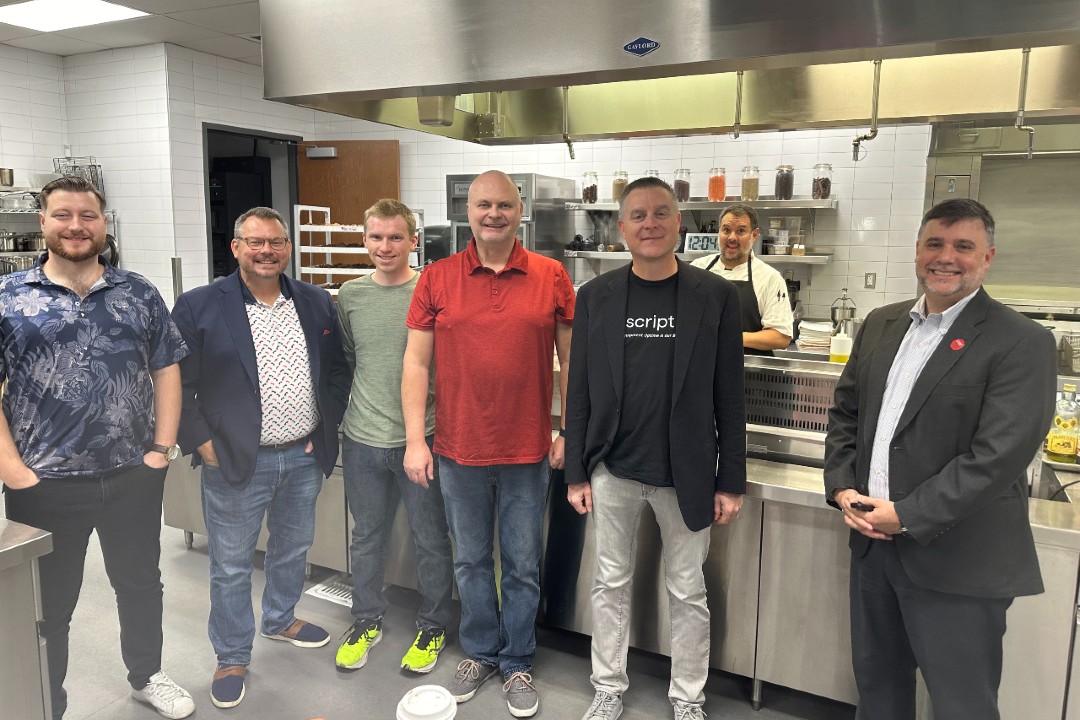
For a founder trained to study faults, a restaurant introduces another kind of system: staff, equipment and customers all depend on timing. The significance of prevention becomes easy to explain without a technical diagram. A repair can restore a machine; it cannot replay the hour in which the machine was unavailable. Predictability has value because an operator still has other decisions to make while the repair is being arranged.
A new role, with familiar colleagues
Scription announced a US$2.5 million pre-seed round led by Markd in October 2023. Villiers’s own announcement thanked early backers and described Alchemist Accelerator and Plug and Play as programmes that helped tune the business. Startup TNT, he wrote, had supplied one of the company’s first cheques. This was a founder giving credit to a collection of people and institutions, rather than presenting a company as a solitary act of invention.
The public exchange had room for a joke. In the comments, Dave Cotter teased Villiers about being better at raising capital than playing ping-pong. A funding announcement is a fairly ceremonial object. Here, someone had brought a paddle to the ceremony. The remark tells us only that a colleague made the joke, but that is enough: the professional network also contained memories of an ordinary game.
The next financing brought a change in leadership. A US$7.85 million seed round closed in January 2025, led by IA Capital Group with further participation from Markd. The May announcement introduced Gerritt Graham as CEO and identified Villiers as Chief Strategy Officer. The company reported US$10.35 million raised to that point. Graham brought insurance-industry experience; Villiers remained a co-founder with a different executive responsibility.
Seed closed January 2025; announced May 2025. Funding is company capital, not personal wealth.
A title change is a visible fact, while a founder’s private feelings about it are something else. What Villiers chose to express publicly was enthusiasm for expanding Scription360 across North America and welcoming Graham. His other posts were similarly attentive to colleagues: sharing vacancies, acknowledging growth and appreciating time spent with leaders after the company began moving from fully remote work toward in-person and hybrid arrangements.
The next problem is sitting on the roof
By September 2026, the company’s public emphasis had moved to fixed-price commercial HVAC service contracts. On September 23, Scription announced a reseller partnership with GlacierGrid, offering its monitoring technology as RoofIQ Plus. The intended customers included smaller commercial operators across the United States. The proposition linked equipment data to the practical responsibility of responding when that data points to trouble.
The current Scription website describes a fixed annual price billed monthly, coverage for parts, labour and travel on covered repairs, and the option to keep an existing contractor. Those details show how much the business depends on fitting into an operator’s life. Changing a payment structure is already a substantial request. Letting a customer retain a familiar service relationship makes the proposition less socially complicated.
The partnership also makes the connection to Villiers’s earlier work visible again. Monitoring can help identify a developing fault. A contract determines how the financial consequences are handled. The two belong together in this business model, although the announcement is a company development rather than evidence that Villiers personally designed each part. His documented career supplies the continuity: machinery, prediction, entrepreneurship and the economics of maintenance.
The student rocketry proposal had an explicit target and a requirement to bring the payload home. Scription’s work is judged by a quieter set of outcomes, spread across equipment, contracts and service calls. Villiers’s story has followed that change in scale. The ambition remains practical. Get the machine to do its job, arrange the people around it, and make the return journey less of a surprise.