A flat tire is an unusually persuasive critic. It has no interest in your qualifications, your schedule, or the excellent reasons you had for postponing a little maintenance. For Josh Carter and his future co-founder, Brandon Richardson, one such interruption became the beginning of a business. Richardson was driving a passenger car while studying at Stanford when a neglected, underinflated tire went flat. His question was simple enough to sound almost impertinent: a wheel was already turning, so could that movement power a pump?
Carter joined Richardson in pursuing the answer. They were mechanical engineering graduate students who had met at Stanford, looking for a problem worth working on. In 2010, they launched Aperia Technologies. Their eventual product, Halo, would use wheel rotation to maintain tire pressure while a vehicle traveled. The invention put an everyday oversight inside a mechanical system that could do something about it.
The attractive part of this origin story is its lack of ceremony. Nobody needed to invent a new desire. People already wanted tires that stayed properly inflated. What Carter and Richardson had to establish was whether they could make that happen reliably, on equipment that earned its living outside a laboratory.
The wheel already had a job. They gave it another.
The founders turned toward commercial trucking, where an underinflated tire carries consequences through a whole operation. Fuel consumption, replacement costs, maintenance time, and interrupted deliveries all belong to the same ledger. A small recurring loss becomes considerable when vehicles keep accumulating miles. Carter’s choice of market placed his engineering work beside those practical concerns from the outset.
Halo bolts onto the wheel hub and uses the wheel’s motion to drive an internal pump. Its original mechanical design needed no connection to a truck’s compressor. Aperia described the principle through a familiar comparison: a self-winding watch. The comparison is useful because it makes the source of power intelligible. The vehicle’s ordinary movement becomes part of its upkeep.
Road travel supplies rotational motion.
Halo converts that motion into pumping.
Air goes into a tire when it needs it.
There was also a business decision hidden in the location of the device. In 2015, Carter explained why drive and trailer tires came before steer tires. One Halo unit could serve two tires on a side in the dual-tire positions; at the steering axle, the unit would serve one. The early market priorities followed the value available to the customer. Even a clever mechanism needs to earn its place on a truck.
That is an appealingly unromantic detail. A founder can love an invention and still count the tires it serves. Carter’s explanation treated cost and application as design constraints, rather than awkward questions to be dealt with after the unveiling.
Before the booth, the listening
Carter and Richardson spent their early years getting close to the industry they hoped to serve. Carter has recalled attending trade shows before Aperia took a booth of its own. Fleet operators and suppliers shared what they knew, helping the founders understand the work around the hardware. For a startup entering trucking, listening was part of product development.
By the time Halo was introduced at the Technology & Maintenance Council meeting in 2014, the company said it had completed more than two years of fleet field trials and eight million miles of road testing. These are useful measures of the distance between an idea and a product. A working prototype answers one question. Repeated use by people with freight to deliver answers many more.
“Our product development philosophy was to involve real users of the product early and often.”
Josh Carter, on Halo’s development
In February 2015, Carter and Richardson accepted the Truck Writers of North America’s 2014 Technical Achievement Award in Nashville. Halo had been selected from five finalists, including an axle system, a fifth-wheel camera system, LED lighting, and a brake drum. It was a competition among things a truck could actually use. The company’s air pump had found its peers.
When Carter discussed the development process, the people he included ranged from senior executives to shop managers, mechanics, and drivers. That list matters. The person buying equipment, the person installing it, and the person relying on it during a trip encounter different versions of the same product. A design has to survive all three conversations.
By February 2016, Carter reported that Halo was on thousands of vehicles across more than 100 fleets. Aperia also brought in Andrew Smith, founder and former chief executive of trailer-aerodynamics company ATDynamics, as a senior advisor. The young company was developing connections to people who understood the work of bringing efficiency equipment into trucking.
Detroit enters the conversation
In 2016, Michelin introduced Michelin Auto Inflate, powered by Aperia’s Halo technology. The device could be retrofitted to existing equipment or fitted to new vehicles, without drilling an axle. The partnership gave the Stanford-born engineering company a relationship with an established tire manufacturer, and gave the tire manufacturer a way to offer automatic pressure management.
For Carter, collaboration also became a subject beyond his own product. In January 2017, he appeared at the North American International Auto Show on a panel called “Bridging the 2,400-Mile Divide.” Alongside venture investors and Bosch North America’s chief innovation officer, he discussed how Silicon Valley and Detroit could work together on mobility.
Autonomous vehicles were an obvious focus of that conversation. Carter also pointed toward opportunities across the vehicle supply chain and transportation ecosystem. His own company provided a tangible example of the argument. A truck’s sophistication does not remove the need to manage the ordinary components carrying it down the road. Progress can happen at a wheel hub as well as behind a windshield.
The Michelin relationship and the Detroit panel describe a particular route for a founder: develop something specialized, then learn to connect it to a much larger industrial system. Carter’s company could contribute a component without having to build the whole vehicle. That narrower responsibility still left plenty to do.
The pump learns to send a message
Halo Connect, introduced in 2019, added a new layer to the work. Automatic inflation could maintain pressure, while analytics could help identify tires needing service. Carter described the ambition as a shorter, prioritized list of maintenance problems. A tire might be holding pressure because the pump was helping it, yet still have a leak that deserved attention.
The distinction is easy to miss. A pressure reading is a snapshot. The behavior around that reading can tell another story. In a 2019 demonstration involving a UPS vehicle, Aperia identified a leak of 16 psi per hour while the tire still registered 100 psi. The truck returned to the shop for a repair. The value lay in recognizing trouble before the pressure figure alone made it obvious.
Inflation and analytics answer different maintenance questions. This was one demonstration, rather than a guaranteed result for every tire.
The expanding product also required ways to reach fleets. In 2020, Aperia named Fontaine Modification a preferred installer for Halo and Halo Connect. Carter said Fontaine had already installed the inflator on thousands of vehicles over two years. The agreement made the full suite available through a network of modification centers near truck manufacturers, allowing installation before delivery to a dealer.
By February 2023, Aperia was extending its predictive analytics to trailers and reporting one million tires under management. Carter described a planned third-quarter rollout for Halo Trailer Connect. Hardware, software, and installation were becoming parts of a broader tire-management service, with each addition tied to the operations of an actual fleet.
A hundred billion miles, accumulated one trip at a time
Aperia’s 2023 growth financing brought another kind of support. EnerTech joined a $45 million round led by Lime Rock New Energy, with the money intended to support product development, market expansion, and new customer delivery models. Carter welcomed the investor’s industry experience and relationships with corporate partners. Capital came with connections that could help an industrial company grow.
In May 2024, Aperia announced that customers using Halo had accumulated more than 100 billion miles across North America, Australia, and Europe. Carter linked the milestone to customer trust and the launch of Halo Connect i3, the company’s integrated intelligent inflation solution. The number describes cumulative customer use. It also gives scale to a story that began with a single passenger-car tire.
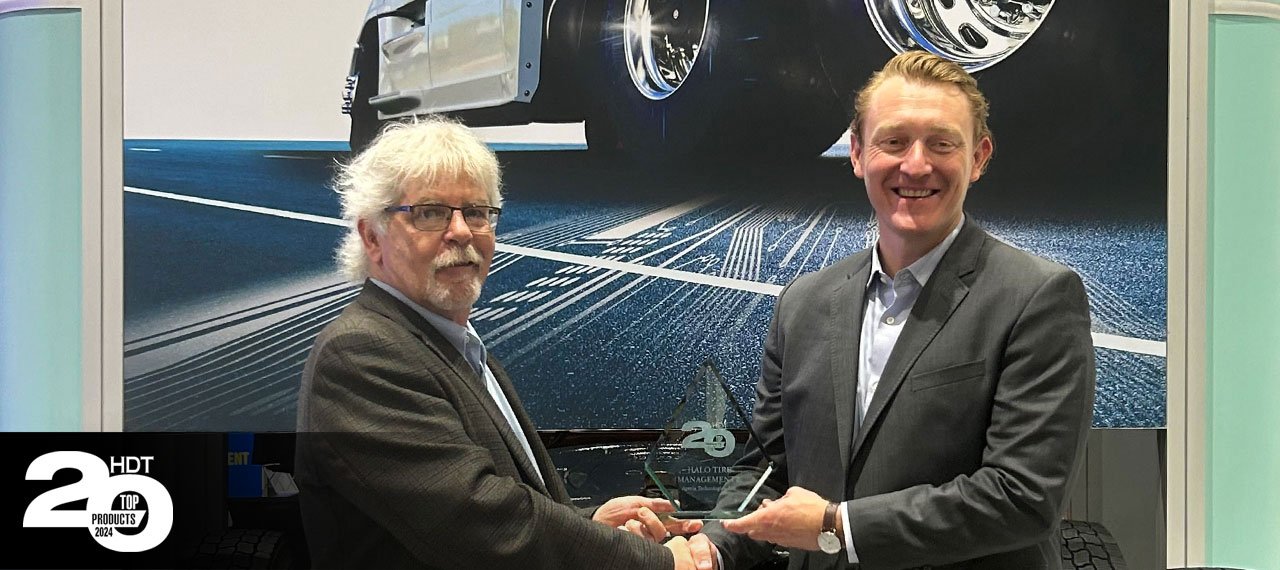
In March 2025, Aperia announced an exclusive automatic-inflation agreement for Goodyear’s Tires-as-a-Service offering, available in North America and Europe. Halo Connect i3 brought integrated pressure sensing, remote setpoint adjustments, and configurable inflation settings into a subscription service combining tires, monitoring, predictive information, and service. Carter’s original company now supplied technology inside someone else’s customer offering.
Later that year, the Nearby Issues feature in the Halo Tech App used a technician’s location to show nearby vehicles needing tire service. It included severity-based priorities, live pressure data over Bluetooth, and maps. There is something refreshingly literal about the progression: after identifying a problem, help the person fixing it find the truck.
Finally, the front wheels
In March 2026, Aperia launched automatic inflation for steer tires, extending Halo’s coverage across commercial-truck and trailer wheel positions. The early economic explanation for focusing on drive tires had not been the end of the story. The company had continued developing the range, returning to the front wheels with hardware built for that application.
The following day, Aperia announced a partnership with Fontaine Fifth Wheel to bring SmartConnect coupling-status data into Halo Connect. The companies planned to commercialize the integration with leading fleets during 2026. Drivers would be able to confirm tractor-trailer coupling in the Halo Drive app, alongside information they already used for tires.
That expansion echoes Carter’s stated wish for suppliers to work together more effectively. Fleet staff have limited attention; another device or screen has to justify the work it adds. His aspiration has been to help them spend less time chasing tire problems and more time keeping vehicles and deliveries moving.
Aperia takes its name from the Latin aperio, meaning to uncover or reveal. Carter’s career at the company gives the word a practical reading. An overlooked tire became an engineering project. The project became equipment, then information, then a set of connections across a fleet. The wheel keeps turning. Carter keeps finding another useful thing for it to do.
Keep the wheels turning
Explore Aperia Technologies, Carter’s LinkedIn profile, and his Facebook profile.
Listen to Carter’s RoadSigns conversation. Watch the Halo Connect i3 hardware explainer or explore Aperia’s YouTube channel.
Read about the 2015 technical achievement award, the 100-billion-mile milestone, and the 2026 Fontaine partnership.